'Safety Is a Fundamental Guarantee': SC Issues Landmark Ruling on Lift Accidents
Recently, in a landmark judgment, the Supreme Court has ruled that the responsibility for accidents involving elevators must be shared by the manufacturer, the maintenance agency, and the building owner or management.
Declaring elevators as "common carriers" akin to public transport, the Court held that all stakeholders owe passengers the highest duty of care and safety.
A Bench of Justices PS Narasimha and Alok Aradhe dismissed an appeal filed by Otis Elevator Company (India) Ltd, affirming the 2014 order of the National Consumer Disputes Redressal Commission (NCDRC), which awarded ₹3.01 crore in compensation to the family of former diplomat Vipin Handa, who died in a lift accident at the Research and Analysis Wing (R&AW) headquarters in 2003.
The Court also upheld the award of 9% annual interest from March 20, 2003—the date of the accident—with a provision for 12% interest if the amount is not paid within 90 days. It directed the NCDRC to ensure prompt enforcement of the order.
Highlighting the growing dependence on elevators in India's rapidly urbanising cities, the Bench observed that modern urban development has shifted vertically due to space constraints, making lifts an indispensable part of daily life. The Court noted that every passenger who enters a lift places complete trust in a mechanical system beyond their control, making safety not just an expectation but a fundamental guarantee.
It further remarked that elevators, particularly in crowded public buildings, can naturally induce anxiety due to confined spaces, stale air, and the sensation of being suspended between floors. In such circumstances, even a minor malfunction can create panic, underscoring the need for strict safety standards.
The Court clarified that victims of elevator accidents cannot be expected to determine the precise extent of negligence by each responsible party before seeking relief. Instead, they are entitled to claim full compensation from any of the liable parties, who may later settle their respective shares of liability among themselves.
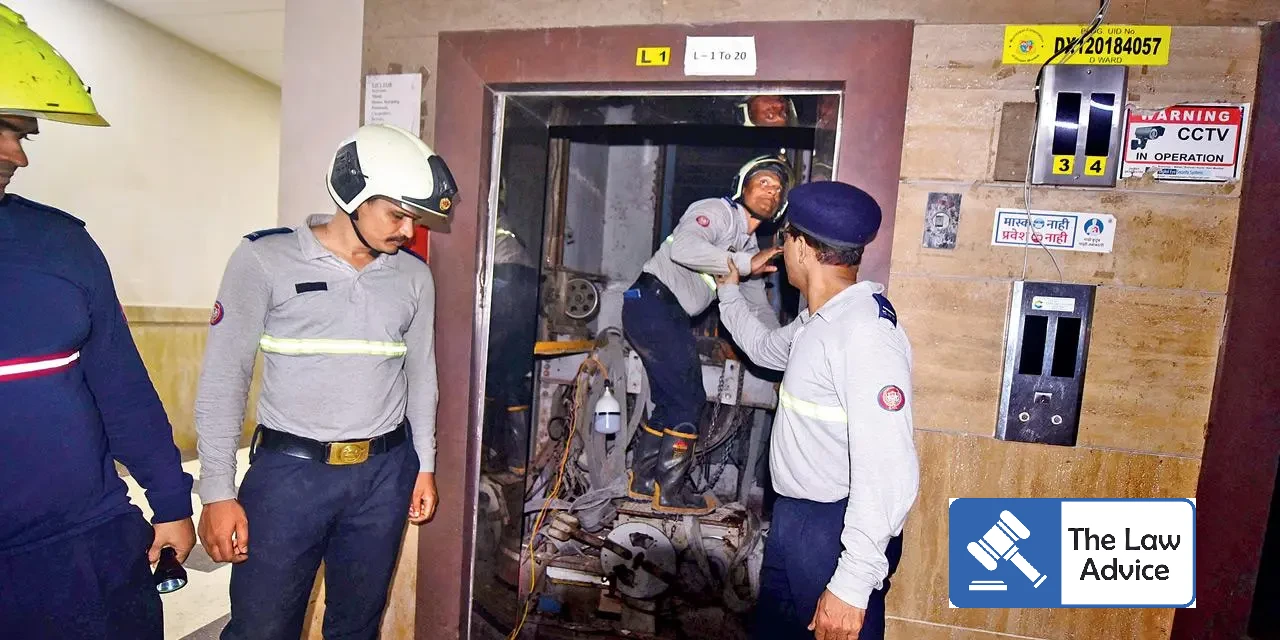
The case stemmed from a tragic incident in March 2003, when a lift at the R&AW headquarters became stuck between the sixth and seventh floors. During the rescue operation, Vipin Handa was halfway out of the elevator when it suddenly slipped, trapping his head between the lift and the floor, resulting in his death. Eleven other passengers were rescued safely.
Before the Court, Otis Elevator argued that the fatal incident occurred due to human error during the rescue process. The company also contended that it had previously advised the installation of a voltage stabiliser to address recurring power fluctuations, but the recommendation was not implemented.
Rejecting these arguments, the Supreme Court held that the accident could not be viewed merely through its immediate cause. The records showed that the elevator had been malfunctioning for a considerable period and that Otis was fully aware of these defects. Despite this knowledge, the company neither ensured adequate safety measures nor declared the lift unsafe for use.
The Court also found that the Military Engineering Services (MES) failed to properly supervise the maintenance work, while the government department using and managing the building ignored repeated complaints regarding the elevator's condition.
Apportioning liability among the parties, the Court directed Otis Elevator Company to bear 70% of the compensation, MES 25%, and the government department 5%, reaffirming that all entities responsible for elevator safety are jointly accountable when negligence leads to loss of life.