
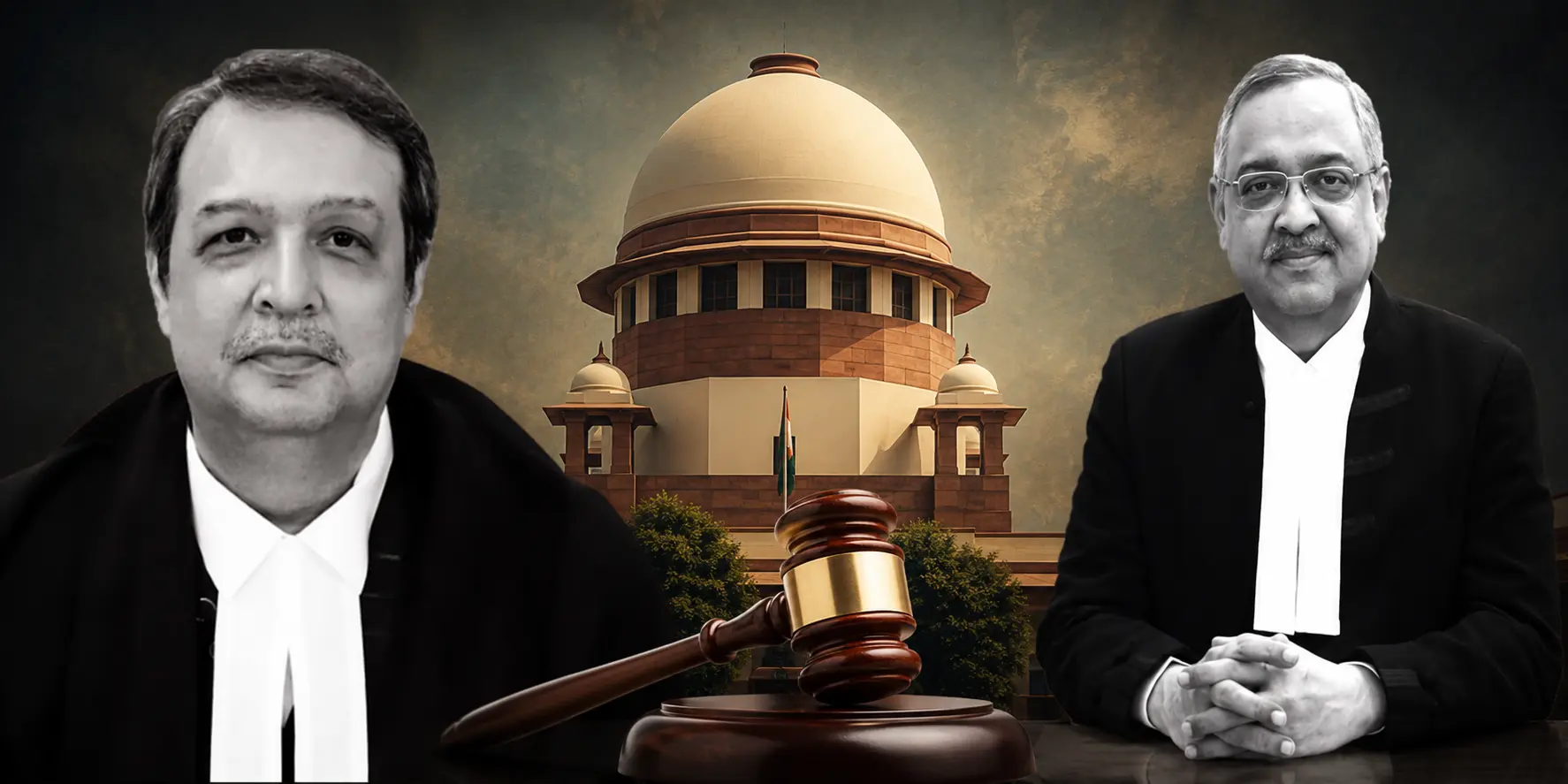
The Supreme Court has restored the acquittal of six persons accused in a 1988 murder case, holding that criminal courts cannot convict merely because a heinous crime has occurred when the prosecution fails to establish guilt beyond reasonable doubt. The Court emphasized that the presumption of innocence is further strengthened after an acquittal by the trial court and that appellate or revisional courts must not interfere unless the findings are clearly unsustainable.
A Bench comprising Justices J. B. Pardiwala and K. Vinod Chandran allowed the appeal filed by the accused, set aside the Bombay High Court's order remanding the matter for fresh consideration, and restored the trial court's judgment acquitting all the accused.
The case arose out of the murder of one Qavi, allegedly committed on 14 February 1988. The trial court had acquitted the accused after finding serious deficiencies in the prosecution's evidence. The deceased's brother challenged the acquittal before the Bombay High Court through a criminal revision.
The High Court had earlier interfered with the acquittal without hearing the accused, prompting the Supreme Court to remand the matter on the ground that Section 401(2) of the Code of Criminal Procedure mandates an opportunity of hearing before exercising revisional powers to the prejudice of the accused. Upon reconsideration, the High Court again remitted the matter to the trial court for fresh evaluation of eyewitness testimony, recoveries under Section 27 of the Evidence Act, and forensic evidence. The accused then approached the Supreme Court.
The Supreme Court observed that after the 2009 amendment introducing the proviso to Section 372 CrPC, victims possess a statutory right to appeal against acquittals. Referring to earlier precedents, the Court reiterated that where such an appellate remedy exists, a criminal revision at the instance of the victim is ordinarily not maintainable.
The Court also noted that Section 401(4) CrPC bars revision where an appeal lies but is not filed. Nevertheless, Section 401(5) empowers the High Court, in appropriate cases, to convert a revision petition into an appeal if the revision was filed under an erroneous belief that no appeal was maintainable. The corresponding provision under the Bharatiya Nagarik Suraksha Sanhita (BNSS), namely Section 442, is substantially identical.
After independently reappreciating the evidence, the Supreme Court found significant inconsistencies in the prosecution's case.
The alleged motive was found doubtful because the prosecution claimed that the deceased had refused to whitewash the house of one accused, whereas evidence indicated that the deceased was engaged in selling clothes and not in whitewashing work.
The Court also found the testimony of the eyewitnesses unreliable. One key witness repeatedly referred to another person, Ajaz, as being present during both the earlier altercation and the assault, but Ajaz was never examined. Moreover, the eyewitnesses did not corroborate each other's presence at the scene and failed to explain why they neither took the injured to hospital nor informed the police despite the police station being only a few minutes away.
The Supreme Court carefully examined the alleged dying declarations said to have been made to the deceased's brother, father, and the treating doctor.
The Court noted material contradictions between the evidence of the doctors. While the first doctor testified that the injured was brought unconscious and never regained consciousness, the surgeon later stated that the deceased was conscious and capable of making a dying declaration.
Further inconsistencies emerged regarding who accompanied the injured to the hospital. The first doctor recorded that the victim was brought solely by an auto-rickshaw driver without any relatives, whereas the second doctor claimed that the father accompanied the patient and narrated the medical history.
These inconsistencies, according to the Court, rendered the alleged dying declarations unreliable.
Although the prosecution proved recovery of a weapon under Section 27 of the Indian Evidence Act and forensic analysis confirmed the presence of human blood, the Court held that this circumstance alone could not sustain a conviction.
The prosecution failed to establish any link between the weapon and the crime beyond the mere presence of human blood. Further, the eyewitnesses were never confronted with the recovered weapon during trial. The Court held that a recovery under Section 27, without a complete chain of incriminating circumstances, is insufficient to prove guilt.
In a significant reaffirmation of criminal law principles, the Supreme Court observed that although the murder was undoubtedly brutal, courts cannot convict merely because the offence remains unsolved.
The Bench held that once a trial court acquits an accused, the presumption of innocence becomes fortified. Even where another view of the evidence may be possible, an appellate court should not overturn an acquittal if the trial court's view is a plausible one.
Accordingly, the Supreme Court restored the acquittal and directed that the accused be released immediately if they were in custody, while cancelling the bail bonds of those already on bail.
Website designed, developed and maintained by webexy