
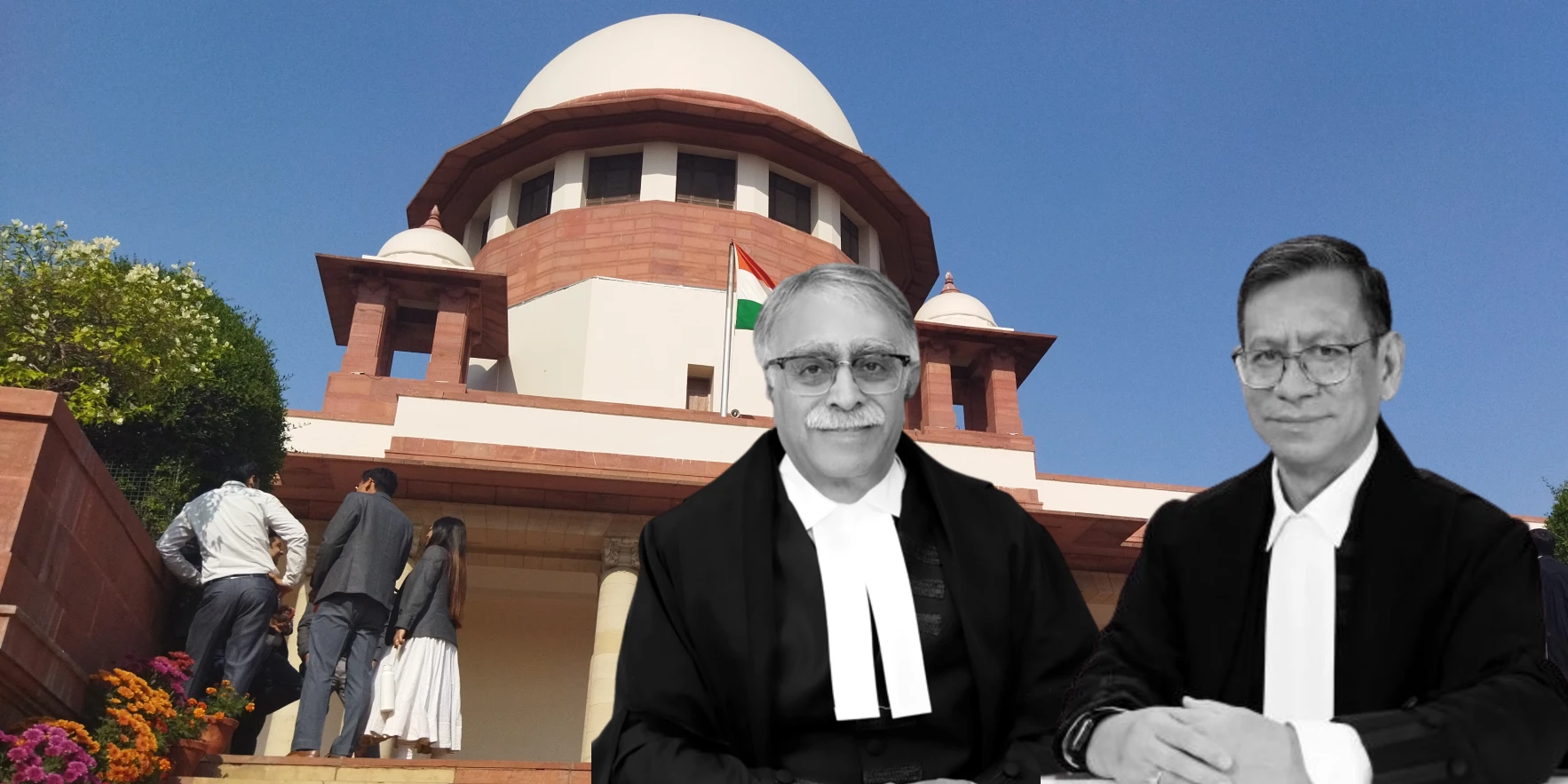
In a significant ruling on motor accident compensation, the Supreme Court has held that an insurance company cannot be saddled with liability where the driver of the offending vehicle did not possess a valid driving licence on the date of the accident. The Court restored the finding of the Motor Accident Claims Tribunal (MACT), set aside the Punjab and Haryana High Court's contrary view, and directed that the principle of "pay and recover" would apply, allowing the insurer to recover the compensation from the vehicle owner and driver after satisfying the award.
A Bench of Justices Sanjay Karol and Nongmeikapam Kotiswar Singh passed the judgment in Reliance General Insurance Company Ltd. v. Om Parkash & Ors.
The case arose from a road accident that occurred on 14 October 2009, in which the offending vehicle struck a two-wheeler. Negligence was undisputed. The central issue was whether the driver possessed a valid driving licence on the date of the accident.
The MACT awarded compensation of ₹86.95 lakh with interest but held the insurer not liable because the driver's licence had expired and was not valid on the accident date. On appeal, the Punjab and Haryana High Court held that the licence had in fact been renewed and fastened liability on the insurer, enhancing the compensation to over ₹1.08 crore with interest. The insurer challenged that decision before the Supreme Court.
The Supreme Court observed that the validity of a driving licence is an issue that must be proved through official records.
The insurer relied on evidence from transport department officials showing that the driver's licence did not cover the period of the accident. Although another licensing officer claimed that the licence had been renewed, the Tribunal had noticed contradictions between his oral testimony and the official records produced by him. The High Court nevertheless relied primarily upon his statement and a departmental communication referring to loss of electronic data during migration of records.
The Supreme Court found this approach erroneous.
The Court reiterated the settled principles governing documentary evidence, holding that official documents must ordinarily be proved through primary evidence, and secondary evidence is admissible only after satisfying the statutory requirements under the Evidence Act.
Referring to its earlier decisions, the Court emphasized that merely producing a letter or relying on oral testimony cannot establish the contents of an official document unless the necessary foundational facts are proved.
A crucial document relied upon by the High Court was a letter issued by the Motor Licensing Office stating that records for the period 2007–2010 were unavailable because of a technical error during migration of computer data. The letter further stated that the driver's licence should nevertheless be treated as valid.
The Supreme Court found that this letter did not establish that the licence was actually valid on the date of the accident. No official records explaining the alleged loss of data, the recovery process, or similar cases involving other licence holders were produced. The Court held that such a letter, unsupported by official records, could not override the documentary evidence indicating that the licence had expired.
The Bench also noted that the driver had paid a penalty while renewing his licence after the relevant period.
According to the licensing officer's own testimony, a penalty had been levied for the intervening period between 21 June 2007 and 25 August 2010, indicating a break in the validity of the licence. The Court observed that if the licence had remained continuously valid, there would have been no occasion to impose such a penalty. The High Court failed to satisfactorily deal with this inconsistency.
The Supreme Court further observed that the vehicle owner did not step into the witness box to establish that he had verified the driver's licence or ensured its timely renewal.
Relying on its earlier judgments, including Beli Ram v. Rajinder Kumar, the Court reiterated that owners have a statutory duty under the Motor Vehicles Act to verify that their drivers possess valid licences and to ensure that renewals are obtained before expiry. Failure to do so constitutes a breach of the insurance policy conditions.
Allowing the insurer's appeal, the Supreme Court held that the insurer could not be made ultimately liable for the compensation because of the breach of policy conditions arising from the absence of a valid licence.
However, since the compensation amount had already been directed to be released to the claimants, the Court applied the "pay and recover" principle. Accordingly, the insurer must first satisfy the award and is thereafter entitled to recover the amount from the vehicle owner and the driver in accordance with law.
While deciding the appeal, the Supreme Court also urged the Ministry of Road Transport and Highways and State Governments to undertake awareness campaigns highlighting the importance of maintaining valid driving licences. The Court recommended stricter compliance mechanisms, simplified renewal procedures, and improvements in the accessibility of licensing services, including regional language support and better regulation of driving schools.
Website designed, developed and maintained by webexy