
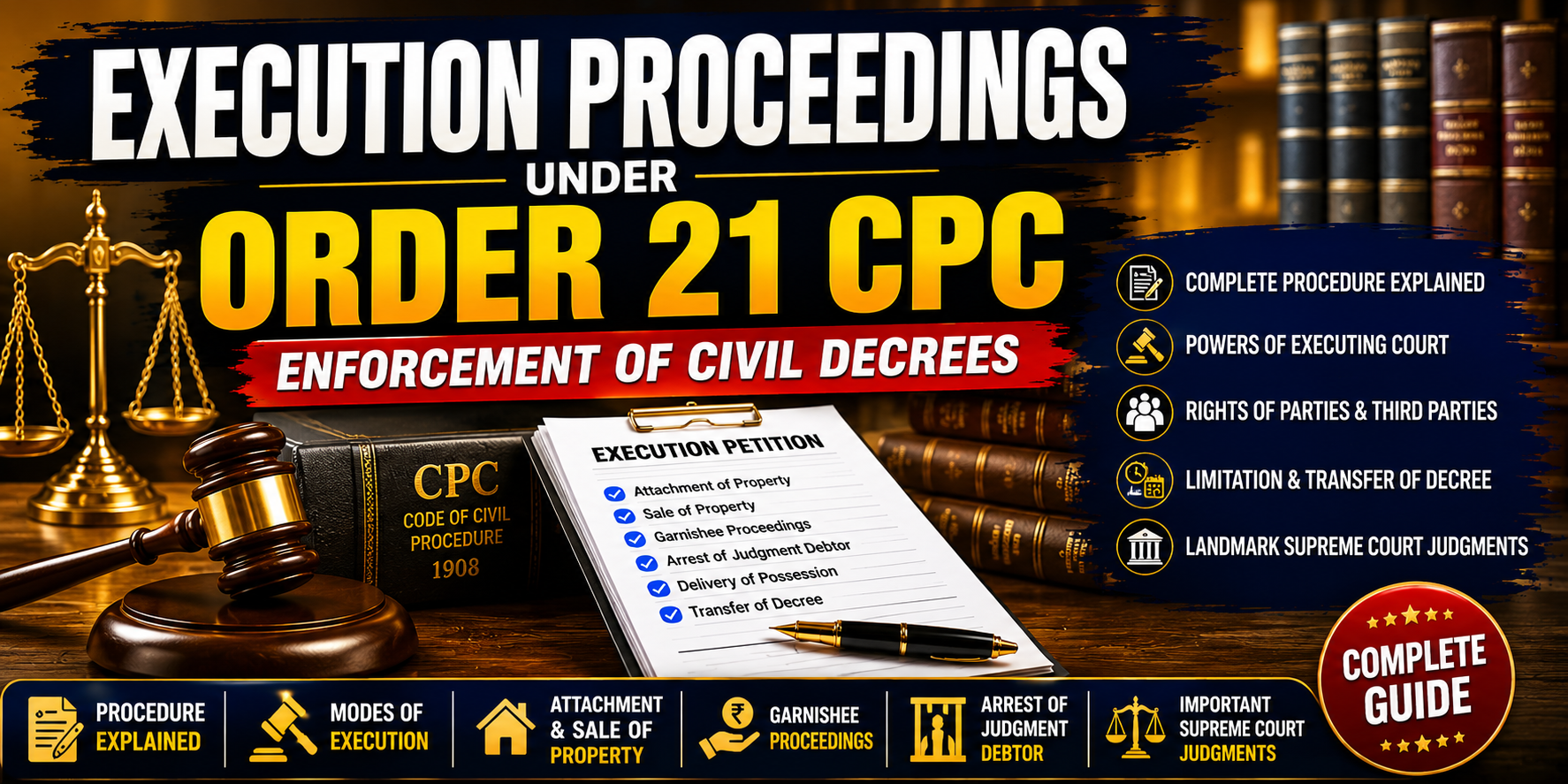
Execution Proceedings under Order XXI CPC: Complete Guide to Enforcement of Civil Decrees, Attachment of Property and Landmark Supreme Court Judgments
Introduction
A decree obtained from a court is valuable only when it can be effectively enforced. In civil litigation, parties often spend years obtaining a favorable judgment, but the real challenge begins after the decree is passed. A successful litigant may still be deprived of the fruits of litigation if the decree remains unexecuted.
To address this concern, the Code of Civil Procedure, 1908 provides a comprehensive mechanism for enforcement of decrees under Order XXI CPC, which is one of the lengthiest and most significant provisions in the Code. Order XXI governs the procedure through which a decree-holder may compel compliance with a decree and obtain the relief granted by the court.
The Supreme Court has repeatedly emphasized that execution proceedings are not merely procedural formalities but an integral part of the justice delivery system. A decree-holder should not be forced into endless litigation merely to enjoy the benefits of a decree already obtained.
This article explains the concept, procedure, modes of execution, powers of the executing court, rights of parties, and landmark judicial pronouncements relating to execution proceedings under Order XXI CPC.
Meaning of Execution
Execution is the process by which a decree or order of a court is enforced.
In simple terms, execution refers to the legal process through which a successful party (decree-holder) compels the unsuccessful party (judgment-debtor) to comply with the decree.
For example:
- Recovery of money awarded by a court.
- Delivery of possession of immovable property.
- Enforcement of injunctions.
- Execution of specific performance decrees.
What is an Executing Court?
Section 37 CPC defines the expression "Court which passed the decree."
The executing court is generally:
- The court that passed the decree, or
- The court to which the decree is transferred for execution.
The executing court possesses jurisdiction to enforce the decree according to law.
Important Terms in Execution Proceedings
Decree Holder
Section 2(3) CPC defines a decree-holder as a person in whose favour a decree has been passed.
Judgment Debtor
Section 2(10) CPC defines a judgment-debtor as a person against whom a decree has been passed.
Decree
A formal adjudication conclusively determining the rights of parties.
When Can a Decree Be Executed?
A decree becomes executable immediately upon its passing unless:
- The decree itself provides otherwise.
- Execution has been stayed by a competent court.
- An appeal has resulted in a stay order.
A mere filing of an appeal does not automatically stay execution.
Application for Execution
Execution proceedings commence with the filing of an execution petition under Order XXI Rule 10 CPC.
The decree-holder must provide:
- Details of the decree.
- Amount due.
- Relief sought.
- Mode of execution desired.
Modes of Execution under Section 51 CPC
Section 51 CPC provides various methods for execution of a decree.
1. Delivery of Property
The court may order delivery of:
Movable Property
Actual delivery of movable assets to the decree-holder.
Immovable Property
Possession of land, house, building or other immovable property may be delivered.
2. Attachment and Sale of Property
The most common mode of execution.
The court may:
- Attach movable property.
- Attach immovable property.
- Auction attached property.
- Utilize sale proceeds for satisfaction of the decree.
Properties Liable to Attachment
Examples:
- Land.
- Buildings.
- Vehicles.
- Bank accounts.
- Shares.
- Business assets.
3. Garnishee Proceedings
Where a third person owes money to the judgment-debtor.
Examples:
- Bank accounts.
- Debts recoverable from third parties.
- Salary receivable.
The court may direct the third party to pay the decree-holder directly.
4. Arrest and Detention of Judgment Debtor
In appropriate cases, the court may order arrest and detention of the judgment-debtor in civil prison.
However:
- The power must be exercised cautiously.
- Principles of natural justice must be followed.
- Opportunity of hearing must be provided.
The court must record reasons before ordering detention.
5. Appointment of Receiver
The court may appoint a receiver to manage and preserve property for satisfaction of the decree.
Execution of Money Decrees
Money decrees are generally executed through:
- Attachment of bank accounts.
- Attachment of salary.
- Attachment and sale of property.
- Garnishee orders.
- Civil imprisonment in exceptional circumstances.
Execution of Decree for Possession
Delivery of Immovable Property
Where a decree grants possession of land or building, the court may remove persons bound by the decree and place the decree-holder in possession.
Symbolic Possession
In some circumstances, symbolic possession may be delivered.
Execution of Decree for Specific Performance
Where a decree directs execution of a sale deed or contract and the judgment-debtor refuses to comply:
- The court may authorize an officer of the court to execute the document.
- Such execution has the same legal effect as if executed by the judgment-debtor.
Execution of Injunction Decrees
Where a person violates an injunction decree:
The court may:
- Attach property.
- Detain the violator in civil prison.
- Pass consequential orders to enforce compliance.
Powers of Executing Court
The executing court possesses extensive powers to enforce decrees effectively.
However, a fundamental principle governs execution proceedings:
Executing Court Cannot Go Behind the Decree
The executing court must execute the decree as it stands.
It cannot:
- Modify the decree.
- Correct errors in the decree.
- Re-examine the merits of the case.
Questions relating to legality or correctness of the decree generally cannot be raised before the executing court.
Questions to be Determined by Executing Court
Section 47 CPC provides that all questions relating to:
- Execution,
- Discharge,
- Satisfaction of the decree,
shall be determined by the executing court itself.
A separate suit is barred.
Transfer of Decree for Execution
Sections 38 to 42 CPC permit transfer of decrees.
Transfer may occur when:
- The judgment-debtor resides outside jurisdiction.
- Property is situated elsewhere.
- Execution can be more effectively carried out in another court.
Limitation for Execution
Article 136 of the Limitation Act, 1963 prescribes:
12 Years
for execution of a decree from the date it becomes enforceable.
Failure to initiate execution within limitation may result in loss of enforceability.
Resistance and Obstruction in Execution
Order XXI Rules 97 to 106 deal with resistance to possession.
Where:
- A third party obstructs execution,
- Illegal resistance is caused,
the executing court can adjudicate such disputes.
Separate litigation is generally unnecessary.
Rights of Third Parties
A third party claiming independent rights in attached property may:
- File objections.
- Seek release of property.
- Establish independent title.
The executing court must adjudicate such claims.
Landmark Supreme Court Judgments
1. Brahmdeo Chaudhary v. Rishikesh Prasad Jaiswal (1997) 3 SCC 694
The Supreme Court held that objections raised by third parties resisting possession can be adjudicated in execution proceedings themselves.
2. Silverline Forum Pvt. Ltd. v. Rajiv Trust (1998) 3 SCC 723
The Court emphasized that execution courts possess sufficient jurisdiction to determine disputes relating to resistance and obstruction.
3. Shreenath v. Rajesh (1998) 4 SCC 543
The Supreme Court recognized the rights of third parties claiming independent title in execution proceedings.
4. Bhavan Vaja v. Solanki Hanuji Khodaji Mansang (1972) 2 SCC 40
The Court reiterated that an executing court cannot travel beyond the decree.
5. Rahul S. Shah v. Jinendra Kumar Gandhi (2021) 6 SCC 418
A landmark decision in which the Supreme Court issued extensive guidelines for expeditious disposal of execution proceedings and expressed concern over delays in enforcement of decrees.
Practical Challenges in Execution Proceedings
Despite obtaining a decree, decree-holders often face:
- Concealment of assets.
- Frivolous objections.
- Multiple proceedings.
- Transfer of properties.
- Delay tactics.
The Supreme Court has repeatedly criticized such practices and directed courts to adopt a proactive approach in execution matters.
Frequently Asked Questions (FAQs)
Can execution be filed immediately after decree?
Yes, unless execution has been stayed.
Does filing an appeal automatically stay execution?
No. A specific stay order is necessary.
Can an executing court modify a decree?
No.
What is the limitation period for execution?
Twelve years under Article 136 of the Limitation Act.
Can a person be arrested for non-payment of a decree?
In appropriate circumstances and subject to statutory safeguards, yes.
Can a decree be executed in another State?
Yes, through transfer of decree under Sections 38 to 42 CPC.
Conclusion
Order XXI CPC represents the enforcement machinery of civil justice. A decree that cannot be executed is of little practical value. Therefore, execution proceedings serve as the bridge between judicial determination and actual realization of rights. The provisions of Order XXI CPC empower courts to ensure that successful litigants receive the fruits of their decrees without unnecessary delay. A sound understanding of execution proceedings is indispensable for every advocate, litigant, and law student, as execution is often the most crucial stage of civil litigation.
Bibliography
Statutes
- The Code of Civil Procedure, 1908
- The Limitation Act, 1963
- The Transfer of Property Act, 1882
- The Civil Rules of Practice (relevant State Rules)
- The Constitution of India, 1950.
Supreme Court Cases
- Vasudev Dhanjibhai Modi v. Rajabhai Abdul Rehman (1970) 1 SCC 670 : AIR 1970 SC 1475
- Bhavan Vaja v. Solanki Hanuji Khodaji Mansang (1972) 2 SCC 40 : AIR 1972 SC 1371
- Sunder Dass v. Ram Prakash (1977) 2 SCC 662 : AIR 1977 SC 1201
- Topanmal Chhotamal v. Kundomal Gangaram AIR 1960 SC 388
- Brahmdeo Chaudhary v. Rishikesh Prasad Jaiswal (1997) 3 SCC 694 : AIR 1997 SC 856
- Silverline Forum Pvt. Ltd. v. Rajiv Trust (1998) 3 SCC 723
- Shreenath v. Rajesh (1998) 4 SCC 543
- Shub Karan Bubna v. Sita Saran Bubna (2009) 9 SCC 689
- Brakewel Automotive Components (India) Pvt. Ltd. v. P.R. Selvam Alagappan (2017) 5 SCC 371
- Desh Raj v. Balkishan (2020) 2 SCC 708
- Rahul S. Shah v. Jinendra Kumar Gandhi (2021) 6 SCC 418
Books
- Mulla, The Code of Civil Procedure (LexisNexis, latest edition)
- C.K. Takwani, Civil Procedure (Eastern Book Company, latest edition)
- Justice C.K. Thakker & M.C. Thakker, Code of Civil Procedure (Eastern Book Company)
- Sarkar, Code of Civil Procedure (LexisNexis Butterworths)
- Universal's Code of Civil Procedure, 1908
- M.P. Jain, The Code of Civil Procedure.
Journals and Legal Databases
- Supreme Court Cases (SCC).
- All India Reporter (AIR).
- SCC Online.
- Manupatra.
- Civil Court Cases (CCC).
- Journal of the Indian Law Institute (JILI).