
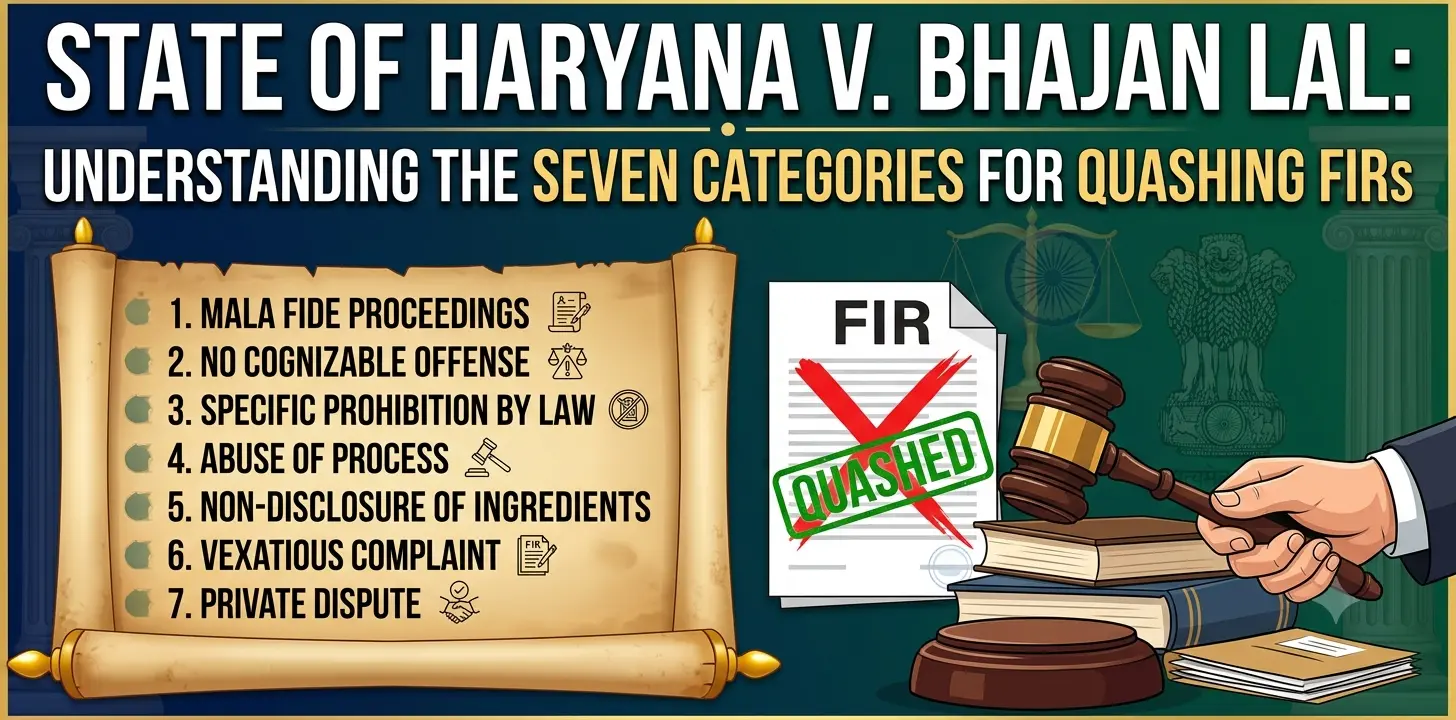
State of Haryana v. Bhajan Lal: Understanding the Seven Categories for Quashing FIRs
Case: State of Haryana & Ors. v. Bhajan Lal & Ors.
Citation: 1992 Supp (1) SCC 335
Court: Supreme Court of India
Subject: Quashing of FIRs and criminal proceedings; inherent powers of the High Court
Introduction
Few judgments have exercised as much influence over the law relating to quashing of criminal proceedings as the Supreme Court's decision in State of Haryana v. Bhajan Lal. The judgment continues to be routinely relied upon whenever an accused approaches the High Court seeking quashing of an FIR or criminal proceedings on the ground that continuation of the prosecution would amount to an abuse of the process of law.
The significance of Bhajan Lal lies not merely in the seven categories identified by the Supreme Court. More fundamentally, the judgment attempts to strike a balance between two competing principles: the need to allow genuine criminal investigations to proceed and the equally important duty of courts to prevent misuse of the criminal justice system.
The Supreme Court itself clarified that the categories were illustrative and could not constitute a rigid or exhaustive formula. (Sci API)
Background of the Case
The case arose out of criminal proceedings initiated against Bhajan Lal, who was a prominent political figure and had served as Chief Minister of Haryana. Allegations were made concerning corruption and abuse of official position, resulting in registration of a criminal case.
The Punjab and Haryana High Court interfered with the criminal proceedings. The matter eventually reached the Supreme Court, which examined the circumstances in which the extraordinary jurisdiction of the High Court could be exercised to prevent abuse of the criminal process.
The Supreme Court ultimately restored the FIR while simultaneously laying down important principles governing the exercise of the High Court's inherent jurisdiction.
The Central Legal Question
The principal issue before the Court was:
When can a High Court interfere with an FIR or criminal proceeding at the threshold, before the criminal trial has taken place?
The Court recognised that the power to quash criminal proceedings is exceptional. It cannot be exercised merely because the accused disputes the allegations or claims that the prosecution is unlikely to succeed at trial.
At the same time, the existence of an FIR does not give the prosecution an unrestricted licence to subject a person to a criminal proceeding which, on its face, is legally untenable.
The jurisdiction therefore operates as a safeguard against abuse of the process of court and to secure the ends of justice.
The Seven Bhajan Lal Categories
The most frequently cited portion of the judgment is paragraph 102, where the Supreme Court identified seven illustrative situations in which the extraordinary powers of the High Court may appropriately be exercised.
1. Allegations Do Not Constitute an Offence
Where the allegations made in the FIR or complaint, even if accepted in their entirety, do not prima facie constitute any offence against the accused, the proceedings may be quashed.
The Court is required to examine the allegations as they stand rather than assume facts that are not contained in the FIR.
2. Allegations Do Not Disclose a Cognizable Offence
Where the allegations fail to disclose a cognizable offence which would justify a police investigation, the continuation of the criminal proceedings may be interfered with.
This category protects individuals from investigation where the basic statutory ingredients necessary to trigger police investigation are absent.
3. Allegations and Evidence Do Not Disclose an Offence
Where the uncontroverted allegations made in the FIR or collected during investigation do not disclose the commission of an offence, the proceedings may be quashed.
This becomes particularly relevant where the investigation has concluded but the material collected by the investigating agency still fails to establish the ingredients of the alleged offence.
4. Legal Bar to Institution or Continuation
Quashing may also be justified where there is an express legal bar to the institution or continuation of the proceedings.
Such a bar may arise from a statutory provision governing the prosecution, sanction, limitation, or other legal requirements necessary for the court to take cognizance of the offence.
5. Allegations Are Absurd or Inherently Improbable
Where the allegations are so absurd or inherently improbable that no prudent person could reasonably reach the conclusion that there is sufficient ground for proceeding against the accused, the High Court may exercise its jurisdiction.
However, this category does not authorise the High Court to conduct a mini-trial or weigh the credibility of witnesses at the FIR stage.
6. Proceedings Are Manifestly Mala Fide
The Court may intervene where criminal proceedings are manifestly attended with mala fide intention or are instituted maliciously with an ulterior motive for wreaking vengeance on the accused.
This principle is particularly significant in cases where criminal law is allegedly being used as a weapon to settle personal, commercial, political or other disputes.
7. Proceedings Amount to Abuse of Process
Finally, where continuation of the criminal proceeding would amount to an abuse of the process of law or where intervention is necessary to secure the ends of justice, the High Court may quash the proceedings.
This is perhaps the broadest principle flowing from Bhajan Lal and has subsequently been applied in numerous factual situations.
The Seven Categories Are Not a Rigid Formula
An important aspect of the judgment is often overlooked.
The Supreme Court did not create a mechanical seven-point test under which every FIR must be placed into one of seven boxes. It expressly stated that the categories were illustrative and that it was not possible to formulate precise, clearly defined and inflexible guidelines covering every possible case.
Thus, Bhajan Lal provides guiding principles rather than an exhaustive statutory checklist. (Sci API)
This distinction is important because quashing jurisdiction is inherently fact-sensitive.
High Court Cannot Conduct a Mini-Trial
One of the practical consequences of Bhajan Lal is that the High Court ordinarily does not determine the truthfulness of the prosecution case while considering a petition for quashing.
The question at this stage is generally whether the allegations, taken at face value, disclose the commission of an offence and whether continuation of the proceedings would constitute an abuse of process.
Questions concerning credibility of witnesses, disputed questions of fact and the reliability of evidence ordinarily belong to the trial.
Therefore, an accused cannot ordinarily seek quashing merely by presenting a competing version of facts and asking the High Court to determine which version is correct.
Bhajan Lal in the BNSS Era
The legal landscape has changed since the judgment was delivered in 1992. The Code of Criminal Procedure, 1973 has now been replaced by the Bharatiya Nagarik Suraksha Sanhita, 2023 (BNSS).
The corresponding provision dealing with the High Court's inherent powers is Section 528 BNSS, which carries forward the inherent jurisdiction of the High Court to make orders necessary to give effect to orders under the Sanhita, prevent abuse of the process of any court, or otherwise secure the ends of justice.
Consequently, although Bhajan Lal was decided under Section 482 CrPC, its underlying principles continue to have considerable relevance to petitions invoking the High Court's inherent jurisdiction under Section 528 BNSS.
Recent legal discussions continue to describe Bhajan Lal as the foundational authority for FIR-quashing principles under the new procedural framework. (Luricio)
Why the Judgment Remains Relevant
The continuing importance of Bhajan Lal can be understood from the nature of criminal litigation itself.
Registration of an FIR can have serious consequences for an accused even before trial. Arrest, investigation, seizure, reputational damage, restrictions on liberty and prolonged criminal proceedings can impose significant burdens.
At the same time, premature judicial interference with investigation can prevent legitimate allegations from being properly investigated.
Bhajan Lal therefore establishes an important institutional balance:
Police investigate; trial courts determine guilt; and the High Court intervenes exceptionally where the criminal process itself is being misused or where the allegations fail to disclose a legally sustainable criminal case.
Conclusion
State of Haryana v. Bhajan Lal remains one of the foundational judgments on the extraordinary jurisdiction of High Courts to prevent abuse of criminal process.
Its enduring contribution is not simply the famous "seven categories", but the broader principle that criminal law cannot be permitted to become an instrument of harassment, vengeance or abuse, while judicial intervention must also remain cautious enough to ensure that genuine criminal investigations are not unnecessarily stifled.
The judgment consequently continues to occupy a central position in petitions seeking quashing of FIRs and criminal proceedings. Its principles have survived the transition from the CrPC to the BNSS and remain an important starting point for understanding the limits of the High Court's inherent jurisdiction.
For lawyers, the practical lesson is clear: a Bhajan Lal petition should not merely allege that the FIR is false. The pleadings must demonstrate, from the FIR, complaint, charge-sheet or unimpeachable material on record, that the case falls within the established principles warranting extraordinary intervention by the High Court.