
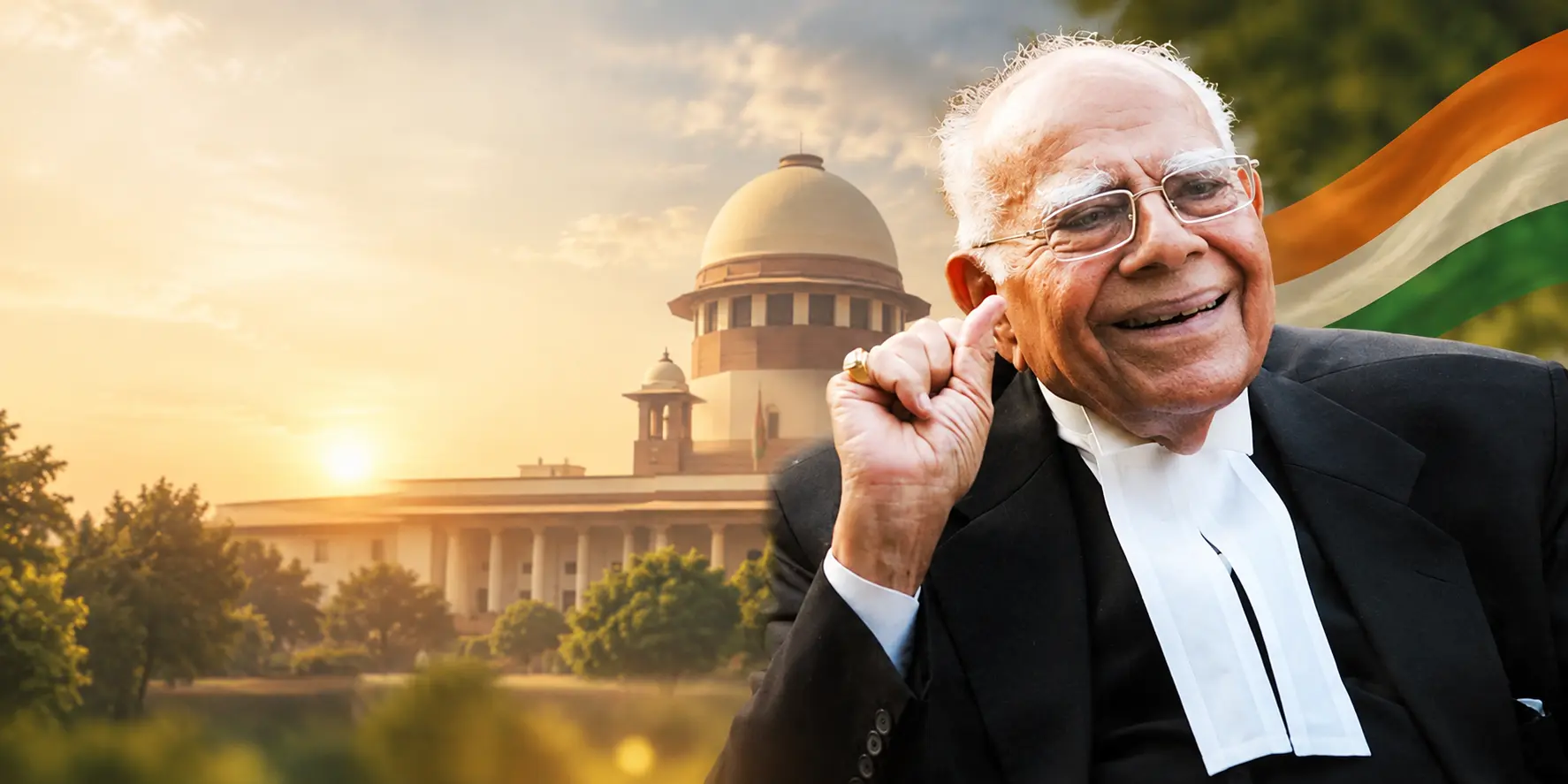
Ram Jethmalani: The Fearless Lawyer Who Redefined Indian Advocacy
Ram Jethmalani was more than a lawyer. He was a courtroom institution, a formidable cross-examiner, a fearless advocate and one of the most influential legal personalities in independent India. During a career spanning more than seven decades, he represented politicians, businessmen, film personalities and people accused in some of the country's most controversial criminal cases.
Known for his sharp intellect, unconventional courtroom style and willingness to take up difficult cases, Jethmalani believed that the role of a lawyer was not to decide whether a person deserved representation. His duty, according to the principles he repeatedly defended, was to ensure that the law and the judicial process were fairly applied.

Early Life and Entry into Law
Ram Boolchand Jethmalani was born on 14 September 1923 in Shikarpur, Sindh, then part of British India. He showed an extraordinary inclination towards law from a young age.
He entered the legal profession while still very young and began practising in Sindh. The Partition of India in 1947 changed the course of his life. Like millions of others, Jethmalani migrated to India and eventually established himself as a lawyer in Bombay, now Mumbai.
The experience of Partition left a deep impression on him. His subsequent career was marked by a strong belief in individual liberty, due process and the importance of an independent legal profession.
The Lawyer Who Never Shied Away from Difficult Cases
Jethmalani became particularly famous for his criminal law practice. His courtroom strategy was often aggressive, detailed and highly focused on exposing weaknesses in the prosecution's case.
He was associated with several high-profile and controversial matters. Among the cases and personalities with which his name became associated were the K.M. Nanavati case, Indira Gandhi assassination case, Rajiv Gandhi assassination case, Haji Mastan-related proceedings, and cases involving prominent political figures and public personalities.

His clients and the cases he represented frequently attracted enormous public attention. But Jethmalani maintained that a lawyer's personal opinion about an accused person could not replace the legal right to representation.
That philosophy became one of the defining characteristics of his career.
A Champion of the Right to Defence
Jethmalani's greatest contribution was perhaps his uncompromising defence of the principle that every accused person is entitled to a fair trial and competent legal representation.
Criminal defence lawyers often face public criticism when they represent unpopular or controversial accused persons. Jethmalani, however, repeatedly maintained that the legal system cannot function on the basis of public opinion.
His approach reflected a fundamental principle of criminal jurisprudence: the prosecution must prove its case according to law, and the accused is presumed innocent until proved guilty.
For generations of young lawyers, his career demonstrated that advocacy is not merely about eloquence. It requires preparation, courage, knowledge of evidence and the ability to challenge the opposing case without fear.
Jethmalani and the Supreme Court Bar
Jethmalani eventually became one of the most prominent advocates practising before the Supreme Court of India.
His courtroom appearances were often memorable. He could be direct, sarcastic, combative and exceptionally persuasive. He was known for questioning assumptions and challenging conventional approaches to legal arguments.

For him, advocacy was not a passive exercise. A lawyer had to fight for the client's case within the boundaries of law.
His long career also coincided with some of the most important constitutional and criminal-law developments in India's history. He appeared in matters concerning personal liberty, criminal justice, constitutional rights and the relationship between the citizen and the State.
A Lawyer Who Entered Politics
Jethmalani's contribution was not limited to the courtroom.
He entered active politics and served as a Member of Parliament. He also held important positions in the Union government, including serving as Union Minister for Law and Justice and later as Union Minister for Urban Development.
His political career was as outspoken as his legal career.

He was not known for blindly following political conventions. His willingness to disagree with political establishments, including those with which he was associated, became another feature of his public life.
His political journey demonstrated that he viewed public life as another avenue through which questions of law, governance and individual freedom could be debated.
His Relationship with Constitutional Liberty
Jethmalani was a strong advocate of civil liberties and individual freedom.
The Emergency period of 1975–77 was particularly significant in his public life. He emerged as a prominent critic of the Emergency and its restrictions on civil liberties.
His opposition to authoritarianism reinforced his reputation as a lawyer who believed that the State must remain accountable to the Constitution.
For Jethmalani, constitutional democracy was not merely about elections. It also required freedom of speech, personal liberty, judicial independence and the rule of law.
Teacher and Mentor
One of the less discussed aspects of Jethmalani's legacy is his influence on younger lawyers.
He was an exceptional speaker and an equally formidable teacher. His public lectures, interactions with lawyers and appearances at legal institutions inspired generations of advocates.

His message to young lawyers was generally straightforward: know the law, prepare thoroughly and never be afraid of the courtroom.
He also believed that lawyers should develop their own style rather than simply imitate successful advocates.
His Unique Courtroom Personality
Jethmalani's personality was inseparable from his advocacy.
He could be humorous one moment and fiercely argumentative the next. He was not afraid of confrontation with judges, provided his argument remained within the discipline of the court.
His style sometimes attracted criticism. But even his critics acknowledged his extraordinary command over legal issues and courtroom strategy.
He demonstrated that effective advocacy can take many forms. A lawyer does not necessarily have to be quiet or conventional to be persuasive. What matters ultimately is the strength of the argument, knowledge of the record and ability to persuade the court.
Legacy of a Legal Giant
Ram Jethmalani died on 8 September 2019, just days before his 96th birthday.
His death marked the end of an extraordinary era in Indian legal practice.
But his influence continues. His name remains associated with some of the country's most important criminal trials, constitutional controversies and political debates.
For young advocates, his life offers several lessons:
-
Never be afraid to take difficult cases.
-
Know the facts before arguing the law.
-
Understand evidence, not merely legal provisions.
-
Defend the client's legal rights without becoming the judge of the client.
-
Maintain independence of thought.
-
Respect the court while fearlessly presenting the case.
-
Remember that advocacy is ultimately about justice and the rule of law.
Ram Jethmalani's career cannot be reduced to a list of famous cases or political positions. His larger legacy lies in the idea of the fearless advocate.
He belonged to a generation of lawyers who saw the courtroom not merely as a workplace but as one of the most important institutions for protecting individual liberty.
Whether one agreed with his arguments, his political positions or his courtroom methods, it was difficult to ignore his presence.
Ram Jethmalani did not merely practise law; he made advocacy itself a subject of public conversation.
For Indian lawyers, his life remains a reminder that the profession demands more than knowledge of statutes and precedents. It demands courage, preparation, independence and the willingness to stand up for the rule of law—even when the case is difficult and the client is unpopular.
