
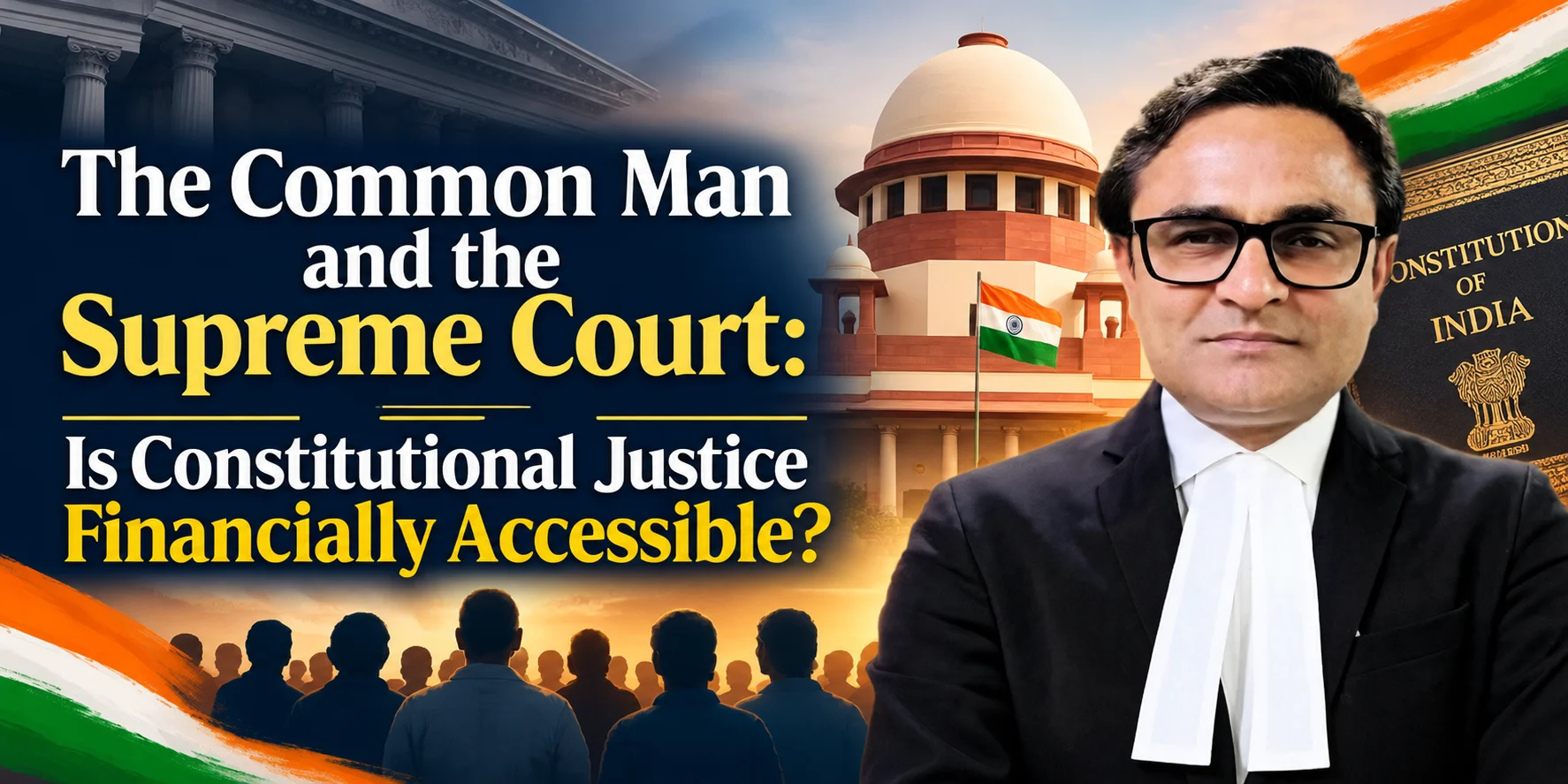
The Common Man and the Supreme Court: Is Constitutional Justice Financially Accessible?
The Constitution promises equal justice, but when the cost of litigation becomes a barrier, can every citizen realistically approach the highest court of the country?
Introduction: A Court for Every Citizen?
For the common citizen, the Supreme Court of India represents the ultimate constitutional safeguard—the institution to which one may turn when fundamental rights are threatened, government action is challenged, or justice appears to have failed elsewhere.
But a constitutional right is meaningful only when it can be effectively enforced. For many citizens, approaching the country's highest court involves more than identifying a legal remedy. It may require substantial expenditure on legal advice, drafting, representation, documentation and, in some cases, travel and accommodation in Delhi.
The question, therefore, is not simply whether the doors of the Supreme Court are open in law. It is whether an ordinary citizen with a genuine and legally sustainable grievance can realistically reach those doors without facing an insurmountable financial burden.
India has constitutional guarantees, legal-aid institutions and mechanisms intended to make justice more accessible. The challenge is to examine whether these safeguards translate into meaningful access in practice.
The Constitutional Promise of Equal Justice
The Indian Constitution does not treat access to justice as a privilege reserved for those who can afford expensive legal representation. Article 14 guarantees equality before the law and equal protection of the laws. Article 21 protects life and personal liberty, while Article 39A directs the State to ensure that the operation of the legal system promotes justice on the basis of equal opportunity and to provide free legal aid so that opportunities for securing justice are not denied because of economic or other disabilities.
Although Article 39A forms part of the Directive Principles of State Policy, its significance has been recognised by the Supreme Court while interpreting fundamental rights and the requirements of fair procedure.
In Hussainara Khatoon v. State of Bihar, decided in 1979, the Supreme Court emphasised that free legal services are an essential element of a fair, just and reasonable procedure under Article 21 in circumstances where an accused cannot afford legal representation and the needs of justice require it. The litigation also exposed the plight of undertrial prisoners who had remained in custody for periods that raised serious questions about the administration of criminal justice. The Court's intervention helped establish that poverty cannot be allowed to deprive an accused person of the legal assistance necessary to protect liberty.
The principle emerging from this constitutional jurisprudence is clear: legal rights must be capable of meaningful enforcement. A right that exists only on paper, but cannot realistically be asserted because a person lacks the resources to approach the legal system, presents a serious challenge to the ideal of equal justice.
However, the constitutional promise must be understood carefully. It does not mean that every litigant is automatically entitled to a privately engaged lawyer at public expense for every kind of proceeding. The nature of the case, applicable legal-aid provisions and the eligibility of the applicant remain relevant. The larger obligation is to ensure that economic disadvantage does not defeat access to justice where legal assistance is necessary.
The Financial Reality of Approaching the Supreme Court
The Supreme Court is not a court of first instance for every ordinary dispute. Most civil and criminal matters begin before subordinate courts or tribunals, and many proceed through the High Courts before reaching the Supreme Court. A litigant seeking to approach the Supreme Court must therefore understand the appropriate jurisdiction, the available remedy and the procedural requirements of the particular case.
For many litigants, the financial burden begins well before a matter is listed before the Court. Legal advice is needed to determine whether a challenge is maintainable, whether a question of law warrants consideration, and whether the case should be pursued through a Special Leave Petition, a writ petition, an appeal or another available remedy.
The Supreme Court's procedures also require compliance with filing rules, documentation and other formal requirements. The Court's official filing resources explain these procedural requirements, while the Supreme Court Legal Services Committee provides assistance to eligible litigants who cannot afford to conduct their cases independently.
Court fees, however, are only one part of the financial equation. The larger expenditure may arise from professional fees, drafting, conferences, preparation of paper books, copying and translation of documents, travel and accommodation, and the need to respond to procedural developments. If a matter is adjourned or continues over several hearings, the financial burden may increase.
For a person with a stable income and sufficient savings, these expenses may be manageable. For a daily-wage worker, a small farmer, a low-income employee or a family already struggling with litigation in the lower courts, even the initial cost of obtaining a reliable legal assessment may be difficult to bear.
The problem is not that every Supreme Court case is necessarily expensive or that every Advocate charges a prohibitive fee. Legal fees vary according to the nature and complexity of a matter, the work required and the professional arrangements between lawyer and client. The concern is that a litigant may have no clear way of estimating the total cost of pursuing a case and may be unable to sustain the expenditure if the proceedings become prolonged.
The financial accessibility of justice must therefore be assessed by examining the entire cost of litigation, not merely the court fee payable at the time of filing.
Free Legal Aid: A Constitutional Safeguard
India has developed a statutory framework to address the problem of economic barriers to justice. The Legal Services Authorities Act, 1987, provides the institutional foundation for free legal services through the National Legal Services Authority (NALSA), State Legal Services Authorities, District Legal Services Authorities and other legal-services institutions.
The framework is not confined to proceedings before subordinate courts. NALSA states that eligible persons may receive legal assistance in civil and criminal matters before courts, tribunals and other authorities, including the High Courts and the Supreme Court. Depending on the case, assistance may include representation by an Advocate, preparation of pleadings and appeals, drafting of legal documents, payment of certain litigation expenses and obtaining relevant documents.
Section 12 of the Legal Services Authorities Act identifies categories of persons entitled to seek legal services, including members of Scheduled Castes and Scheduled Tribes, women and children, persons with disabilities, industrial workmen, victims of trafficking and certain forms of disaster or violence, and persons in custody. Eligibility may also arise under the applicable income criteria. The concerned legal-services institution must examine the statutory requirements and the case in accordance with the Act.
An important feature of this system is that free legal aid is not limited to the initial stages of litigation. An eligible person may apply for assistance at the appellate stage as well, subject to the applicable requirements. A litigant who previously engaged a private lawyer is not necessarily excluded from seeking legal aid later if the person qualifies under the law.
These safeguards are significant. They recognise that access to justice cannot depend entirely on a person's capacity to pay professional fees.
Nevertheless, a statutory entitlement and the practical experience of obtaining assistance are two different matters. A person must know that legal aid exists, understand the eligibility criteria, identify the correct institution and submit the necessary application and documents. The system must also be capable of providing timely, competent assistance.
For legal aid to fulfil its constitutional purpose, it must be more than a scheme available in official documents. It must be a service that an eligible citizen can locate, understand and use without unnecessary difficulty.
Is Free Legal Aid Enough?
Free legal aid is indispensable, but it cannot be treated as the complete answer to every problem associated with the cost of Supreme Court litigation.
First, awareness remains essential. People may know that legal aid exists without understanding where to apply, which documents are required or whether their particular case falls within the applicable criteria. Information about legal aid must therefore reach citizens through district courts, prisons, legal-services clinics, community organisations and accessible digital platforms.
Second, the quality and timeliness of representation matter. The mere appointment of a lawyer does not automatically ensure that a litigant receives effective assistance. Supreme Court proceedings may involve complicated questions of law, strict procedural requirements and substantial records. Legal-aid representation must provide adequate preparation, communication with the client and continuity of assistance.
Third, the financial burden extends beyond professional representation. A person may still face difficulties in collecting documents, obtaining certified copies, arranging translations, travelling for necessary proceedings or managing obligations arising from parallel litigation. Legal-aid mechanisms must address the expenses covered by the applicable framework and help beneficiaries understand what support is available.
Fourth, the needs of different litigants are not identical. An undertrial prisoner challenging the denial of liberty may require urgent legal assistance. A worker pursuing unpaid wages may need a relatively simple remedy. A family involved in a complicated civil dispute may require sustained representation and careful assessment of whether approaching the Supreme Court is legally appropriate. An effective legal-services system must respond to the actual needs of the case rather than operate as a purely formal process.
Finally, legal aid must not become a substitute for improving the broader justice-delivery system. If disputes take excessive time to resolve, even a litigant who receives assistance without paying professional fees may continue to suffer economic and personal hardship. Access to justice requires both affordable representation and a functioning system that resolves cases fairly and without avoidable delay.
The Middle-Income Litigant: Caught Between Two Systems
The debate about affordability should not focus exclusively on those living below the poverty line. A substantial number of citizens occupy an uncomfortable middle ground. They may earn too much to qualify under a particular free-legal-aid income threshold, yet lack the savings necessary to sustain litigation before the Supreme Court.
A salaried employee, a small business owner, a retired person or a middle-class family may be financially independent in ordinary life but unable to absorb the cumulative cost of prolonged litigation. Legal expenses may compete with school fees, medical expenditure, housing payments and other essential obligations.
The Supreme Court has a Middle Income Group Legal Aid Scheme administered through the Supreme Court Middle Income Group Legal Aid Society. The Court's official website states that the scheme is intended for citizens whose gross annual income does not exceed ₹12 lakh and provides legal services on a prescribed fee basis. It is designed for cases intended to be filed before the Supreme Court, subject to the scheme's conditions and applicable charges.
This is an important bridge between free legal aid and fully private representation. It acknowledges that people who do not qualify for free services may still need a more affordable route to legal assistance.
However, the availability of such a scheme does not establish that every middle-income litigant can afford every case. Its practical value depends on awareness, eligibility, the prescribed fee structure, the work required and the person's financial circumstances.
The larger policy question is whether affordable and predictable legal assistance can be made available to a wider range of litigants without compromising professional standards or the quality of representation.
Public Interest Litigation and the Common Citizen
One of the most important developments in Indian constitutional law has been the evolution of Public Interest Litigation (PIL). It has enabled public-spirited individuals and groups to approach the Supreme Court in appropriate matters involving public interest, including concerns affecting people who may not be able to pursue conventional litigation themselves.
The Supreme Court's official description of its jurisdiction recognises that, in matters of public importance, a writ petition may be moved by a public-spirited individual or group. In appropriate circumstances, the Court has also treated letters and other communications highlighting public grievances as petitions. This development helped broaden access to constitutional remedies beyond the traditional model in which only the directly aggrieved person could approach the Court.
PIL has been particularly significant in matters involving prisoners' rights, environmental protection, the rights of disadvantaged communities and other issues affecting the public at large. It demonstrates that constitutional justice need not always depend on the resources of an individual litigant.
At the same time, PIL is not a universal substitute for ordinary legal remedies. It must be used for genuine public-interest concerns and in accordance with the Court's jurisdiction and procedural requirements. A private dispute does not become a public-interest matter merely because the litigant cannot afford to pursue it. Nor does PIL guarantee that every grievance will be entertained.
The contribution of PIL is therefore best understood as an additional constitutional mechanism for appropriate public-interest cases, rather than a complete solution to the financial barriers faced by individual litigants.
Can Technology Reduce the Cost of Justice?
Technology offers another opportunity to make the justice system more accessible. Electronic filing, online case-status services, digital access to judgments and virtual hearings can reduce certain expenses and make information available to litigants who might otherwise need to travel or rely on intermediaries.
The Supreme Court's e-Courts initiatives have also sought to take judicial information and legal-aid services closer to citizens. In September 2026, the Supreme Court's eCommittee, in collaboration with NALSA and the Department of Justice, announced the launch of Mobile eSewa Vans intended to bring e-Courts services and legal aid directly to people's doorsteps.
Such initiatives can help bridge geographical and informational barriers. A person may be able to obtain basic information about a case without travelling to a court complex, while digital legal resources can assist litigants in understanding procedural developments.
But technology is not a complete answer. Many citizens lack reliable internet access, digital literacy, suitable devices or the ability to navigate complex legal portals. Some litigants require assistance in understanding documents or communicating their grievances. Digital systems must therefore supplement, rather than replace, accessible human assistance.
The objective should be to make technology a means of reducing avoidable costs and procedural obstacles, while preserving meaningful access for those who cannot use digital services independently.
What Reforms Are Needed?
If constitutional justice is to become more financially accessible, reform must address the practical barriers that arise before, during and after litigation.
First, legal-aid awareness must improve. Every court complex should provide clear information about the relevant legal-services authority, eligibility requirements, application procedures and the assistance available at different stages of a case. Such information should be accessible in regional languages and through simple digital resources.
Second, legal aid must be timely and effective. An applicant should not lose valuable time because of avoidable administrative delays. Legal-services institutions should be able to assess urgent matters promptly, particularly where liberty, personal safety or imminent legal deadlines are involved. The quality of representation must be evaluated through preparation, communication and the actual assistance provided.
Third, affordable representation for middle-income citizens deserves continued attention. The Supreme Court's Middle Income Group scheme is a useful institutional model. Its accessibility, fee structure and public awareness should be reviewed periodically so that eligible citizens can understand the available assistance before deciding whether to litigate.
Fourth, the cost of documentation and procedural compliance should be examined. Clear guidance on filing requirements, document preparation, certified copies and translations can reduce unnecessary expenditure and prevent avoidable defects. Where the applicable legal-aid framework permits support for such costs, beneficiaries should be informed of that support.
Fifth, technology should be designed around citizens' needs. Digital filing and case-information systems must be accompanied by help desks, regional-language guidance and physical assistance for people who cannot navigate online services. Mobile legal-aid initiatives can play a valuable role in reaching remote and underserved communities.
Sixth, avoidable delay must be reduced. Every unnecessary adjournment or prolonged procedural stage can increase the burden on litigants. Better case management, effective listing practices and appropriate use of mediation and other dispute-resolution mechanisms can reduce the time and expense involved in resolving suitable disputes. Alternative dispute resolution, however, must not deprive a litigant of a judicial remedy where one is legally necessary.
Finally, access to the Supreme Court must be understood within the wider justice system. Most citizens first encounter the legal system through police stations, tribunals, district courts and High Courts. Strengthening these institutions, improving legal awareness and ensuring competent representation at every stage can prevent grievances from becoming more complicated and expensive than necessary.
These reforms require coordination among the judiciary, governments, legal-services authorities, the Bar and civil society. Financial accessibility is not the responsibility of one institution alone.
The Responsibility of the Bar and the Bench
The legal profession has an important role in ensuring that access to justice does not become synonymous with the ability to pay high professional fees. Advocates must be able to charge fairly for their expertise and work, but professional responsibility also includes transparent communication about fees, realistic advice regarding the merits of a case and respect for the client's financial circumstances.
Clients should understand the likely stages of litigation, the nature of the work involved and the possible additional expenses. A clear explanation at the outset can help prevent misunderstandings and enable informed decisions.
The Bar can also contribute through legal-aid work, pro bono assistance where appropriate, public legal education and support for institutional reforms. Senior members of the profession can help younger lawyers understand that professional excellence and service to the justice system are not competing ideals.
The judiciary, meanwhile, must continue to protect the principle that access to constitutional remedies cannot be defeated by economic disadvantage. Legal-services institutions must translate that principle into practical assistance, while governments must provide the institutional support and resources necessary to make legal aid effective.
None of this requires treating the cost of every case as unjustified or assuming that all litigation should be publicly funded. It requires recognising that a fair justice system must have workable arrangements for those who cannot reasonably bear the cost of enforcing their rights.
Conclusion: Equal Justice Must Be More Than a Constitutional Promise
The Supreme Court of India occupies a central place in the constitutional imagination of the country. For millions of citizens, it represents the possibility that even the most powerful institution or authority must remain subject to law.
But the credibility of this promise depends not only on the quality of judicial decisions. It also depends on whether people with legitimate grievances can realistically access the legal system that produces those decisions.
India has taken important steps through Article 39A, the Legal Services Authorities Act, 1987, free legal-aid institutions, the Supreme Court's Middle Income Group scheme and the development of Public Interest Litigation. These mechanisms provide a foundation on which more accessible justice can be built. Yet their existence should encourage a continuing examination of whether assistance is timely, understandable, affordable and effective in practice.
The question is not whether every citizen should approach the Supreme Court for every dispute. The question is whether a person with a genuine and legally sustainable grievance should be prevented from seeking an appropriate remedy merely because the cost of doing so is beyond their means.
A constitutional democracy cannot measure access to justice solely by counting the number of courts, petitions or judgments. It must also consider whether an ordinary citizen can understand the available remedy, obtain competent legal assistance and pursue a case without being pushed into financial hardship.
The Supreme Court belongs to the constitutional order of every citizen. Its doors may be open in law, but the promise of equal justice requires that those doors remain practically reachable as well.
Ultimately, constitutional justice becomes meaningful when the right to seek justice is not determined by the capacity to pay for it.
Sources and references
1. Constitution of India, Articles 14, 21 and 39A.
2. Legal Services Authorities Act, 1987, particularly Sections 3A, 12 and 13.
3. Hussainara Khatoon v. State of Bihar, (1980) 1 SCC 98 and connected decisions.
4. National Legal Services Authority (NALSA), Legal Services and FAQs
5. Supreme Court of India, Legal Aid and Jurisdiction.
6. Supreme Court of India eCommittee, Mobile eSewa Vans initiative, 4 September 2026.
|
Rohit Pandey is a distinguished Advocate practising before the Supreme Court of India. He has previously served as the Secretary of the Supreme Court Bar Association and has been actively involved in the legal profession and matters concerning the legal fraternity. |