
The Supreme Court has held that a Hindu widow’s limited interest in agricultural land can be enlarged into absolute ownership under Section 14(1) of the Hindu Succession Act, 1956. The Court further clarified that succession to the property must be determined with reference to the personal law applicable at the time of the woman’s death.
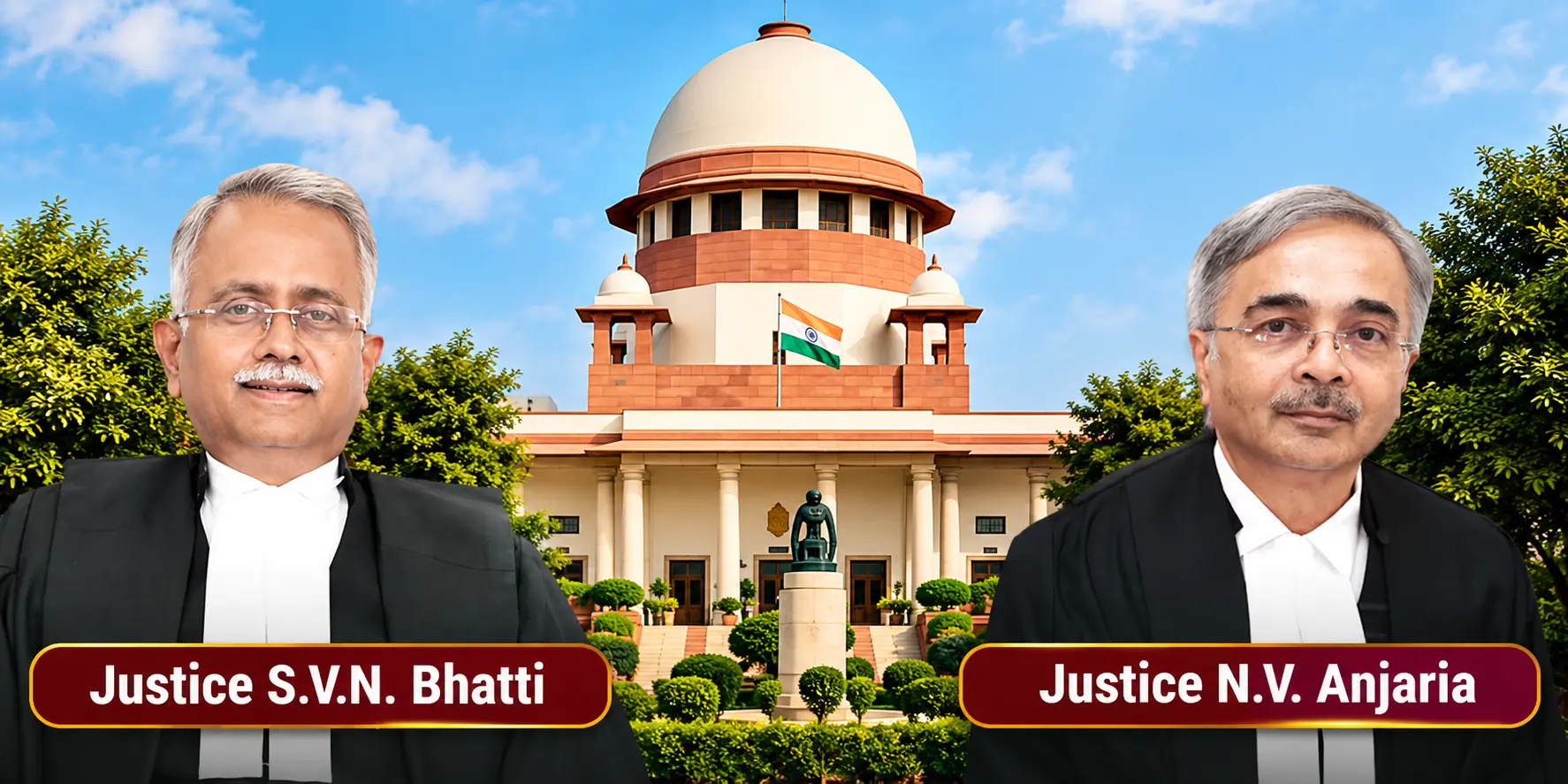
A Bench of Justice S.V.N. Bhatti and Justice N.V. Anjaria delivered the ruling while dismissing an appeal concerning approximately 45 bighas of agricultural land in Delhi. The dispute arose between the heirs of a woman’s first husband’s family and her two sons from her second marriage.
Background of the Dispute
The case concerned a woman named Khajano, who had inherited an interest in property associated with her first husband, Mauji Ram, and their son, Ram Chander. Under the law applicable at the time, she held a limited interest in the property.
Khajano subsequently married Bal Kishan and had two sons, Chand Ram and Chander Bhan. She was recognised as a Bhumidhar under the Delhi Land Reforms Act, 1954, and died in 1973.
After her death, her two sons sought mutation of the land records in their favour. However, members of Mauji Ram’s family objected, contending that the property should devolve upon the heirs of the last male proprietor because Khajano had originally possessed only a limited interest.
The revenue authorities rejected their claim, following which the dispute eventually reached the Supreme Court.
Section 14(1) of Hindu Succession Act Enlarges Limited Estate
The Supreme Court explained that Section 14(1) of the Hindu Succession Act, 1956, generally converts property possessed by a Hindu woman, in which she has a legally recognised interest, into her absolute property, subject to the statutory requirements and exceptions.
The Bench held that Khajano’s limited interest had become absolute ownership after the Hindu Succession Act came into force in 1956, well before her death in 1973.
The Court rejected the argument that her rights should be determined solely by the law applicable when she originally acquired the interest or was recognised as a Bhumidhar in 1954.
The judgment observed:
“By operation of Section 14(1) read with the Explanation, with effect from 17.06.1956, Khajano is not only a proprietor, but, through the general referential legislation of personal law, i.e., HSA, 1956, her limited estate right is transformed into an absolute right, thus changing the course of succession from Section 50 to Section 53 of the Act, 1954.”
Applicable Personal Law Must Be Determined on the Date of Death
The appellants contended that Khajano’s original limited interest should continue to govern the succession, notwithstanding the subsequent enactment of the Hindu Succession Act.
Rejecting this contention, the Court interpreted Section 51(2) of the Delhi Land Reforms Act, 1954, particularly the expressions “in accordance with the personal law applicable to her” and “dies”.
The Bench clarified that the personal law applicable to succession is not frozen as of the date on which the 1954 Act was enacted. Instead, the applicable law must be considered with reference to the date of the female Bhumidhar’s death.
The Court observed:
“Therefore, the personal law is not frozen on the enactment of the Act, 1954, and it keeps open the classes of persons entitled to succeed to an interest of a female Bhumidhar to the personal law applicable on the date of her demise.”
The Court further explained that the decisive considerations are the timing of the woman’s death and the nature of the right held by her at that time, as determined under the personal law governing succession.
Since Khajano died in 1973, after the Hindu Succession Act came into force, the Court held that her absolute ownership attracted Section 51(2)(a)(ii) of the Delhi Land Reforms Act, 1954.
Accordingly, the Supreme Court dismissed the appeal.
Case Title: Sultan Singh (Dead) Through LRs and Others v. The Financial Commissioner, Government of NCT of Delhi and Others
Citation:- 2026 INSC 1107

Representation:-
For Appellant(s): Mr. Rupesh Kumar Sr. Adv., Ms. Pankhuri Shrivastava Advocate, Ms. Neelam Sharma AOR, Mr. Rajeev Sharma Advocate, Mr. Mukul Advocate
For the Respondent(s): Mr. Anirudh Sharma AOR, Ms. Ateeyi Chatterjee Advocate, Mr. Varun Keshwarwani Advocate, Mr. Aryan Khare Advocate, Mr. Ramakrishnan Viraraghavan Sr. Adv., Mr. Anirudh Sharma AOR, Mr. Dhananjay Kumar Advocate
Website designed, developed and maintained by webexy