
The Supreme Court has ruled that a government servant cannot claim inter-district transfer as a matter of right merely on the ground of separation from family. The Court observed that the interests of students and the requirements of the education system must be considered while deciding transfer requests of teachers.
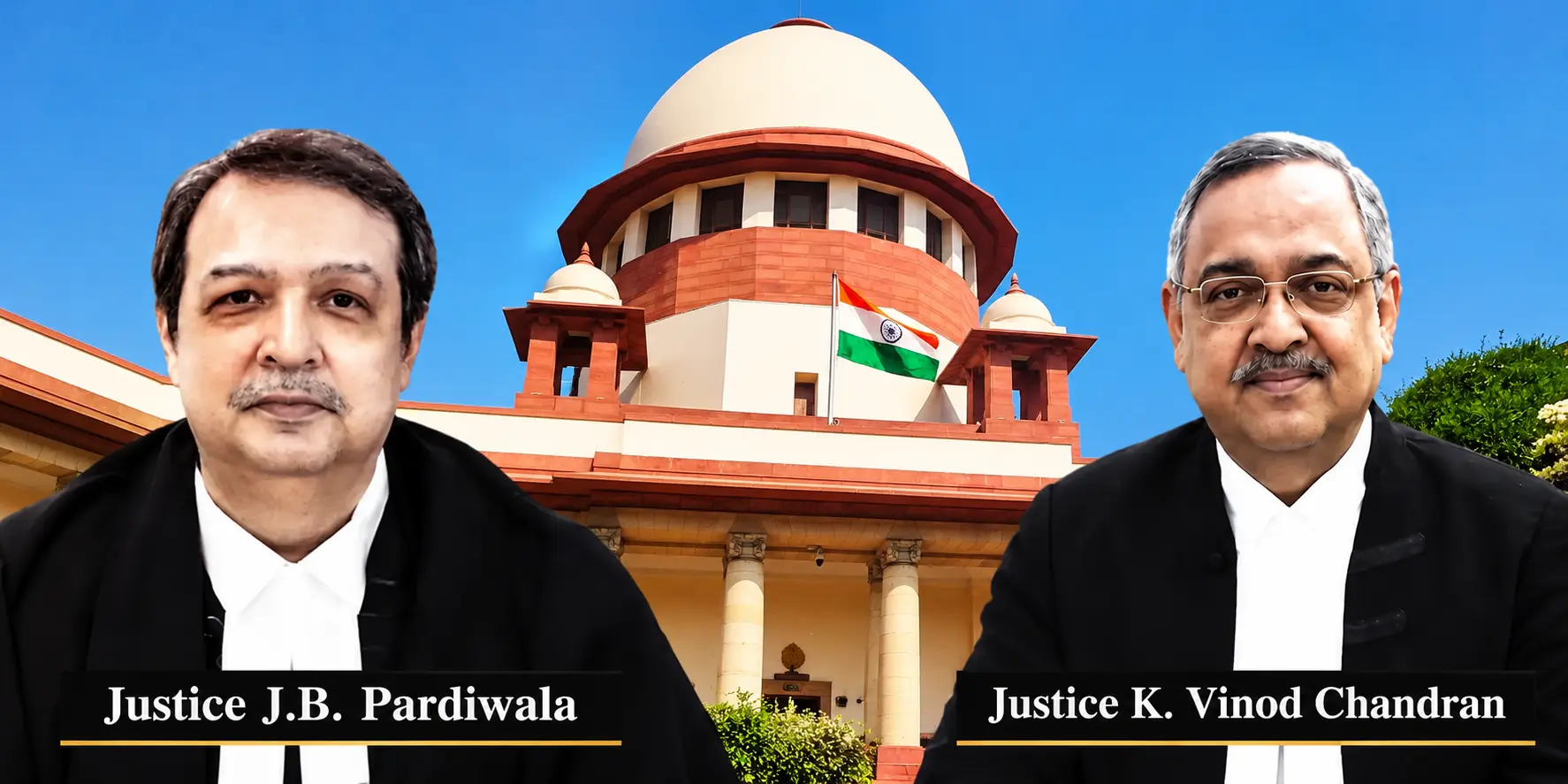
A Bench of Justice J.B. Pardiwala and Justice K. Vinod Chandran made the observations while setting aside an Allahabad High Court order that had prima facie found contempt in the rejection of a female teacher’s inter-district transfer request. The Supreme Court held that the reasons for rejecting the request were justified.
Teacher Sought Transfer to Lucknow to Join Husband
The case arose from a transfer request made by a female teacher posted in Bahraich, Uttar Pradesh. She had submitted that she was living alone with her two-and-a-half-year-old daughter, while her husband and in-laws resided in Lucknow.
The teacher sought consideration of her request under Rule 8(2)(d) of the Uttar Pradesh Basic Education (Teachers) (Posting) Rules, 2008, which provides for consideration of inter-district transfer requests of female teachers in special circumstances, including transfer to the district where their husbands reside.
The Allahabad High Court had earlier directed the authorities to consider her claim under the relevant provision. Subsequently, in contempt proceedings, the High Court had prima facie found disobedience of its earlier directions, leading the Secretary, Board of Basic Education, Prayagraj, to approach the Supreme Court.
Supreme Court Highlights Shortage of Teachers
Examining the rejection order, the Supreme Court noted that the teacher had secured 12 marks, whereas the minimum cut-off for inter-district transfer out of Bahraich was 22.
The Bench also considered the staffing position at the school where she was posted. The school had 137 students, but only two teachers were working in the primary section. Under the Right of Children to Free and Compulsory Education Act, 2009, the school required five teachers.
The Court observed that transferring one of the two available teachers could adversely affect students’ education. It held that the authorities had valid reasons for rejecting the transfer request.
“Every teacher should remember that the educational system is primarily for the students and not to further the career of the teachers or to enable convenient postings to the teachers,” the Bench observed.
Transfer Cannot Be Claimed Merely Due to Family Separation
The Supreme Court further observed that separation from family is a problem faced by employees generally and does not, by itself, create an enforceable right to an inter-district transfer.
The Bench noted that a teacher’s appointment is linked to a particular local cadre and that an inter-district transfer may also involve a change of cadre. It observed that the teacher had voluntarily chosen her cadre at the time of appointment.
The Court clarified that Rule 8(2)(d) provides a relaxation for women employees in appropriate circumstances, but that relaxation cannot be exercised in a manner that jeopardises students’ education.
“This is a universal problem faced by employees and one cannot, on the mere displacement from the family, claim an inter-district transfer, which in the present case also entails a cadre change; as a matter of right,” the Bench observed.
Allahabad High Court Order Set Aside
Concluding that the rejection of the teacher’s transfer request was justified, the Supreme Court set aside the Allahabad High Court’s order in the contempt proceedings.
The decision underscores that transfer requests must be examined in light of the applicable rules, the circumstances of the employee and the administrative requirements of the institution. In the case of government schools, the Court emphasised that the interests and educational needs of students cannot be overlooked while considering requests for convenient postings.
Case: Pratap Singh Baghel v. Akanksha Shukla
Case Number: Diary No. 10142/2025
Bench: Justice J.B. Pardiwala and Justice K. Vinod Chandran

Representation:-
For the Petitioner(s): Ms. Aishwarya Bhati A.S.G., Mr. Ankit Goel AOR, Mr. Varun Yadav Advocate
For the Respondent(s): Mr. Shashank Singh AOR, Ms. Prapti Shrivastava Advocate, Mr. Amritya Sen Advocate, Ms. Sweety Gautam Advocate
Website designed, developed and maintained by webexy