
Supreme Court Restores Acquittal of Telephone Department Cashier, Says Prosecution Must Prove Entrustment and Dishonest Intent
The Supreme Court has set aside a Bombay High Court judgment that had reversed the acquittal of a former Telephone Department cashier convicted of criminal breach of trust, holding that the prosecution failed to prove the essential ingredients of the offence under Section 409 of the Indian Penal Code, 1860.
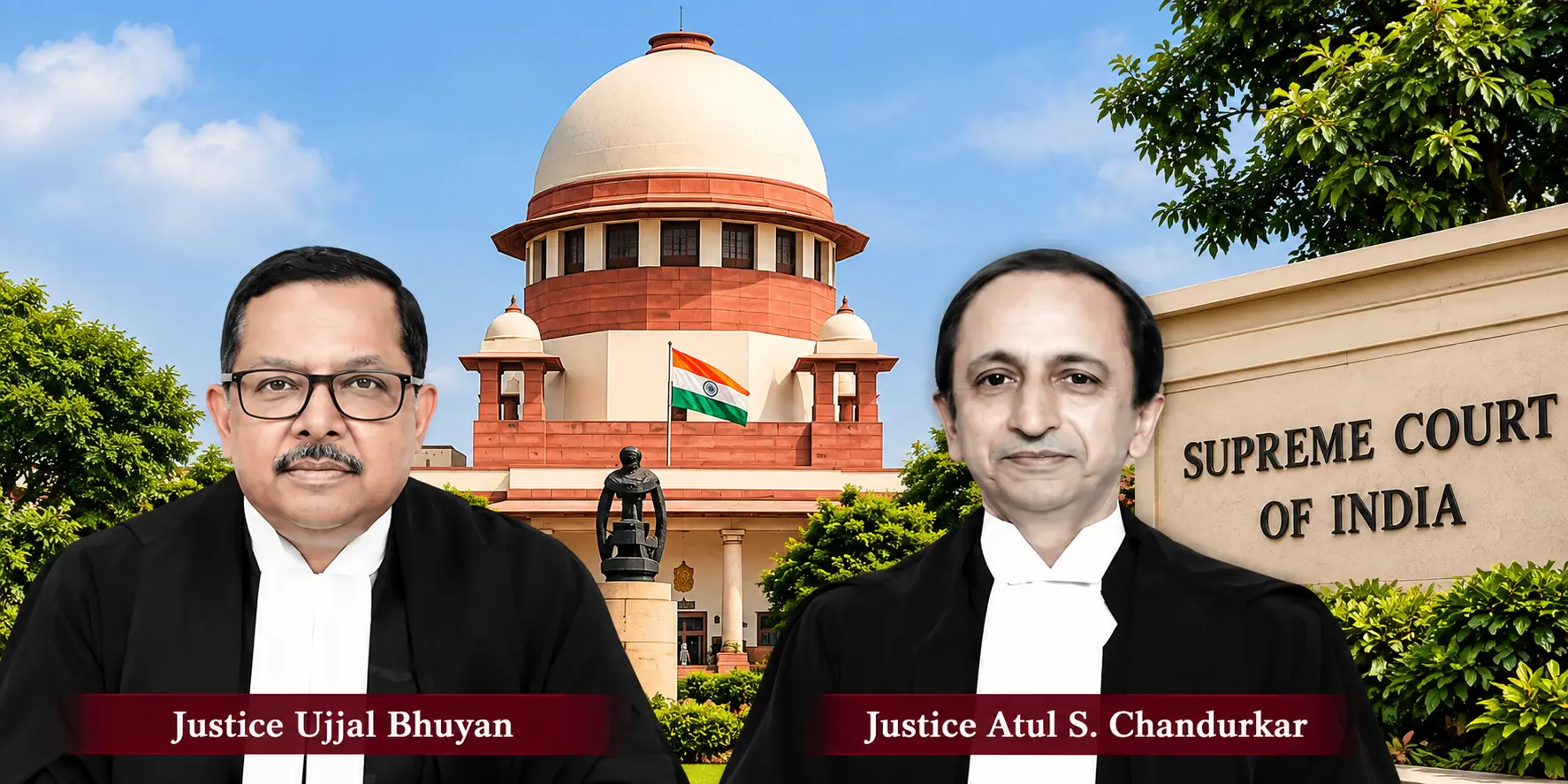
A Bench of Justice Ujjal Bhuyan and Justice Atul S. Chandurkar allowed the appeal filed by Ramkrushna Prahllad Dongardive against the State of Maharashtra and restored the acquittal recorded by the trial court.
In its judgment dated October 8, 2026, the Court held that the prosecution had failed to establish entrustment of the alleged amount to the appellant or any dishonest intention on his part. It also found that the High Court had erred in reversing the acquittal despite significant gaps in the prosecution evidence.
Prosecution Alleged Misappropriation of ₹8.73 Lakh
The appellant was working as a Cashier-cum-Counter Clerk in the Telephone Department at Aurangabad. The prosecution alleged that between July 1, 1993, and October 9, 1993, he collected ₹8,73,737 from telephone subscribers.
According to the prosecution, ₹3,88,035 was credited to the Government account belatedly, while ₹4,75,702 was allegedly not deposited at all. A complaint was lodged by an Assistant Accounts Officer on October 11, 1993, following which an offence was registered under Sections 409, 477 and 420 of the IPC.
The trial court acquitted the appellant on February 20, 2002, holding that the prosecution evidence was vague and insufficient to establish the charge. However, the Bombay High Court, Aurangabad Bench, reversed the acquittal on October 12, 2017, convicted him under Section 409 IPC and sentenced him to one year of rigorous imprisonment along with a fine of ₹5,000.
Original Cashbooks and Registers Not Produced
The Supreme Court noted that the prosecution had failed to produce crucial records, including the original cashbook, daily registers, audit report and other documents necessary to establish the collection and deposit of money by the appellant.
The Court observed that these records were essential to prove the alleged entrustment of the amount and determine whether the appellant had failed to deposit the money or had temporarily misappropriated it.
The appellant had also sought production of the daily cash handover register and the stock register relating to the supply of receipt books. These records were not produced despite requests.
The Bench upheld the trial court’s decision to draw an adverse inference against the prosecution for withholding material documents that were in the custody of the Telephone Department.
Seizure of Documents Found Unreliable
The prosecution had also relied upon 46 articles allegedly seized from the appellant’s house during the investigation. However, both seizure witnesses had turned hostile, and the investigating officer admitted shortcomings in the seizure proceedings.
The Court found that the requirements of Sections 100(4) and 100(7) of the Code of Criminal Procedure, 1973, had not been complied with. The prosecution had failed to establish the seizure in accordance with law or explain why a list of the seized articles had not been furnished to the appellant.
The Bench clarified that non-compliance with search and seizure provisions does not, by itself, automatically invalidate a seizure. However, when considered cumulatively with other deficiencies in the prosecution case, such irregularities can materially affect the evidentiary value of the alleged recovery.
The Court held that the High Court had erred in treating the seized documents as incriminating circumstances against the appellant when the seizure itself had not been properly proved.
Entrustment and Dishonest Intention Are Essential Ingredients
The Supreme Court reiterated that an offence of criminal breach of trust under Sections 405 and 409 IPC requires proof of entrustment of property, or dominion over it, and dishonest misappropriation, conversion, use or disposal in violation of law or a legal direction.
The Bench found that the prosecution had failed to establish these essential ingredients. The documentary evidence relied upon by the prosecution did not sufficiently connect the appellant with the alleged amounts, and the relevant records that could have demonstrated the alleged shortfall were missing.
The Court further observed that the High Court had improperly shifted the burden onto the appellant by expecting him to explain the circumstances surrounding the documents allegedly seized from his residence.
Reiterating the settled principle of criminal jurisprudence, the Court emphasised that the prosecution must prove its case beyond reasonable doubt and cannot derive an advantage from the weakness or alleged falsity of the defence.
High Court Erred in Reversing Acquittal
The Bench also reiterated that, while an appellate court has the power to review evidence in an appeal against acquittal, it must give due weight to the trial court’s assessment of witness credibility, the presumption of innocence and the accused’s right to the benefit of reasonable doubt.
The Supreme Court concluded that the trial court had rightly acquitted the appellant and that the High Court had failed to give due consideration to the absence of material documents and the deficiencies in the prosecution evidence.
The Court also noted that the High Court had sentenced the appellant after reversing his acquittal without hearing him on the question of sentence. It referred to the legal requirement that an appellate court convicting an accused for the first time after reversing an acquittal must hear the accused before imposing sentence.
Acquittal Restored
Setting aside the Bombay High Court’s judgment dated October 12, 2017, the Supreme Court restored the acquittal recorded by the Chief Judicial Magistrate, Aurangabad, on February 20, 2002.
The appellant was acquitted of the offence under Section 409 IPC, his bail bonds were cancelled, and the criminal appeal was allowed.
Case Title: Ramkrushna Prahllad Dongardive v. State of Maharashtra
Citation: 2026 INSC 1099
Case Number: Criminal Appeal No. 1432 of 2019
Bench: Justice Ujjal Bhuyan and Justice Atul S. Chandurkar
Date of Judgment: October 8, 2026

Representation:-
For the Appellant(s): Mr. B.H. Marlapalle Sr. Adv., Mr. Sudhanshu S. Choudhari Sr. Adv., Mr. Vatsalya Vigya AOR, Mr. Ajit Wagh Advocate, Ms. Aanchal Rathore Advocate, Mr. Avinish Kumar Saurabh Advocate, Ms. Gautami Yadav Advocate, Ms. Pranjal Chapalgaonkar Advocate, Mr. Yash Singhania Advocate
For the Respondent(s): Mr. Shrirang B. Varma Advocate, Mr. Siddharth Dharmadhikari Advocate, Mr. Aaditya Aniruddha Pande AOR, Mr. Harshavardhan V. Ghadge Advocate
Website designed, developed and maintained by webexy