
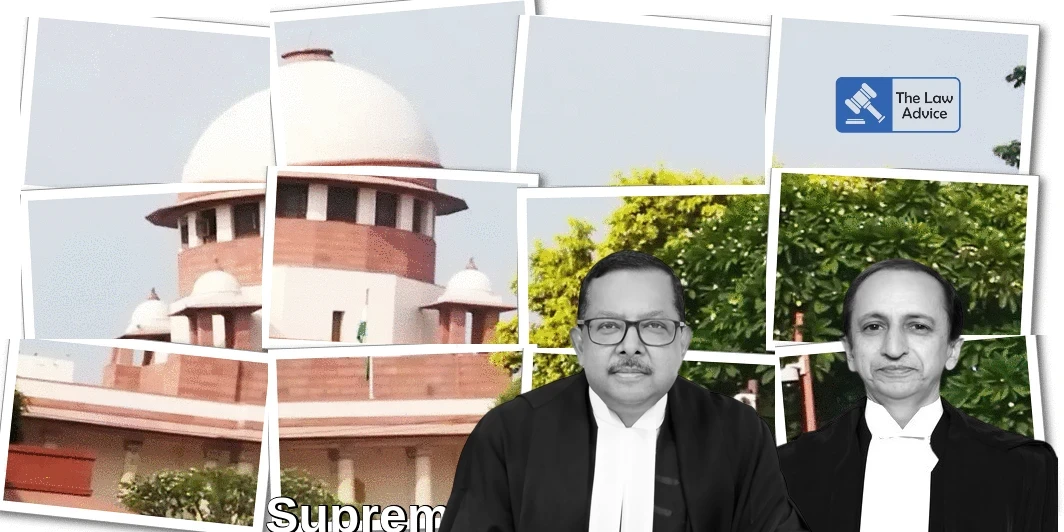
The Supreme Court has acquitted Santosh Gurung, who had been convicted for the rape and murder of a minor girl, holding that the prosecution failed to establish a complete chain of circumstances pointing exclusively towards his guilt.
A Bench comprising Justice Ujjal Bhuyan and Justice Atul S. Chandurkar allowed the appeal and set aside the judgments of the Sessions Court and the High Court of Sikkim. The judgment was pronounced on October 1, 2026. Pasted markdown
Gurung had been convicted under Sections 376(2)(i), 302 and 201 of the IPC, as well as Sections 4 and 6 of the Protection of Children from Sexual Offences Act, 2012. The Sessions Court had sentenced him to life imprisonment, and the High Court had upheld his conviction. Pasted markdown
The prosecution case was that the minor went missing on November 6, 2013, after allegedly accompanying the appellant. A Missing Report was lodged on November 12, 2013, while the FIR was registered on May 13, 2014 after the appellant was traced at Siliguri. The prosecution relied entirely on circumstantial evidence as there was no eyewitness to the alleged offence. Pasted markdown
The Court found that the prosecution had failed to establish that Gurung was actually the last person seen with the victim.
The witnesses examined by the prosecution were uncertain about whether the appellant and the victim had left the house together. The Investigating Officer also admitted that no person had seen the appellant taking the victim away from the house. Pasted markdown
The Court further noted that there was a gap of around six months between the alleged date when the appellant was last seen with the victim and the subsequent discovery of bones and teeth. Referring to the principles governing the “last seen theory”, the Court observed that where there is a long time gap and the possibility of other persons intervening exists, it would be unsafe to draw a conclusion of guilt merely on that basis. Pasted markdown
The prosecution had relied upon the recovery of articles allegedly made at the instance of the appellant under Section 27 of the Indian Evidence Act, 1872.
However, the Court noted that the place from where the articles were recovered was not a thick jungle and was regularly visited by people collecting fodder and grazing cattle. The Court therefore held that the recovery from such a location required careful scrutiny. Pasted markdown
The Supreme Court also found that the DNA evidence did not support the prosecution case.
The DNA report stated that the recovered bone sample was of human male origin and was not biologically related to the blood samples of the victim's mother and sister. The Court noted that the victim was female and, therefore, the DNA evidence could not establish that the recovered bones belonged to her. Pasted markdown
The Court also noted that the medical expert was unable to conclusively state whether certain recovered specimens were human bones, a human tooth or even a nail. Pasted markdown
The Regional FSL report could not establish whether the blood found on the brown shawl was human or animal blood. The Court also noted that the mother of the appellant could not identify the shawl as belonging to her, while the Investigating Officer admitted that no witness had seen the appellant taking the shawl from his mother's house. Pasted markdown
The Court further held that the appellant's statement under Section 313 CrPC could not be used to fill gaps in the prosecution case.
Referring to the law governing Section 313 statements, the Bench reiterated that such a statement is not substantive evidence and cannot become the sole basis of conviction where the prosecution evidence itself is insufficient. An adverse inference can arise only where the incriminating material has first been fully established and the accused fails to explain it. Pasted markdown
The Supreme Court concluded that the prosecution evidence was insufficient to establish the appellant's guilt beyond reasonable doubt. The Court held that the chain of circumstances was incomplete and did not point towards the appellant alone.
Accordingly, the Court quashed the Sessions Court judgment and the High Court judgment, acquitted Santosh Gurung of the offences for which he was convicted, and directed that he be set free forthwith if not required in any other case. Pasted markdown
Case: Santosh Gurung v. State of Sikkim
Citation: 2026 INSC 1073
Criminal Appeal No.: 107 of 2018
Judgment Date: October 1, 2026
Bench: Justice Ujjwal Bhuyan and Justice Atul S. Chandurkar

Representation:-
For Appellant(s) : Ms. Sangeeta Kumar-AOR, Ms. Vidushi Garg, Adv.
For Respondent(s) : Mr. Sameer Abhyankar, AOR Mr. Krishna Rastogi, Adv. Mr. Aryan Srivastava, Adv. Mr. Aakash Thakur, Adv.
Website designed, developed and maintained by webexy