
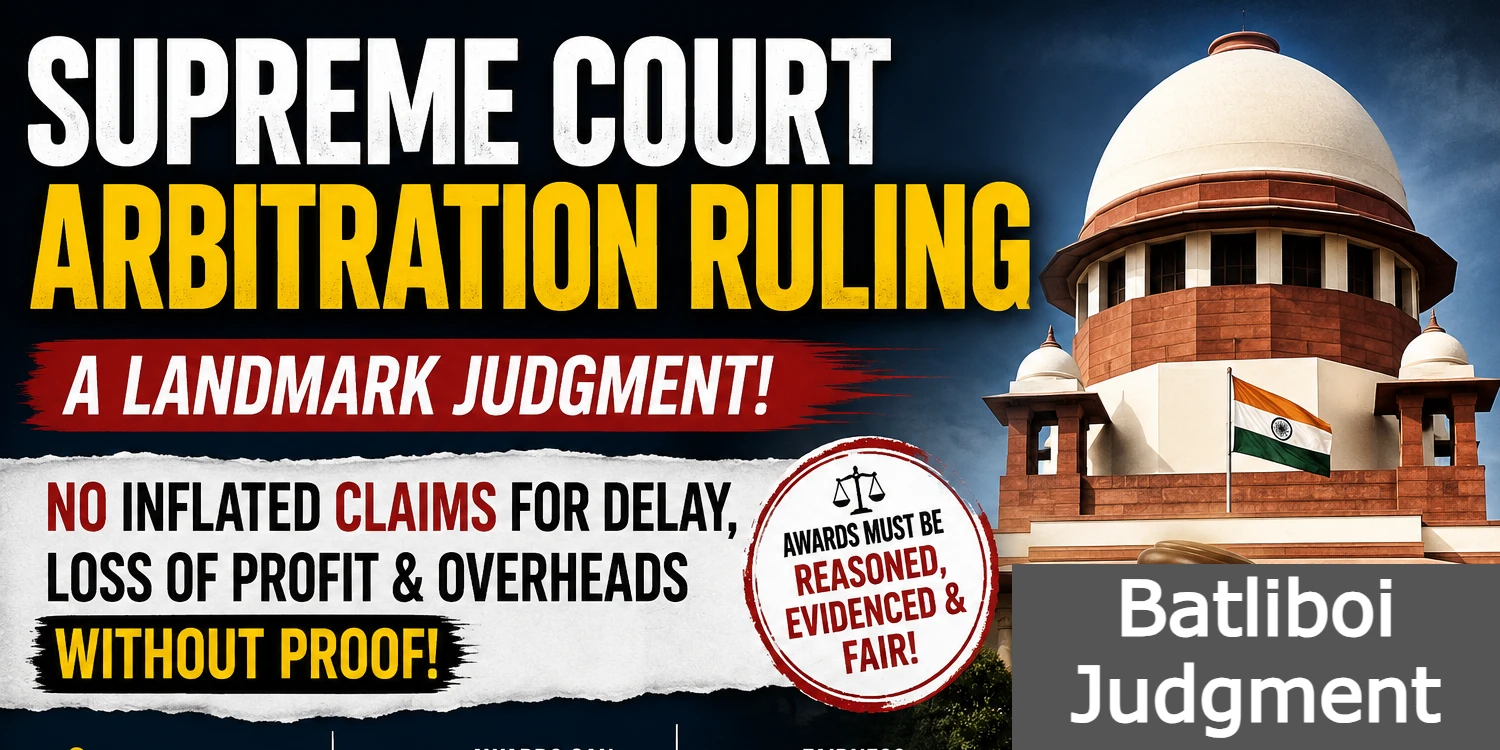
Judgment Analysis -Batliboi Environmental Engineers Limited v. Hindustan Petroleum Corporation Limited
Citation: 2023 INSC 850
Delivered by:
- Justice Sanjiv Khanna
- Justice M.M. Sundresh
The judgment delivered by the Supreme Court in September 2023 is a significant exposition on two interconnected aspects of arbitration law under the Arbitration and Conciliation Act, 1996: first, the legal standards governing claims for loss of profit, overheads, and delay damages in construction contracts; and second, the permissible scope of judicial interference with arbitral awards under Sections 34 and 37 of the Act prior to the 2015 amendments. The Court undertook an extensive doctrinal and factual scrutiny of the arbitral award and ultimately upheld the High Court’s decision setting aside the award on the ground that the arbitral tribunal had acted in a manner contrary to settled legal principles, resulting in an award that was irrational, unsupported by evidence, and patently unsustainable.
At the outset, the Court examined the jurisprudence relating to claims for loss of profitability and unabsorbed overheads arising from delay in execution of contracts. The Court emphasized that such claims cannot be awarded mechanically merely because delay has occurred. A contractor seeking compensation for loss of profit or overheads must establish actual financial injury caused by the delay. This includes proving that the contractor was deprived of opportunities to undertake other profitable work, that the contractor’s turnover suffered due to the specific delay in question, and that the contractor could not deploy its workforce or resources elsewhere during the extended contract period. The Court clarified that if no loss of turnover is proved, the contractor is ordinarily entitled only to interest on blocked capital and not to anticipated profits. In doing so, the Court reaffirmed the principle that damages in contract law are compensatory rather than speculative.
The judgment contains an elaborate discussion on Hudson’s Formula, Eichleay Formula, and related methodologies used internationally for quantifying overhead and profit losses in delayed construction contracts. The Court noted that although Hudson’s Formula is frequently invoked in arbitration proceedings, it is based on several assumptions that may not exist in every case. Referring to English jurisprudence, particularly Property and Land Contractors Ltd. v. Alfred McAlpine Homes North Ltd., the Court highlighted that the formula presupposes that the contractor had other profitable opportunities available, that market conditions remained stable, and that the contractor could not mitigate losses by reallocating resources. Without proof of these foundational elements, application of such formulae becomes unreliable. The Court observed that Hudson’s Formula may also lead to double recovery because profit is often already embedded within the contract sum. Consequently, courts and arbitral tribunals must apply these formulae cautiously and only as a last resort where precise computation is otherwise impossible.
Applying these principles to the facts of the case, the Court found that the arbitral tribunal had awarded an extraordinarily inflated amount towards loss of overheads and profitability without any rational basis or proper computation. The tribunal awarded more than Rs. 1.57 crore as damages in a contract where substantial payments had already been made and most of the work had been completed. The Court noted glaring contradictions and absence of reasoning in the award, observing that the damages granted were disproportionate and appeared to involve overlap or duplication of compensation. Importantly, the tribunal failed to explain how the figures were arrived at or how the claimant had actually suffered the alleged losses. The Court therefore concluded that the award suffered from manifest arbitrariness and amounted to overcompensation unsupported by evidence.
The Court also criticized the arbitral tribunal’s approach regarding mitigation of damages. While the tribunal accepted that the principle of mitigation applied, it reasoned that the contractor could have mitigated losses only by working on Sundays and holidays. The Supreme Court termed this reasoning “ex facie fallacious,” holding that mitigation in the context of overhead claims concerns the ability of the contractor to redeploy resources, obtain alternate work, or reduce financial exposure—not merely extending work hours. The Court thus reaffirmed the broader contractual principle that a claimant must take reasonable commercial steps to reduce avoidable losses.
Another important aspect of the judgment concerns Claim No. 2 relating to idle machinery and equipment. The arbitral tribunal had awarded compensation based largely on its own site inspection conducted long after the contractor had abandoned the work. The Supreme Court held that such an award, unsupported by documentary evidence or analytical reasoning, amounted to a mere ipse dixit of the arbitrator. This reinforced the principle that even though arbitral tribunals enjoy procedural flexibility, their conclusions must still be grounded in evidence and reasoned adjudication.
The latter half of the judgment is devoted to an extensive discussion on the scope of judicial review of arbitral awards under Section 34 of the Arbitration and Conciliation Act as it existed before the 2015 amendments. The Court acknowledged the continuing tension between two competing principles: party autonomy and minimal judicial intervention on one hand, and the need to ensure fairness, legality, and rationality in arbitral decision-making on the other. The Court recognized arbitration as a consensual alternative dispute resolution mechanism intended to provide speedy and final adjudication. However, it cautioned that party autonomy cannot operate as a shield to protect awards that are arbitrary, perverse, irrational, or fundamentally unfair.
In this context, the Court traced the evolution of the “public policy of India” doctrine through leading precedents such as ONGC Ltd. v. Saw Pipes Ltd., McDermott International Inc. v. Burn Standard Co. Ltd., Associate Builders v. DDA, and ONGC Ltd. v. Western Geco International Ltd.. It reiterated that under the pre-amendment framework, an arbitral award could be set aside if it was contrary to the fundamental policy of Indian law, the interests of India, justice or morality, or if it was patently illegal. Nevertheless, the Court carefully emphasized that Section 34 does not permit courts to act as appellate forums reappreciating evidence or correcting mere errors of fact or law.
The judgment further elaborated on the meaning of “fundamental policy of Indian law” by relying on the principles developed in Western Geco and Associate Builders. According to the Court, arbitral tribunals must adopt a judicial approach, act fairly and objectively, apply their mind to the material on record, and provide intelligible reasons for their conclusions. An award becomes vulnerable when it ignores vital evidence, relies on irrelevant considerations, reaches conclusions no reasonable person could arrive at, or displays perversity and irrationality. The Court clarified that perversity arises not merely because another view is possible, but when findings are based on no evidence, disregard material evidence, or outrageously defy logic.
Significantly, the Court reaffirmed that interpretation of contractual terms ordinarily falls within the exclusive domain of the arbitrator, and courts should not substitute their own interpretation merely because another view is possible. However, if the arbitrator construes the contract in a manner that no fair-minded or reasonable person would adopt, judicial interference becomes justified. Thus, while emphasizing restraint, the Court also preserved the supervisory role of courts in preventing manifest injustice.
Ultimately, the Supreme Court concluded that the arbitral award in the present case suffered from patent flaws including absence of reasoning, contradictory findings, inflated computation of damages, and duplication of claims. The award violated the standards of fairness and rational adjudication required under Indian arbitration law. Consequently, the Court upheld the High Court’s decision under Sections 34 and 37 setting aside the award. The judgment therefore stands as an important authority emphasizing that arbitral autonomy does not permit speculative or unsupported awards, and that judicial intervention remains available where arbitral decisions become perverse, irrational, or contrary to the fundamental policy of Indian law.