
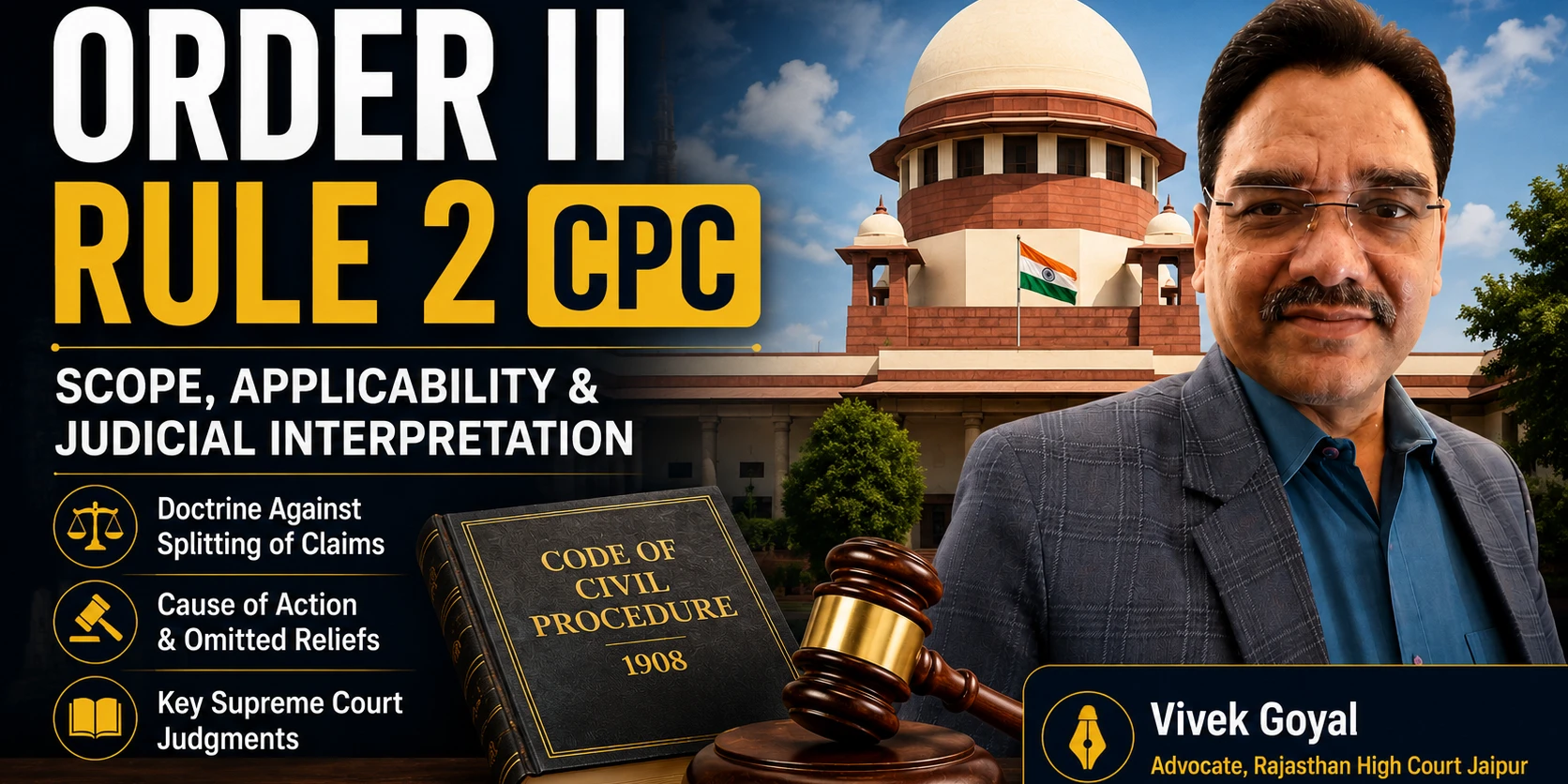
Successive Suits and the Bar of Order II Rule 2 CPC: Principles and Precedents
Introduction of the author:-
|
Advocate Vivek Goyal is a renowned legal practitioner with extensive experience in civil litigation and constitutional matters. He has been practicing primarily on the civil side, property disputes, and constitutional matters before the Rajasthan High Court, Jaipur Bench, for the last 27 years. Over the course of his legal career, he has represented clients in a wide range of matters involving civil disputes, property laws, contractual issues, arbitration, service matters, and writ jurisdiction. |
INDEX
-
- Introduction
- Statutory Provision
- Object of Order II Rule 2
- Essential Ingredients for Applicability
- Meaning of "Cause of Action"
- Illustrations
- Burden of Proof
- Difference Between Order II Rule 2 and Res Judicata
- Landmark Judicial Pronouncements on Order II Rule 2 CPC
- Situations Where Order II Rule 2 Does Not Apply
- Conclusion
Introduction
Order II Rule 2 of the Code of Civil Procedure, 1908 (CPC) embodies the principle that a plaintiff must claim all reliefs arising from the same cause of action in one suit. The provision seeks to prevent multiplicity of litigation and ensure that disputes between parties are adjudicated comprehensively in a single proceeding.
The rule is based on the doctrine that a party should not be allowed to vex the opposite party repeatedly by instituting multiple suits arising out of the same cause of action. It compels a plaintiff to include the whole claim to which he is entitled in respect of a particular cause of action.
Order II Rule 2 is frequently invoked in civil litigation involving property disputes, contractual claims, recovery suits, specific performance actions, and injunction matters.
Statutory Provision
(1) Every suit shall include the whole of the claim which the plaintiff is entitled to make in respect of the cause of action; but a plaintiff may relinquish any portion of his claim in order to bring the suit within the jurisdiction of any Court.
(2) Where a plaintiff omits to sue in respect of, or intentionally relinquishes, any portion of his claim, he shall not afterwards sue in respect of the portion so omitted or relinquished.
(3) A person entitled to more than one relief in respect of the same cause of action may sue for all or any of such reliefs; but if he omits, except with the leave of the Court, to sue for all such reliefs, he shall not afterwards sue for any relief so omitted.
Object of Order II Rule 2
The primary objectives of the provision are:
1. To avoid multiplicity of proceedings.
2. To prevent harassment of defendants through repeated litigation.
3. To ensure finality of disputes.
4. To save judicial time and resources.
5. To compel plaintiffs to bring forward their entire case at one time.
The rule is founded upon the maxim:
"Nemo debet bis vexari pro una et eadem causa"
which means that no person should be vexed twice for the same cause.
Essential Ingredients for Applicability
For Order II Rule 2 CPC to apply, the following conditions must be satisfied:
1. Both Suits Must Arise from the Same Cause of Action
The earlier and subsequent suits must be founded on the same cause of action.
A cause of action comprises all material facts that a plaintiff must prove to obtain relief.
If the causes of action are different, the bar under Order II Rule 2 does not apply.
2. Earlier Suit Must Have Been Filed First
The first suit should have been instituted before the second suit.
The bar operates only when a plaintiff, after filing one suit, subsequently files another suit based on the same cause of action.
3. Omission of Relief or Claim
The plaintiff must have omitted to claim a relief that was available at the time of institution of the first suit.
4. No Leave of Court Obtained
If the plaintiff obtained permission from the court to reserve a relief for future litigation, the subsequent suit may be maintainable.
Meaning of "Cause of Action"
The expression "cause of action" has not been exhaustively defined in the CPC.
Judicially, it means:
A bundle of essential facts which gives a person the right to seek judicial relief.
The determination of whether two suits arise from the same cause of action is the most crucial aspect of Order II Rule 2.
Courts generally examine:
- Facts pleaded in both suits;
- Rights asserted by the plaintiff;
- Reliefs claimed;
- Whether evidence required in both suits is substantially the same.
Illustrations
Illustration 1: Recovery of Money
A lends ₹10 lakh to B.
A files a suit claiming recovery of only ₹6 lakh although the entire amount had become due.
Later, A files another suit for the remaining ₹4 lakh.
The second suit is barred under Order II Rule 2 because the entire claim arose from the same cause of action.
Illustration 2: Injunction Followed by Possession
A trespasses upon B's property.
B files a suit merely seeking injunction without claiming possession despite already being dispossessed.
Later, B files another suit seeking possession based on the same dispossession.
The second suit may be barred under Order II Rule 2 because the relief of possession was available when the first suit was filed.
Illustration 3: Different Causes of Action
A tenant defaults in rent for January.
Landlord files a suit for recovery of January rent.
Subsequently, tenant defaults in rent for February and March.
A later suit for February and March rent is maintainable because it arises from a fresh cause of action.
Burden of Proof
The burden lies on the defendant who raises the plea under Order II Rule 2 CPC.
The defendant must establish:
1. Identity of cause of action;
2. Existence of an earlier suit;
3. Omission of the claim or relief in the earlier suit.
Courts have consistently held that this plea must be specifically pleaded and proved.
Difference Between Order II Rule 2 and Res Judicata
|
Particulars |
Order II Rule 2 CPC |
Res Judicata |
|
Basis |
Same cause of action |
Same issue already decided |
|
Relevant Provision |
Order II Rule 2 CPC |
Section 11 CPC |
|
Requirement of Prior Decision |
Not necessary |
Necessary |
|
Focus |
Omission of claim or relief |
Final adjudication of issue |
|
Stage |
Before merits are decided |
After adjudication |
Thus, the two doctrines operate in different fields though both aim to prevent repetitive litigation.
Landmark Judicial Pronouncements on Order II Rule 2 CPC
The law relating to Order II Rule 2 of the Code of Civil Procedure has been substantially developed through a series of decisions of the Supreme Court of India. These judgments have clarified the scope of the provision, the meaning of "cause of action," the burden of proof, and the circumstances in which a subsequent suit would be barred. Among these decisions, Gurbux Singh v. Bhooralal remains the foundational authority on the subject. In this case, the Supreme Court emphasized that a plea under Order II Rule 2 is a technical defence and must be specifically pleaded and proved by the defendant. The Court held that before a subsequent suit can be barred, the defendant must establish that both suits arise from the same cause of action, that the plaintiff was entitled to claim the omitted relief in the earlier suit, and that such relief was omitted without obtaining leave of the court. The Court further observed that the burden lies on the defendant to produce the pleadings of the earlier suit so that the court can compare the causes of action in both proceedings. This judgment laid down the celebrated three-fold test which continues to guide courts while examining objections under Order II Rule 2 CPC.
Another significant decision is Deva Ram v. Ishwar Chand, wherein the Supreme Court cautioned courts against adopting an expansive interpretation of Order II Rule 2. The Court observed that since the provision has the effect of depriving a litigant of a legal remedy, it must be construed strictly. The Court clarified that the mere fact that two suits relate to the same property or involve the same parties does not automatically attract the bar under Order II Rule 2. What is material is whether the suits arise from the same cause of action. The Court explained that a cause of action consists of the bundle of material facts which a plaintiff must prove in order to obtain relief. Therefore, even if the subject matter of the dispute remains the same, the subsequent suit would not be barred if it is founded on a distinct set of facts giving rise to an independent cause of action. This judgment significantly strengthened the principle that identity of property or subject matter is not equivalent to identity of cause of action.
The Supreme Court's decision in Virgo Industries (Eng.) Pvt. Ltd. v. Venturetech Solutions Pvt. Ltd. represents one of the most important modern interpretations of Order II Rule 2 CPC. In this case, the plaintiff initially filed a suit seeking only an injunction to restrain the defendant from dealing with certain property, despite the fact that the cause of action for specific performance of the agreement had already arisen. Subsequently, the plaintiff instituted another suit seeking specific performance of the same agreement. The Supreme Court held that once the cause of action for specific performance had accrued, the plaintiff was obliged to claim all available reliefs arising from that cause of action in the first suit itself. By omitting the relief of specific performance and seeking only an injunction, the plaintiff effectively split the cause of action, which is precisely what Order II Rule 2 seeks to prevent. The Court therefore held that the subsequent suit for specific performance was barred. This judgment serves as an important warning to litigants and lawyers that all consequential reliefs available on the date of institution of the suit should ordinarily be claimed together.
A different perspective on the application of Order II Rule 2 was provided by the Supreme Court in Bengal Waterproof Ltd. v. Bombay Waterproof Manufacturing Co. The dispute arose in the context of trademark infringement and passing off. The defendant argued that the plaintiff's subsequent suit was barred because an earlier suit relating to the same trademark had already been filed. Rejecting this contention, the Supreme Court held that every fresh act of infringement constituted a fresh cause of action. Since the subsequent suit was based on continuing and recurring violations that occurred after the institution of the earlier suit, it could not be said to arise from the same cause of action. The Court observed that Order II Rule 2 does not apply where new facts emerge or where a fresh legal injury gives rise to a distinct cause of action. This judgment is particularly significant in cases involving continuing wrongs, recurring breaches of contract, trademark infringement, copyright violations, and similar situations where each successive violation creates an independent right to sue.
Collectively, these judgments establish the fundamental principles governing Order II Rule 2 CPC. While Gurbux Singh defines the essential conditions for attracting the bar, Deva Ram emphasizes the need for strict construction of the provision, Virgo Industries highlights the consequences of omitting available reliefs, and Bengal Waterproof Ltd. clarifies that fresh causes of action are not affected by the rule. Together, they demonstrate that the true test under Order II Rule 2 is not whether the parties or subject matter are the same, but whether the subsequent suit is founded on the very same cause of action that formed the basis of the earlier proceeding. These decisions continue to serve as the cornerstone of judicial interpretation in matters involving the splitting of claims and multiplicity of litigation.
Situations Where Order II Rule 2 Does Not Apply
The provision does not apply when:
- Causes of action are different.
- Subsequent events create a fresh cause of action.
- Relief claimed later was not available at the time of the first suit.
- Leave of the court was obtained.
- The defendant fails to prove identity of causes of action.
Conclusion
Order II Rule 2 CPC serves as an important procedural safeguard against fragmented litigation. The provision obliges plaintiffs to present their entire claim arising from a single cause of action in one suit and discourages piecemeal litigation. However, because the rule may defeat substantive rights, courts insist on strict proof of identity of cause of action before applying the bar.
The jurisprudence developed by the Supreme Court demonstrates that the key inquiry in every case is whether the subsequent claim arises from the same cause of action as the earlier suit. If it does, omission of relief may prove fatal; if it does not, the subsequent suit remains maintainable. Consequently, Order II Rule 2 continues to play a pivotal role in balancing procedural efficiency with substantive justice in civil litigation.
Bibliography
Books
1. Mulla, Dinshaw Fardunji, The Code of Civil Procedure, 20th edn., LexisNexis Butterworths, New Delhi.
2. C.K. Takwani, Civil Procedure with Limitation Act, 1963, 10th edn., Eastern Book Company, Lucknow.
3. M.P. Jain, The Code of Civil Procedure, 7th edn., LexisNexis, New Delhi.
4. Justice C.K. Thakker and M.C. Thakker, Code of Civil Procedure, Vol. I, Eastern Book Company, Lucknow.
5. P.M. Bakshi, Code of Civil Procedure, Universal Law Publishing, New Delhi.
6. Sarkar, Sudipto, and V.R. Manohar, Sarkar's Law of Civil Procedure, LexisNexis Butterworths, New Delhi.
Statutes
1. The Code of Civil Procedure, 1908.
Cases
1. Gurbux Singh v. Bhooralal, AIR 1964 SC 1810.
2. Deva Ram v. Ishwar Chand, (1995) 6 SCC 733.
3. Virgo Industries (Eng.) Pvt. Ltd. v. Venturetech Solutions Pvt. Ltd.., (2013) 1 SCC 625.
4. Bengal Waterproof Ltd. v. Bombay Waterproof Manufacturing Co., (1997) 1 SCC 99.
5. Alka Gupta v. Narender Kumar Gupta, (2010) 10 SCC 141.
6. Coffee Board v. Ramesh Exports Pvt. Ltd., (2014) 6 SCC 424.
7. State Bank of India v. Gracure Pharmaceuticals Ltd., (2014) 3 SCC 595.
Journal Articles and Online Resources
1. SCC Online Database.
2. Manupatra Legal Database.
3. LexisNexis India Legal Database.
4. Indian Kanoon Database.
5. Journal of the Indian Law Institute (JILI).
6. Supreme Court Cases (SCC) Journal.
7. All India Reporter (AIR).