
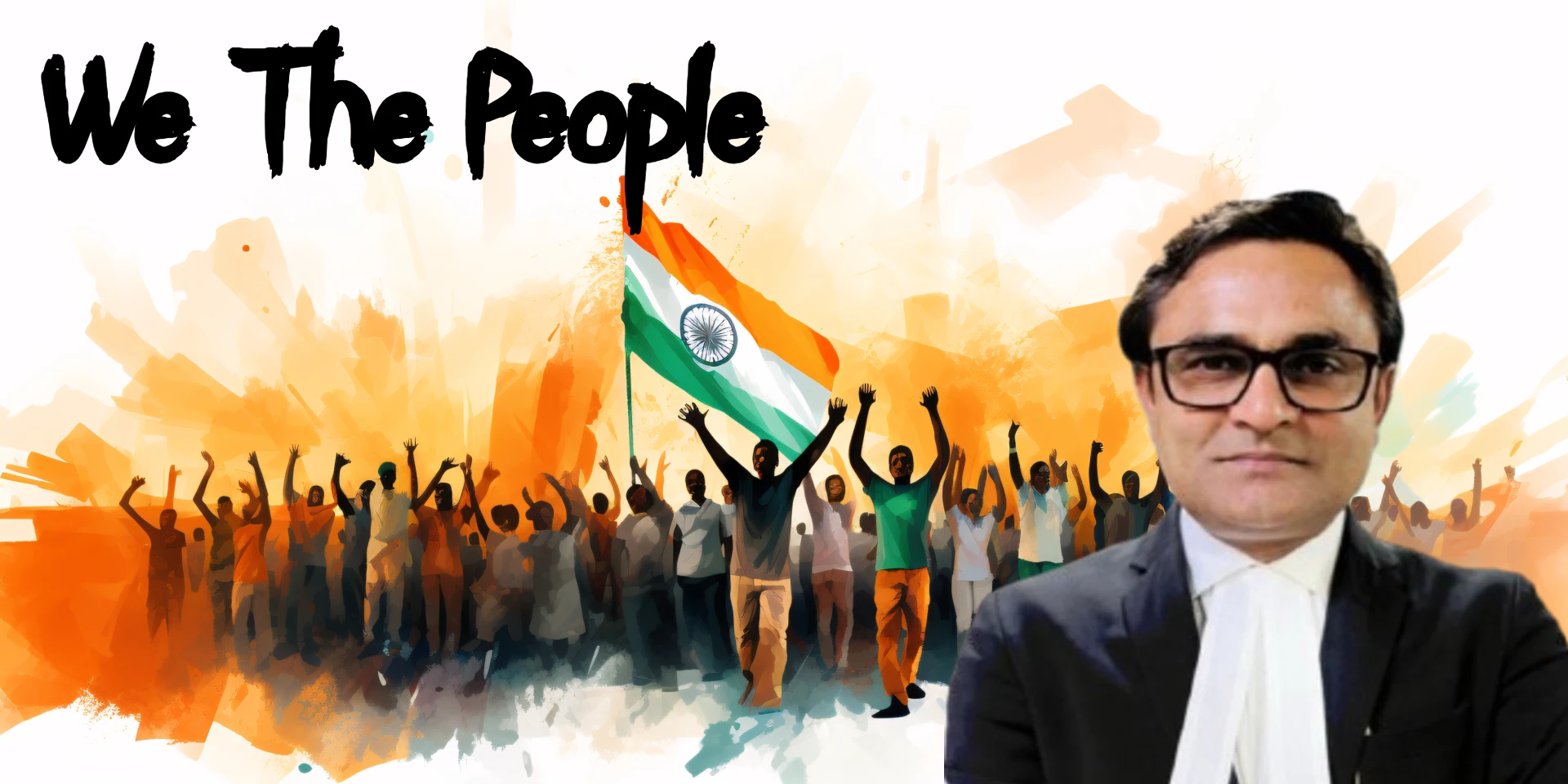
What Unites Us: “We the People”
The words “We the People of India”, enshrined in the Preamble of the Constitution, are not merely a formal opening—they are the soul of Indian democracy. These three words capture the collective identity, authority, and unity of a nation marked by extraordinary diversity. In a country divided by language, religion, caste, region, and culture, “We the People” stands as the strongest unifying force.
At its core, “We the People” signifies that sovereignty lies with the citizens, not with rulers, institutions, or the State. The Constitution does not derive its authority from kings, colonizers, or elites, but from the collective will of the people of India. This idea transformed subjects of colonial rule into equal citizens of a republic, bound by shared constitutional values.
The phrase also embodies the principle of equality. It does not distinguish between majority and minority, rich and poor, urban and rural, or powerful and powerless. Every individual—irrespective of social or economic status—is an equal stakeholder in the constitutional order. This inclusiveness is reinforced through universal adult franchise, ensuring that every voice matters in the democratic process.
“We the People” further reflects unity in diversity. India’s strength lies not in uniformity, but in coexistence. The Constitution recognizes multiple identities—linguistic, cultural, religious—yet binds them together under a common constitutional framework. It unites citizens through shared rights, duties, and responsibilities, rather than imposing a single way of life.
The phrase also carries a sense of collective responsibility. Rights guaranteed under the Constitution are balanced by Fundamental Duties, reminding citizens that democracy survives not only through entitlements but through active participation, tolerance, and respect for constitutional institutions. “We the People” therefore calls upon citizens to protect public property, promote harmony, and uphold the dignity of the nation.
Judicial interpretation has repeatedly emphasized that the Constitution is a people-centric document. Courts have invoked “We the People” to expand access to justice, protect civil liberties, and strengthen democratic accountability. It serves as a constant reminder that all organs of the State exist to serve the people—not the other way around.
In times of crisis, disagreement, or social tension, “We the People” acts as a moral compass. It reminds Indians that despite differences in opinion or identity, the ultimate bond is constitutional citizenship. It urges dialogue over division, rule of law over arbitrariness, and unity over fragmentation.
Ultimately, “We the People of India” is not just a phrase written in the Preamble—it is a continuing promise. A promise that India belongs equally to all its citizens, that power flows upward from the people, and that the nation’s future will be shaped collectively. In these words lies the enduring answer to what truly unites us as Indians.
Big Moments When India Truly Found “We the People”
The idea of “We the People of India” did not emerge overnight. It was discovered, tested, and reaffirmed at critical moments in India’s history—moments when individuals rose above differences and acted as one collective nation. These turning points shaped India’s democratic soul and strengthened the meaning of We the People.
1. The Freedom Struggle (1857–1947)
India’s first and most powerful realization of We the People came during the freedom movement. From the Revolt of 1857 to the mass movements led by Mahatma Gandhi, millions of ordinary Indians—peasants, workers, women, students—participated in a shared struggle against colonial rule. The freedom movement transformed scattered subjects into a political community with a common purpose.
2. Adoption of the Constitution (1950)
On 26 January 1950, India formally declared that sovereignty rests with its citizens. The Preamble’s opening words—“We the People of India”—marked a historic shift from colonial governance to popular sovereignty. For the first time, Indians were not ruled for or over, but ruled by themselves through a constitutional framework.
3. Universal Adult Franchise at Independence
Unlike many nations that limited voting rights, India granted the right to vote to every adult citizen from day one. In a country with widespread poverty and illiteracy, this was a revolutionary affirmation of equality. Every ballot cast reaffirmed the idea that every citizen counts.
4. Linguistic Reorganization of States (1956)
When states were reorganized on linguistic lines, India faced a serious test of unity. Instead of fragmenting, the nation adapted democratically, recognizing linguistic identities while preserving national integrity. This moment showed that We the People could accommodate diversity without breaking unity.
5. The Emergency and Its Aftermath (1975–1977)
The Emergency was a dark chapter, but its aftermath became a defining moment for We the People. In 1977, citizens voted out an authoritarian regime, restoring democratic values. It was a clear assertion that ultimate power lies with the people, not the State.
6. Kesavananda Bharati Judgment (1973)
Through this landmark judgment, the Supreme Court held that Parliament cannot destroy the basic structure of the Constitution. This was a constitutional moment where institutions acted as trustees of We the People, preserving democracy, liberty, and rule of law against excesses of power.
7. 73rd and 74th Constitutional Amendments
By empowering Panchayats and Municipalities, these amendments brought democracy to the grassroots. Ordinary citizens began participating directly in governance, giving real meaning to We the People at the village and local level.
8. RTI Movement and the Right to Information Act (2005)
The RTI Act transformed citizens from passive recipients of governance into active watchdogs. Transparency and accountability became people-driven demands, reinforcing democratic participation.
9. Judicial Expansion of Rights
Public Interest Litigation (PIL), expansion of Article 21, and access to justice for marginalized groups ensured that constitutional promises reached the masses. Courts repeatedly reaffirmed that the Constitution belongs to We the People, not just the privileged few.
10. National Crises and Collective Resilience
Moments such as natural disasters, pandemics, and national security challenges have seen Indians transcend divisions to support one another. Voluntary action, community solidarity, and civic responsibility during crises reflect the lived reality of We the People.
Ultimately, “We the People of India” is not just a phrase written in the Preamble—it is a continuing promise. A promise that India belongs equally to all its citizens, that power flows upward from the people, and that the nation’s future will be shaped collectively. In these words lies the enduring answer to what truly unites us as Indians.
India finds “We the People” not in perfection, but in participation, resistance, and renewal. Every time citizens defend democracy, demand accountability, or stand together despite differences, the Constitution’s opening words come alive. These moments remind us that We the People is not a historical phrase—it is an ongoing democratic journey.