
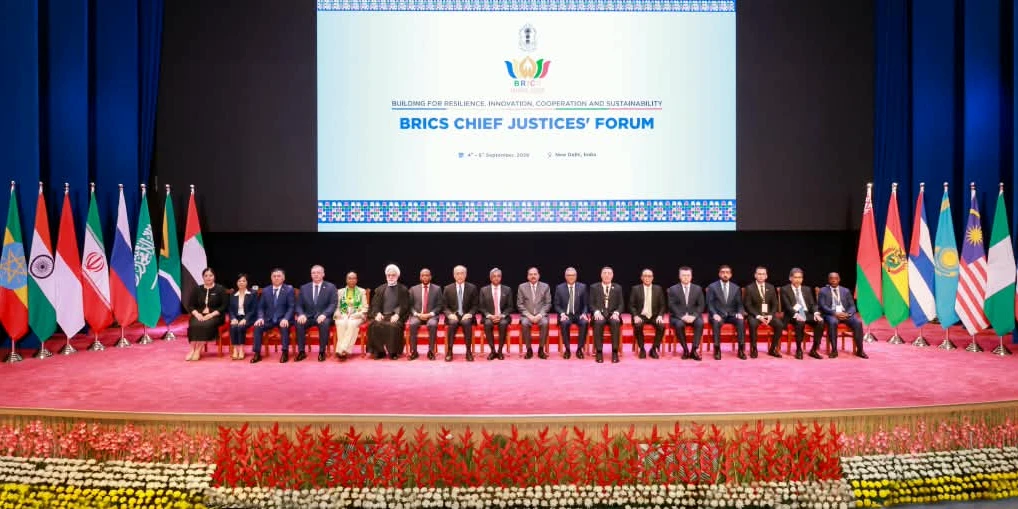
Chief Justice of India Justice Surya Kant has called for BRICS to evolve into a “living Nalanda University”, drawing inspiration from the ancient centre of learning that brought scholars from different civilisations together for intellectual exchange, debate and refinement of ideas.
Addressing the second day of the BRICS Chief Justices’ Forum at the Supreme Court of India, CJI Surya Kant said Nalanda represented a space where scholars from distant lands could engage in intellectual inquiry without being constrained by geographical or cultural boundaries.
He highlighted that Nalanda's strength lay in its ability to accommodate differences rather than insist upon a single system of law or philosophy. According to the CJI, it offered a “healthy and hospitable space for disagreement and deliberation.”
Drawing a parallel with the BRICS judicial forum, Justice Surya Kant said different legal traditions and judicial systems should come together for direct engagement and mutual learning.
“BRICS should also be known as the living Nalanda University,” he said.
The CJI also stressed the importance of timely, consistent and predictable justice, describing an effective justice delivery system as essential for economic development, technological progress, dispute resolution and sustainable energy.
Comparing the justice system to a building's “load-bearing wall”, he observed that although it may not always be visible, the structure cannot stand without it.
He further noted that uncertainty regarding the speed and fairness of dispute resolution can increase costs and risks for foreign investors, including through higher risk premiums, additional security requirements and stricter exit clauses.
According to Justice Surya Kant, courts that deliver judgments swiftly and consistently, and in language that the world can rely upon, can eliminate such hidden costs.
The BRICS Chief Justices’ Forum is deliberating on four broad areas:
Mediation and international commercial disputes
Cross-border enforcement of arbitral awards
Artificial Intelligence and the judiciary
Judicial leadership and sustainable development
Discussions on AI have included its potential use in judicial administration, including AI-assisted case listing and triage and predictive analytics for court management, while emphasising that human judgment must remain central to judicial decision-making.
The forum has also examined mediation as a strategic tool for resolving international commercial disputes and explored greater procedural harmonisation in cross-border enforcement of arbitral awards.
Judicial leaders from Brazil, China, Egypt, Ethiopia, Indonesia, Iran, Russia, South Africa and the UAE, along with representatives from several partner nations, are participating in the forum.
Surya Kant’s remarks underscore the potential of judicial cooperation within BRICS as a platform for sharing legal experience, strengthening dispute resolution mechanisms and promoting greater understanding among different judicial traditions.
Website designed, developed and maintained by webexy