
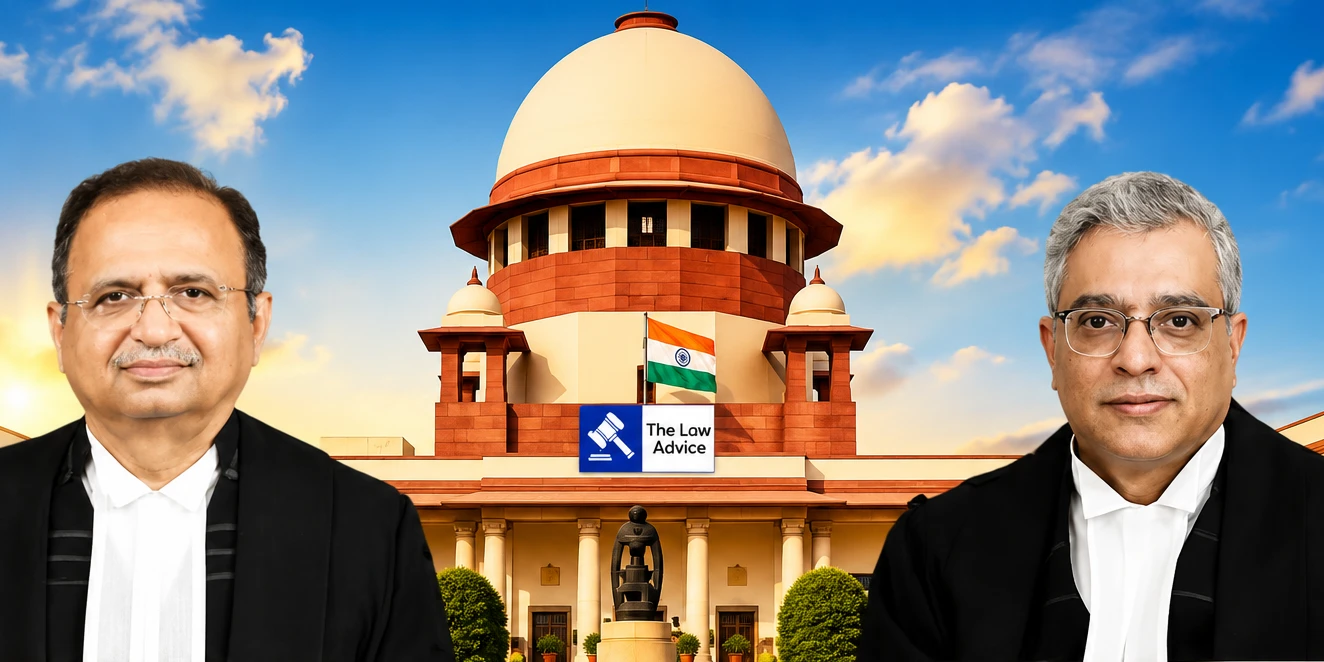
The Supreme Court has referred the issue of disqualification of candidates with more than two children to a larger Bench for reconsideration of its 2003 ruling in Javed v. State of Haryana. The Court observed that declining fertility rates and changing demographic realities have undermined the rationale behind such restrictions.# Supreme Court Refers Two-Child Norm for Panchayat Elections to Larger Bench, Says Population Control Rationale Has Crumbled
The Supreme Court on November 4 referred to a larger Bench the question of reconsidering its 2003 decision in Javed v. State of Haryana, which upheld the disqualification of candidates with more than two children from contesting Panchayat elections.
A Bench of Justice Pamidighantam Sri Narasimha and Justice Alok Aradhe observed that the demographic assumptions underlying the two-child norm have substantially changed, with India’s Total Fertility Rate (TFR) falling from approximately 3.0 in 2003 to 1.9 today—below the replacement level of 2.1.
Pasted text(20261104-144845).txt
The Court was hearing an appeal filed by Mangala Bhimrao Ingle, whose election as Sarpanch of Kakoda Gram Panchayat in Maharashtra was set aside on the ground that she had more than two children, attracting disqualification under Section 14(1)(j-1) of the Maharashtra Village Panchayats Act, 1959.
‘Laws Penalising Having More Than Two Children Have Lost Their Relevance’
The Court stated that laws penalising individuals for having more than two children have lost their relevance as the fear of overpopulation, which formed their foundation, has weakened due to demographic changes.
It noted that India’s fertility rate has fallen below replacement level, signalling a demographic transition towards an ageing population and a declining share of working-age persons. The Court cautioned that policies must respond to these changing realities.
The Bench observed that failure to adapt laws to changed circumstances can produce injustice and amount, in a sense, to an abuse of power.
Reproductive Autonomy and Political Representation
The Court also expressed concern that such restrictions exclude citizens from political representation on grounds having little rational connection with their capacity to hold public office.
It observed that the two-child norm may force individuals—particularly women—to choose between having children and participating in democratic governance, thereby impinging upon reproductive autonomy under Article 21 of the Constitution.
The judgment noted that women may be disproportionately affected by such laws because reproductive decisions are often influenced by patriarchal social structures. It also referred to instances of forced abortions, desertion of pregnant wives and denial of paternity in attempts to avoid electoral disqualification.
Larger Bench to Reconsider Javed
The Court clarified that the constitutional validity of the Maharashtra provision was not directly challenged before it and that it was not adjudicating upon the provision’s validity.
However, it held that the changed social and demographic circumstances warrant reconsideration of the precedent in Javed, which upheld similar restrictions based on the population-control rationale prevalent at the time.
The Bench directed the Registry to place the judgment before the Chief Justice of India for constitution of an appropriate larger Bench.
Meanwhile, the Court continued its interim order staying the High Court’s decision, permitting Mangala Bhimrao Ingle to continue as Sarpanch until disposal of the civil appeal.
Case Details:-

Representation:-
For the Petitioner(s): Mr. Pratik R. Bombarde, Advocate-on-Record, Mr. Devendra Singh, Advocate, Mr. Abhishek Kumar, Advocate, Mr. Ashish Bansal, Advocate.
For the Respondent(s): Ms. Rukhmini Bobde, Advocate, Mr. Siddharth Dharmadhikari, Advocate, Mr. Aaditya Aniruddha Pande, Advocate-on-Record, Mr. Shrirang B. Varma, Advocate, Mr. Vinayak Aren, Advocate, Mr. Jatin Dhamija, Advocate, Ms. Aishwarya Nigam, Advocate, Mr. Siddharth Gautam, Advocate-on-Record, Mr. Harnish R. Gadhia, Advocate, Mr. Virendra Zadokar, Advocate, Mr. Aniket Sawal, Advocate, Mr. Satyam Chauhan, Advocate, Mr. Mayur Gadhia, Advocate, Mr. Vedant Sarda, Advocate, Mr. Kartik Kamwani, Advocate.
Website designed, developed and maintained by webexy