
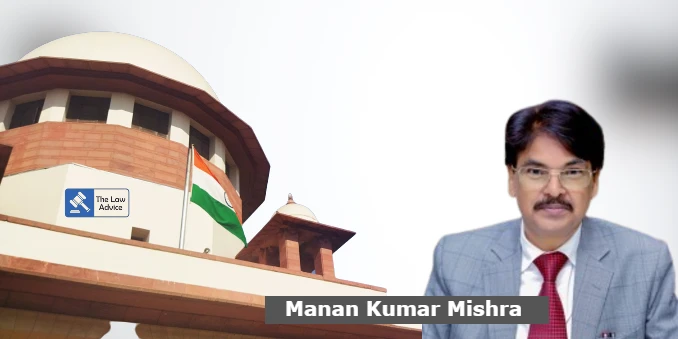
The Supreme Court on Wednesday reminded Bar Council of India (BCI) Chairman Manan Kumar Mishra that his continued position is only a pro tem arrangement until a newly elected Bar Council of India is constituted, and cannot be treated as continuation of a democratically elected tenure.
A Bench comprising Chief Justice of India Surya Kant, Justice Joymalya Bagchi and Justice V. Mohana made the observation while hearing petitions challenging the prolonged continuation of Mishra as BCI Chairman beyond the tenure contemplated under the BCI Rules.
The Court indicated that while Mishra's continuation may be permitted to ensure the day-to-day functioning of the BCI, his role in the interim arrangement cannot be equated with that of a democratically elected Chairman.
‘You Are Like a Pro Tem Chairman’
Addressing Senior Advocate Guru Krishnakumar, who appeared for the BCI, Justice Joymalya Bagchi observed that Mishra's continuation should be viewed as that of a pro tem Chairman until fresh elections to the BCI are completed.
The Court noted that the new State Bar Councils are in the process of being constituted following elections already held at the State level, after which their representatives would form the new BCI.
The Bench emphasised that the pro tem arrangement should primarily facilitate the day-to-day functioning of the institution.
AG and SG Must Be Involved in Major Policy Decisions
The Supreme Court further made it clear that significant policy decisions should not be taken by the pro tem Chairman alone.
The Court suggested that the Attorney General for India and the Solicitor General of India, who are permanent ex-officio members of the BCI under the statutory scheme, should be involved whenever matters involving significant policy implications are considered.
Justice Bagchi observed that the Attorney General and Solicitor General need not participate in the routine functioning of the BCI, but could be invited to Council meetings whenever important policy matters arise.
The Court stated that until an elected BCI is constituted, continuation under the proviso to Section 4(3) of the Advocates Act may continue for day-to-day administration, but policy decisions must involve the Attorney General.
Senior Advocates Maninder Singh and Guru Krishnakumar agreed to the Court's suggestion regarding the involvement of the AG and SG in policy decisions of the BCI.
Supreme Court Pushes for Early Constitution of New BCI
The Bench also issued directions aimed at expediting the notification of the newly elected State Bar Councils, so that their representatives can be elected to the Bar Council of India within a time-bound process.
The Court's directions are intended to facilitate the constitution of a newly elected BCI at the earliest and bring an end to the prolonged interim arrangement.
The Court also recorded the undertaking given on behalf of the BCI that the Attorney General and Solicitor General would be involved in policy decisions.
Petitions Filed Amid NALSAR Controversy
The challenge to Mishra's continuation as BCI Chairman was filed against the backdrop of the controversy involving NALSAR University of Law, where the BCI Chairman had issued directions concerning the enrolment of NALSAR graduates after objections were raised over the invitation extended to CJI Surya Kant as a guest at the university's convocation.
Mishra subsequently apologised following widespread criticism.
The Supreme Court clarified that its observations were aimed at ensuring institutional integrity and proper functioning of the BCI during the transitional period.
The petitions were argued by Senior Advocates Madhavi Divan, Chander Uday Singh, Shobha Gupta, Sanjay Hegde and Gopal Sankaranarayanan, with Shobha Gupta assisted by Advocate Deepak Prakash and AOR Sreeram Parakkat.
The matter concerns the constitution and functioning of the Bar Council of India pending the formation of its newly elected body.
Website designed, developed and maintained by webexy