
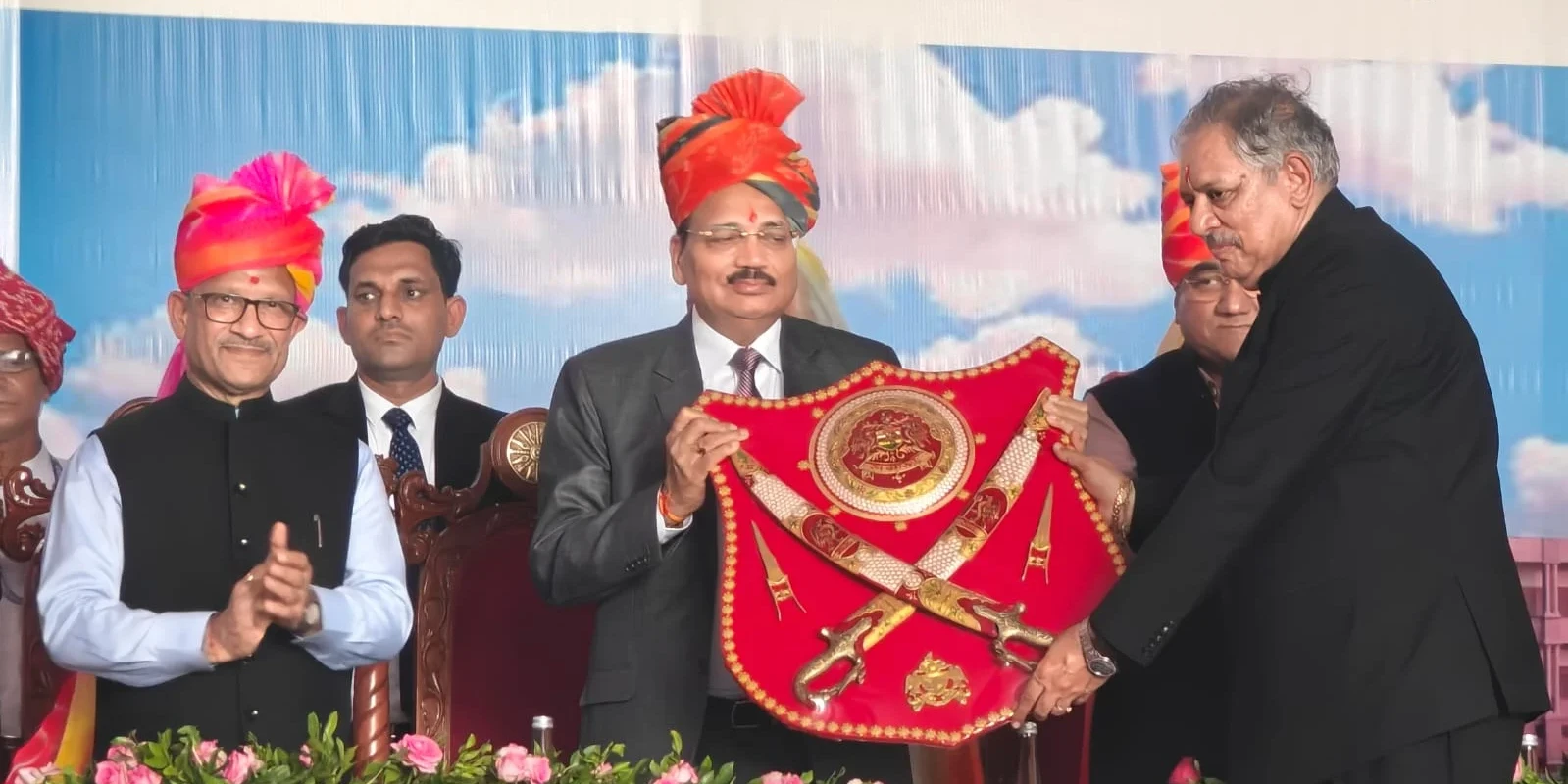
Chief Justice of India Justice Surya Kant called for a fundamental change in the way courts and all stakeholders in the justice delivery system interact with litigants, emphasizing that courts should be as sensitive and reassuring as hospitals.
Justice Surya Kant made the remarks during the inauguration of the new seven-storey G-7 District Court building in Jodhpur and a felicitation ceremony organized in his honour by the Rajasthan High Court Advocates Association and the Rajasthan High Court Lawyers Association, Jodhpur. The event was attended by several Supreme Court judges, senior judges of the Rajasthan High Court, judicial officers and a large number of advocates.
Addressing the gathering, CJI Justice Surya Kant stressed the need to make the justice system more humane and sensitive. Drawing an analogy with hospitals, he said that when a patient enters a hospital, the person is often anxious about their illness and future. A reassuring conversation with doctors, nurses or paramedical staff can significantly reduce that fear.
According to the CJI, a person approaching a court for justice is in a similar psychological state. Litigants are often worried about their rights, their problems and what the outcome of the proceedings may mean for their future.
He emphasized that simple but important facilities can make a substantial difference to a litigant's experience. Adequate seating, drinking water and clean washrooms, coupled with a lawyer properly explaining the person's rights and the status of the case, can considerably reduce the mental burden on litigants.
Justice Surya Kant underlined that a litigant should not be viewed merely as a case number. Every person entering a courtroom brings an individual problem, personal suffering and hope for justice. Consequently, judicial officers, lawyers and everyone associated with the justice system should maintain a respectful, empathetic and humane approach.
The CJI also highlighted the importance of judicial infrastructure, saying that it should not be regarded merely as an additional facility but as a fundamental requirement for an effective justice delivery system.
He said that a scientific assessment is being undertaken to determine judicial infrastructure requirements across the country, from district courts to High Courts. The findings of the study will be placed before the Central and State Governments so that future infrastructure requirements can be appropriately addressed.
Justice Surya Kant particularly stressed the need for adequate chambers, libraries and other facilities for first-generation lawyers and young advocates. Such infrastructure, he said, is important to ensure that lawyers without a family background in the profession also receive a fair opportunity to establish themselves and progress in the legal profession.
Supreme Court Justice Sandeep Mehta, while addressing the inauguration and felicitation ceremony, highlighted the importance of putting completed judicial infrastructure to immediate use.
Referring to the new court building, Justice Mehta expressed concern that although the infrastructure had been completed, it remained unused for nearly a year. He observed that keeping completed public infrastructure unused amounts to wastage of public resources and also increases the possibility of the building deteriorating over time.
He advocated the redevelopment of the existing district court building into a modern, digital and multi-storey complex, expressing hope that Jodhpur's judicial infrastructure would receive another state-of-the-art facility in the future.
Supreme Court Justice Vijay Bishnoi said that the new building would help address several practical problems confronting Jodhpur's judicial system.
He pointed out that around 15 courts in Jodhpur were functioning from rented premises, where inadequate space and parking facilities were causing difficulties for judicial officers, advocates and litigants. The new building is expected to help consolidate courts within a single campus and improve the overall functioning of the judicial system.
Justice Bishnoi also highlighted the importance of technology in the new G-7 building and said that its modern facilities would benefit advocates, judicial officers and litigants.
Attorney General for India R. Venkataramani emphasized the responsibility of members of the Bar in strengthening the legal profession and its ethical foundations.
He said that the role of advocates goes beyond merely practising law. Lawyers also have an important responsibility to uphold and strengthen ethical values within the profession. According to him, prioritising professional ethics would strengthen legal and judicial institutions while also providing proper direction to the next generation of lawyers.
The Attorney General also spoke about India's linguistic diversity and observed that the country's 22 languages represent a rich heritage. He highlighted the importance of diversity and inclusion in Indian legal education and recalled the contribution of his law teacher, Professor Mahajan, who had envisaged a national-level law school much before the establishment of several National Law Universities across the country.
He further expressed his intention to initiate an endowment in Rajasthan in memory of Professor Mahajan.
Acting Chief Justice of the Rajasthan High Court Justice Sanjeev Prakash Sharma praised the distinguished judicial legacy of the Jodhpur High Court Bar.
He noted that six members associated with the two Bar associations have gone on to become judges of the Supreme Court, while 46 members have served as judges of the Rajasthan High Court. He described this record as evidence of the strong judicial tradition and legacy of the two Bar associations.
Justice Sharma also urged advocates to continuously develop their technological capabilities and prepare themselves for emerging challenges in the legal profession. He emphasized that effective use of technology could open new opportunities and responsibilities for lawyers.
Law Commission of India Chairman Justice Dinesh Maheshwari recalled his longstanding association with Jodhpur, saying that he had witnessed the development of the complex since 1980-81.
He observed that the High Court campus had initially expanded horizontally but had now witnessed vertical expansion through the seven-storey building. He described the new facility as an important milestone in the development of the justice delivery system.
Justice Maheshwari also praised Jodhpur's tradition of hospitality and warmth, saying that despite changes in the physical infrastructure and judicial arrangements over the decades, the city's welcoming character remained unchanged.
Senior Judge Justice P.S. Bhati identified three key areas that would shape the future of the justice system—technology, women's empowerment and mediation/Alternative Dispute Resolution (ADR).
He said the judiciary should not remain a passive observer of technological change but should proactively embrace technology. At the same time, he cautioned that Artificial Intelligence should be used as an assistive tool and that the legal system must remain alert to risks such as fabricated citations, deepfakes and other forms of misuse.
Justice Bhati also highlighted the increasing participation of women in Rajasthan's judiciary and called for greater opportunities and leadership roles for women advocates at the Bar.
He further emphasized the need to strengthen mediation and ADR mechanisms, observing that the Rajasthan High Court was playing a leading role in this field. With coordinated efforts by the judiciary, Bar and other stakeholders, he said, Rajasthan could establish a stronger national and international identity in ADR.
During the felicitation ceremony, CJI Justice Surya Kant was honoured with a traditional Rajasthani safa, symbolising the state's cultural pride and heritage.
He was also presented with a special Rajasthani memento. Acting Chief Justice Justice Sanjeev Prakash Sharma presented the symbolic memento to the CJI, while Rajasthan High Court Advocates Association President Ranjit Joshi honoured him by presenting the traditional safa.
The ceremony brought together several prominent figures from the Indian judicial system, including Supreme Court Justices Sandeep Mehta and Vijay Bishnoi, Law Commission Chairman Justice Dinesh Maheshwari, Rajasthan High Court Acting Chief Justice Sanjeev Prakash Sharma and Justice Pushpendra Singh Bhati, among others.
Rajasthan High Court Advocates Association President Ranjit Joshi described the CJI's visit to Jodhpur as a matter of pride for the judicial community. He termed the inauguration of the new seven-storey G-7 District Court building a significant achievement and urged that courts currently functioning from rented premises be shifted to the new facility to provide better and modern facilities for judicial work.
Joshi also called for greater representation of women advocates in the justice system and stressed the need to strengthen the Legal Aid Defense Counsel System so that persons in need can receive effective legal assistance.
He concluded by emphasizing the importance of coordination between the Bar and the Bench, describing them as the “two wheels” of the justice system whose effective coordination is essential for strengthening the administration of justice.
The Jodhpur event thus brought together several interconnected themes concerning the future of India's justice delivery system: greater sensitivity towards litigants, modern judicial infrastructure, ethical legal practice, technological advancement, women's participation and stronger ADR mechanisms.
The CJI's emphasis on treating litigants with empathy, alongside the broader call for modern infrastructure and professional reforms, underlined the need for a justice system that is not only efficient and technologically equipped but also accessible, respectful and responsive to the human concerns of those who approach the courts seeking justice.
Website designed, developed and maintained by webexy