
The Supreme Court has ruled that a court cannot pass a decree under Order XII Rule 6 of the Code of Civil Procedure merely on the basis of an admission unless the admission is clear, categorical, unconditional and unequivocal. The Court restored the trial court's order and set aside a Delhi High Court judgment that had awarded nearly ₹45 lakh to a family member on the basis of an alleged admission in a written statement.
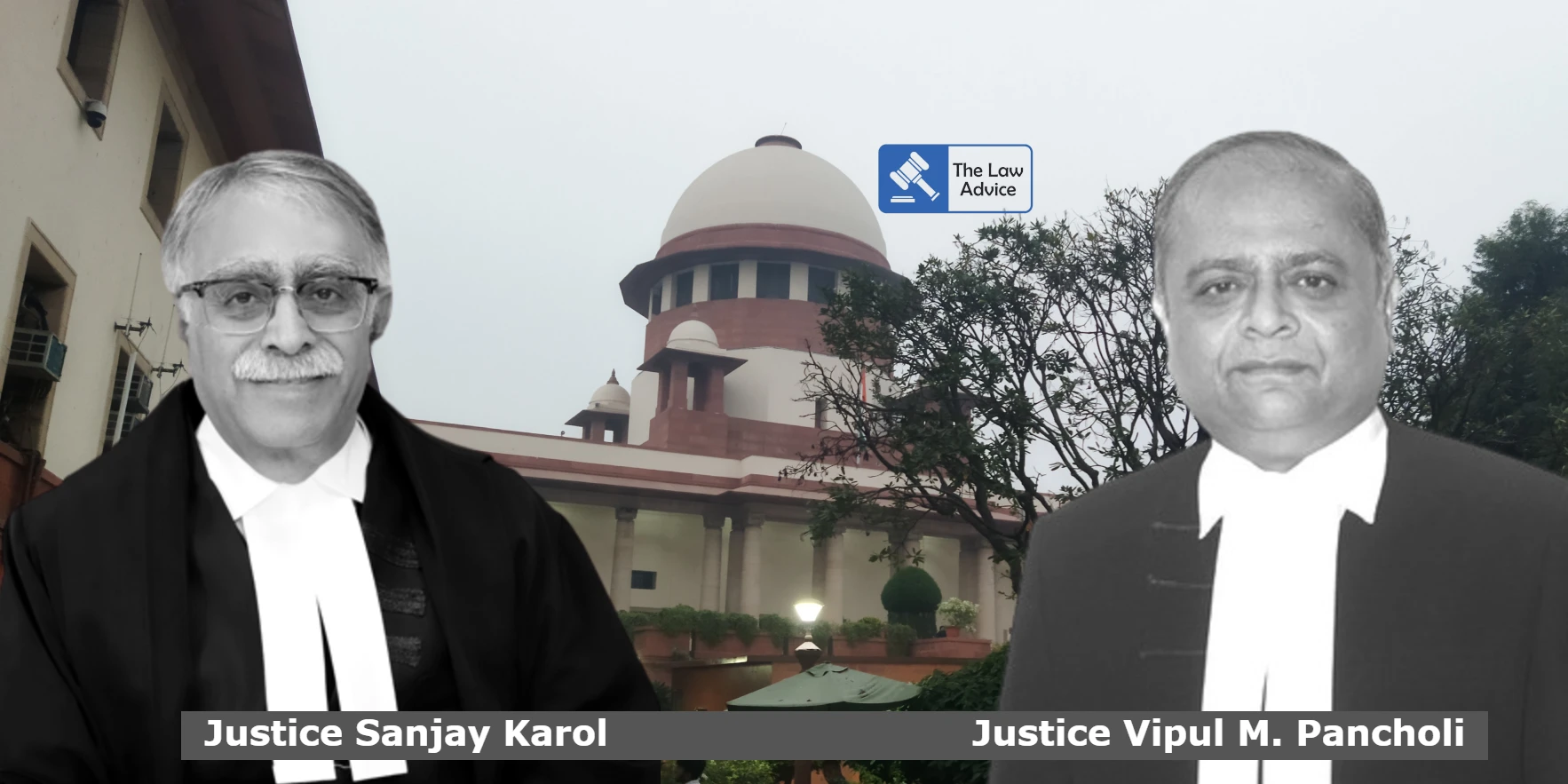
A Bench of Justice Sanjay Karol and Justice Vipul M. Pancholi delivered the judgment in Pushpa & Ors. v. Dayawati & Ors.
The dispute arose from the sale of ancestral agricultural land in 2007 for over ₹15 crore. Following the sale, family members became embroiled in litigation over the distribution of sale proceeds and partition of family properties.
Respondent Dayawati had filed a suit seeking recovery of ₹45 lakh along with partition and other reliefs. She later moved an application under Order XII Rule 6 CPC, claiming that one of the defendants had admitted in his written statement that he received ₹3 crore from the sale proceeds. According to her, after the determination of shares in the partition proceedings, the defendant had received approximately ₹44.79 lakh more than his lawful entitlement and was therefore liable to refund the excess amount.
The trial court rejected the application, holding that the matter involved disputed questions of fact requiring evidence. However, the Delhi High Court reversed that decision and decreed recovery of ₹44.79 lakh with interest on the basis of the alleged admission.
The Supreme Court disagreed with the High Court and held that the statement relied upon by the plaintiff did not amount to an unequivocal admission of liability.
The Court observed that the statement was made in the context of a family settlement and merely acknowledged receipt of certain amounts and properties. It did not contain any admission that the recipient had received more than his lawful share or that he owed any money to the plaintiff.
The Bench emphasized that pleadings must be read as a whole and cannot be interpreted in a piecemeal manner by isolating a single sentence.
According to the Court, the defendant had consistently disputed the plaintiff's claim and asserted that he had received only his share under the family arrangement. Therefore, the alleged admission required interpretation and could not form the sole basis for a decree without trial.
The Court reiterated that:
A decree on admission is an exception to the normal rule of adjudication after trial.
Admissions must be clear, categorical, unconditional and unequivocal.
If the admission requires interpretation or examination of surrounding circumstances, the matter must proceed to trial.
Courts should exercise caution because a decree on admission deprives a party of the opportunity to lead evidence and contest the claim on merits.
The Bench also noted that the High Court itself had earlier framed issues for trial, indicating the existence of substantial disputed questions of fact. Once triable issues were identified, it was inappropriate to bypass the evidentiary process and grant a decree on admission.
The Supreme Court further held that the High Court exceeded the limits of its revisional jurisdiction under Section 115 CPC by reassessing factual issues and substituting its own interpretation of the pleadings.
The Court observed that a revisional court cannot function as an appellate court unless there is a jurisdictional error or material irregularity in the trial court's order.
Allowing the appeal, the Supreme Court:
Set aside the Delhi High Court's judgment dated April 16, 2019.
Restored the trial court's order rejecting the application under Order XII Rule 6 CPC.
Directed that the underlying suit be decided independently on the basis of evidence without being influenced by observations made in the judgment.
The ruling reinforces the principle that courts should not grant decrees on admission unless the admission leaves absolutely no room for doubt or factual controversy.
Case Title: Pushpa & Ors. v. Dayawati & Ors.
Citation: 2026 INSC 603
Decision Date: May 29, 2026

Representation:-
For Petitioner(s) :Mr. Rakesh Kumar-i, AOR, Mr. Harshit Shrama, Adv., Mr. Ujjwal Kumar Priyadashi, Adv.
For Respondent(s) :Mr. Anand Yadav, Adv., Mr. Pradyumn Rao, Adv., Mr. Chander Shekhar Ashri, AOR
Website designed, developed and maintained by webexy