
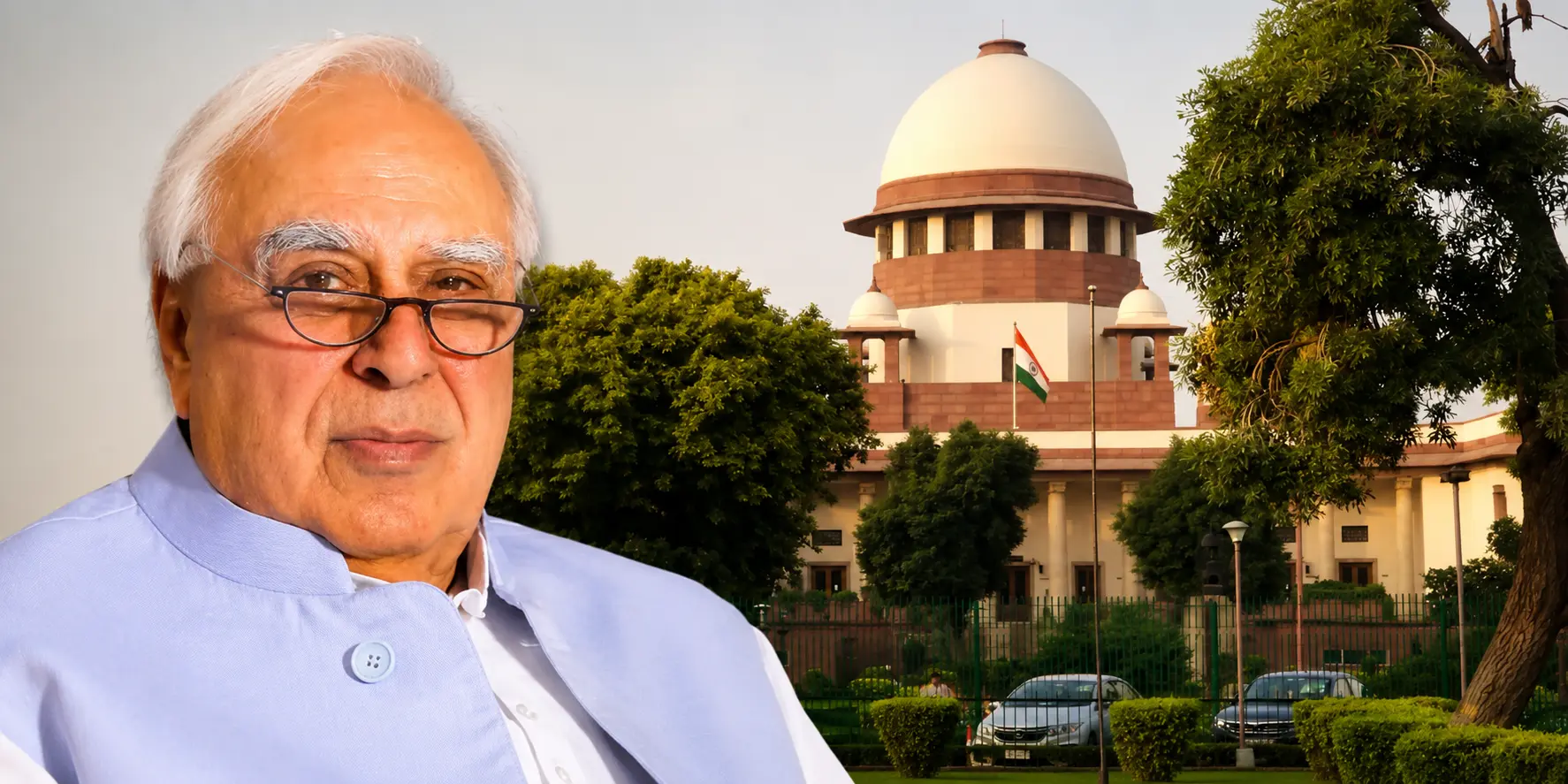
The Supreme Court on Monday issued notice to the Union Government on a writ petition filed by Senior Advocate Kapil Sibal, appearing as a party-in-person, challenging the prevailing interpretation of the Tenth Schedule to the Constitution, which permits legislators to avoid disqualification under the anti-defection law by claiming protection through political party mergers.
A Bench comprising Justice P.S. Narasimha and Justice Alok Aradhe heard the matter briefly before directing notice to the Centre.
At the outset, Justice Narasimha questioned the maintainability of the petition under Article 32 of the Constitution, asking why the extraordinary writ jurisdiction of the Supreme Court had been invoked directly.
Responding to the Bench, Sibal argued that the issue has far-reaching constitutional and democratic consequences. He submitted that the current interpretation of the merger provision under Paragraph 4 of the Tenth Schedule enables elected representatives to alter the mandate of the electorate after elections.
"Electoral verdict can be changed through this process. A majority can become minority and a minority can become majority," Sibal told the Court while referring to political developments, including matters arising from Goa.
While issuing notice, Justice Narasimha expressed reservations regarding judicial intervention in what he described as issues primarily concerning the functioning of legislatures.
According to the Bench, disputes concerning the operation of the Tenth Schedule are ordinarily matters to be addressed on the floor of the House or through political processes.
Justice Narasimha observed that the Tenth Schedule was enacted to regulate relationships among legislators and acknowledged that its implementation has generated "enormous issues" over the years.
Sibal, however, countered that those in power would have little incentive to reform the law themselves, making judicial scrutiny essential.
The petition challenges the constitutional interpretation of Paragraph 4 of the Tenth Schedule, which grants protection from disqualification where legislators claim that their party has merged with another political party.
According to Sibal, this provision has increasingly been used by splinter groups to engineer defections under the guise of mergers, thereby defeating the very purpose of the anti-defection law. He contends that the present interpretation has created a loophole that enables legislators to evade disqualification despite abandoning the political mandate on which they were elected.
Sibal informed the Court that several related matters are already pending before the Supreme Court.
He referred to the petition filed by Shiv Sena (Uddhav Balasaheb Thackeray) challenging the Lok Sabha Speaker's decision recognizing the merger of certain party MPs with the Shinde Sena, a matter that is also listed before Justice Narasimha's Bench.
The petition has also been filed against the backdrop of recent instances in which legislators belonging to the Aam Aadmi Party, Trinamool Congress, and Shiv Sena (UBT) have joined other political parties through merger claims.
Additionally, the Supreme Court is already seized of a petition filed by the Congress challenging the Bombay High Court's Goa Bench ruling that held a legislative wing could validly merge with another political party without requiring approval of the original political party.
Case: Kapil Sibal v. Union of India
Diary No.: 42846/2026.
Website designed, developed and maintained by webexy