
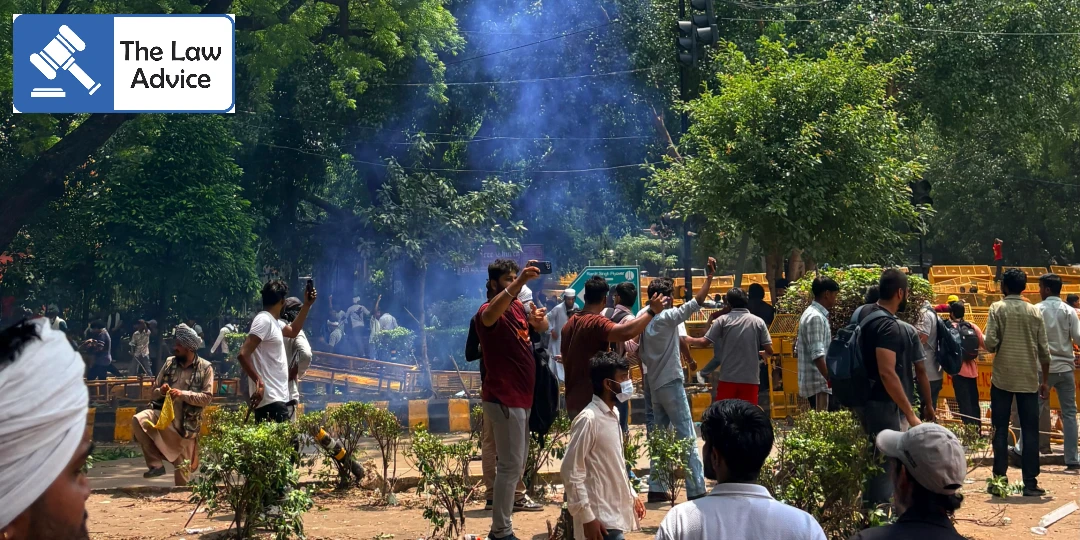
The Supreme Court on Monday observed that the right to hold peaceful protests is fully protected under the law and said that police excesses during such demonstrations cannot be justified merely because people are agitating.
A Bench comprising Chief Justice of India (CJI) Surya Kant, Justice Joymalya Bagchi and Justice V. Mohana made the oral observations while hearing petitions seeking nationwide guidelines to ensure peaceful protests are conducted without unnecessary restrictions or use of force.
"Right to peaceful protest is absolutely guaranteed. That cannot be denied. Merely because there is agitation cannot justify police excess," CJI Surya Kant remarked.
The Chief Justice also stressed the need for discipline from all sides during protests, saying that democratic movements should remain peaceful.
"Just because there is an agitation does not mean there should be a lathi charge. Self-evolved discipline is needed, which is essential to the democratic process," he observed.
The petitions were filed following allegations of police action against protesters at Delhi's Jantar Mantar and during demonstrations in Bihar.
Appearing for one of the petitioners, Advocate Fauzia Shakil told the Court that security forces had allegedly used AK-47 rifles during the Bihar Bandh protests in Siwan.
"AK-47 was used yesterday," she submitted.
Senior Advocate Vikas Singh also highlighted alleged attacks on students during the Bihar protests and urged the Court to frame uniform guidelines applicable across the country.
"Bihar also had a lot of attacks on students. An all-India order is needed," Singh argued.
During the hearing, another lawyer pointed out that police personnel had also suffered injuries during protests.
"My Lords, police officers were lynched. We also need to be heard," he said.
Justice Joymalya Bagchi responded that every life deserves equal protection.
"Life of every individual, irrespective of who they are, is important," he observed.
The Chief Justice further noted that there should be a proper protocol for handling protests, including designated spaces where people can demonstrate peacefully. He added that while anti-social elements can be dealt with separately, the absence of a uniform policy creates unnecessary problems.
"There should be a protocol in place. There should be proper space and no restriction. If there are anti-social elements, they can be dealt with. This is not a question of Delhi alone. Uniformity of protocol is needed," the CJI said.
Solicitor General Tushar Mehta informed the Court that the Centre would assist the Bench impartially.
"We will assist the Court dispassionately," Mehta said.
The Bench directed that all petitions concerning the issue be taken up together on Tuesday, July 28.
The petitions arise in the backdrop of recent protests at Delhi's Jantar Mantar and in Bihar. The Jantar Mantar demonstrations began in June over repeated examination paper leaks and demanded the resignation of then Education Minister Dharmendra Pradhan.
The protests intensified after climate activist Sonam Wangchuk joined a hunger strike in support of the movement. He was later shifted to a hospital by Delhi Police due to health concerns and ended his 26-day fast on July 23.
Tensions escalated during the "Sansad Chalo" march on July 20, when clashes broke out between protesters and police. Allegations of lathi-charge, tear gas and excessive use of force against student protesters followed.
After Dharmendra Pradhan resigned on July 25, the Jantar Mantar protest was called off. Similar protests and allegations of police excess have also been reported from Bihar, prompting the Supreme Court to examine whether uniform national guidelines are required for managing peaceful demonstrations while safeguarding both protesters and law enforcement personnel.
Website designed, developed and maintained by webexy