
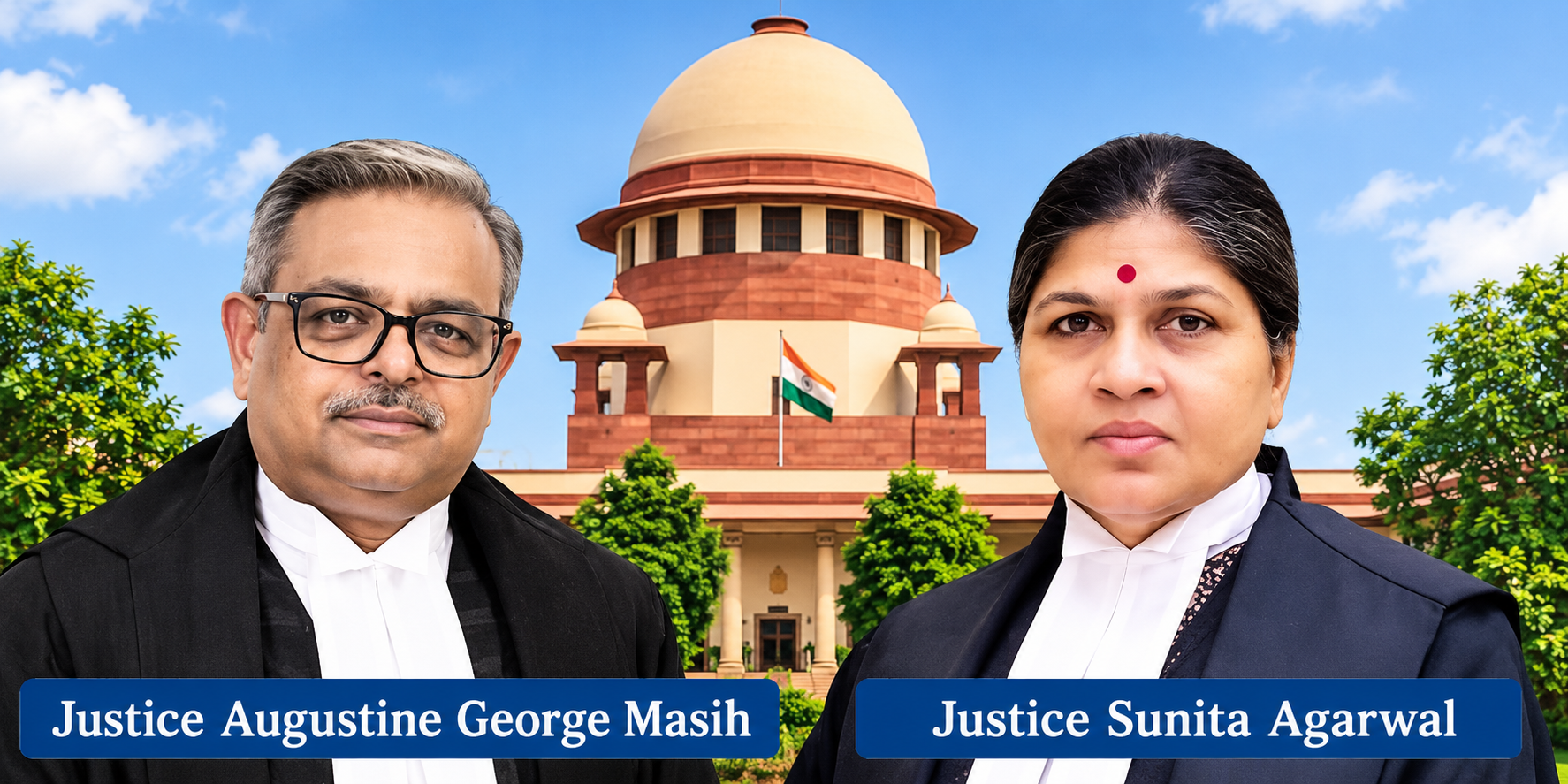
The Supreme Court has held that a grandson cannot claim a birthright in property allotted to his father following the partition of his grandfather's estate, if the property devolved upon the father under Section 8 of the Hindu Succession Act, 1956.
The Court clarified that property inherited by a Hindu male under Section 8 is his individual property and does not automatically become ancestral or joint family property in the hands of his son.
A Bench of Justice Augustine George Masih and Justice Sunita Agarwal dismissed an appeal filed by a son seeking a half share in a property allotted to his father during the partition of his grandfather's estate. The father had subsequently sold the property to two purchasers.
The dispute arose from a suit filed in 1997 by a minor son, represented by his mother as natural guardian, seeking partition and possession of half the share in a plot measuring 1,811 sq. ft. He claimed that the property originally belonged to his grandfather and had passed on to his father and subsequently to him as joint family property.
Earlier, the grandfather's daughter had filed a partition suit, which was settled through a compromise decree in 1994. Under the settlement, the appellant's father was allotted the disputed property. He subsequently sold it to two purchasers through sale deeds executed in 1997.
The City Civil Court in Chennai initially passed a preliminary decree granting partition. However, the First Appellate Court set aside the decree, holding that property inherited by a son under Section 8 of the Hindu Succession Act becomes his absolute property and his own son does not acquire any right in it by birth.
The Madras High Court upheld this decision, following which the son approached the Supreme Court.
Grandson Cannot Claim Birthright In Father's Inherited Property
Before the Supreme Court, the appellant argued that the compromise decree did not convert his father's share into self-acquired property and that his father continued to hold it as the Karta of a coparcenary.
He also relied on Section 29A of the Hindu Succession (Tamil Nadu Amendment) Act, 1989, to claim coparcenary rights in the property.
The appellant further argued that the purchasers could not acquire a better title than his father and that the sale could not be justified without establishing legal necessity. He relied on the Supreme Court's decisions in Rohit Chauhan v. Surinder Singh and Arshnoor Singh v. Harpal Kaur.
Opposing the appeal, the respondents submitted that the property had devolved upon the grandfather's Class I legal heirs under Section 8 of the Hindu Succession Act. Therefore, each heir had become the exclusive owner of the share allotted to them.
Agreeing with the respondents, the Bench relied on the Supreme Court's decision in CWT v. Chander Sen, which held that property inherited by a son under Section 8 is received in his individual capacity and does not automatically become joint family property.
The Court also referred to Bhanwar Singh v. Puran and Radha Bai v. Ram Narayan while examining the law relating to succession and coparcenary rights.
The Bench observed that a grandson is not included as a Class I heir under the Hindu Succession Act when his father is alive and inherits the property.
*“A son's son is not mentioned as an heir under Class I of the Schedule, and, therefore he
Website designed, developed and maintained by webexy