
In a significant judgment, the Supreme Court has ruled that a municipal authority cannot ordinarily be held liable under the Motor Vehicles Act merely because a roadside tree branch falls on a stationary vehicle during heavy rain. However, invoking its extraordinary powers under Article 142 of the Constitution, the Court enhanced the compensation payable to the injured victim from ₹17.10 lakh to ₹25 lakh.
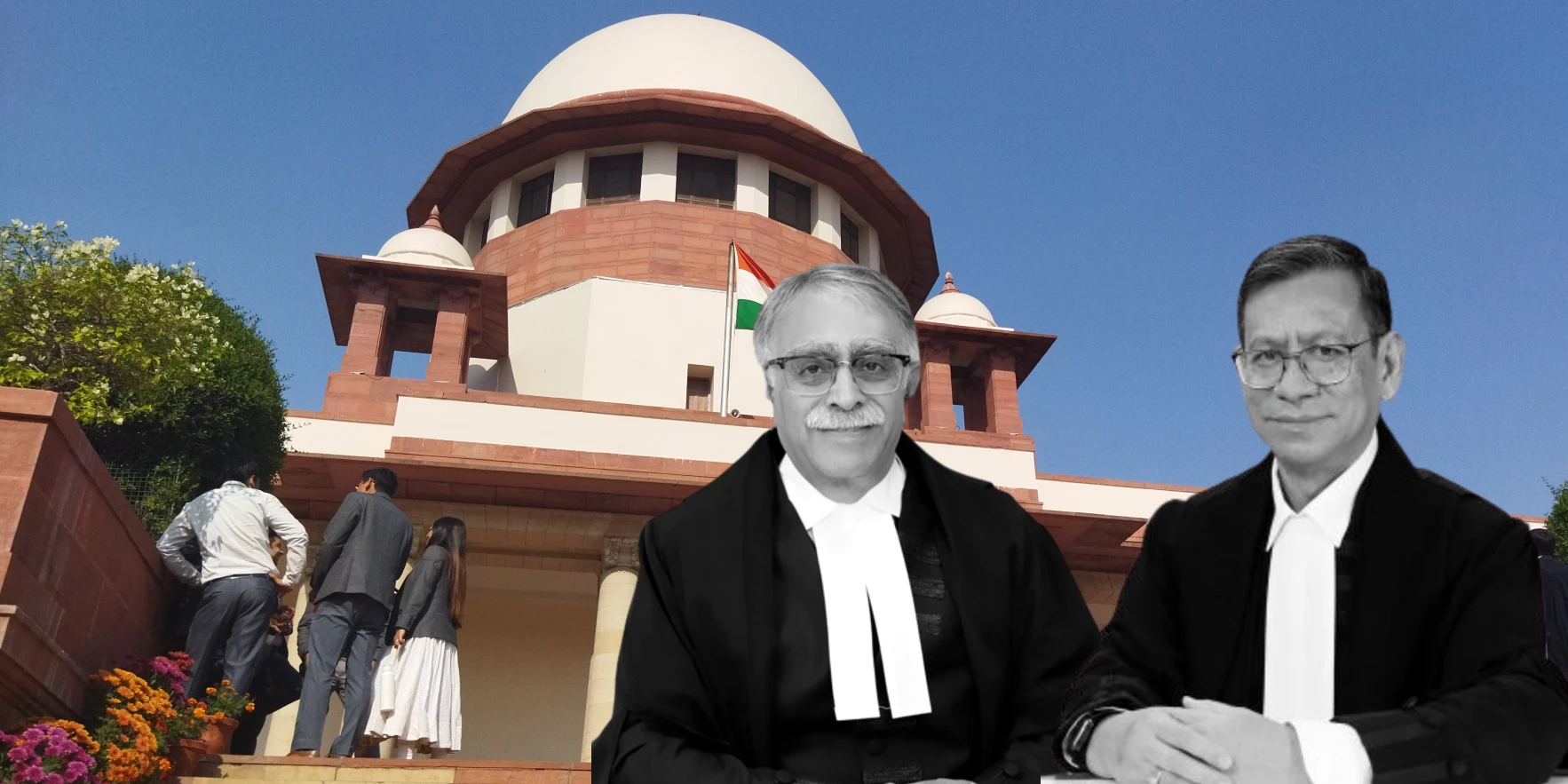
The judgment was delivered by a Bench of Justices Sanjay Karol and Nongmeikapam Kotiswar Singh in The Commissioner, Bruhat Bangalore Mahanagara Palike v. K.K. Umesh Kumar & Ors.
The case arose from an unfortunate incident on June 23, 2007. K.K. Umesh Kumar was travelling in an autorickshaw in Bengaluru when heavy rain forced the vehicle to stop beneath a roadside tree near Chinnaswamy Stadium. While waiting for the rain to subside, a branch from the tree suddenly broke off and fell on the autorickshaw, causing severe injuries to Kumar.
The victim was rushed to Mallya Hospital, where he underwent treatment. Subsequently, he filed a compensation claim of ₹50 lakh before the Motor Accident Claims Tribunal (MACT).
Initially, the Tribunal dismissed the claim, treating the incident as a natural calamity. The Karnataka High Court also dismissed the claim on the ground of delay. However, the Supreme Court later remanded the matter, leading to a fresh consideration by the High Court.
In the second round of litigation, the High Court awarded compensation of ₹17.10 lakh and apportioned liability as follows:
50% to the autorickshaw's insurer;
25% to the Bruhat Bengaluru Mahanagara Palike (BBMP);
25% to the Horticulture Department of Karnataka.
BBMP challenged the finding before the Supreme Court.
The Court extensively discussed the legal doctrine of "Act of God" (Vis Major), referring to English and Indian precedents.
It observed that municipal authorities undoubtedly have a duty to maintain roadside trees and ensure public safety. However, the Court cautioned against imposing unrealistic expectations on civic bodies to constantly monitor every tree in a growing city.
The Bench noted that while old branches may occasionally fall, it would be impractical to expect authorities to remove every potentially weak branch merely as a precaution.
According to the Court, the incident resulted from a natural occurrence during heavy rainfall and was not something that could reasonably have been anticipated or prevented.
It answered the Question as under:-
"In view of the stated liberal interpretation of this term, will the presence of the respondent in the auto rickshaw suffice as ‘use’. In ordinary circumstances, it probably would have. But take for instance a scenario where the respondent was a pedestrian and stood near or under the tree in an attempt to take shelter from the heavy rain and now the branch falls on him. This is an entirely likely scenario. In other words, the motor vehicle itself does not play an active role in the accident. It is not part of the proximate-cause of the accident. For that reason, a claim under Section 166 specifically may not be appropriate."
A key legal question before the Court was whether the accident could be treated as one "arising out of the use of a motor vehicle" under Sections 165 and 166 of the Motor Vehicles Act.
The Court held that although the victim happened to be sitting inside an autorickshaw, the vehicle itself played no active role in causing the injury.
The Bench explained that if the victim had been standing under the same tree as a pedestrian and suffered identical injuries, the accident would have occurred in exactly the same manner.
Therefore, the falling tree branch was not sufficiently connected to the use of the motor vehicle to justify a claim under the Motor Vehicles Act.
Despite holding that fastening liability under the Motor Vehicles Act was legally problematic, the Supreme Court was unwilling to leave the injured victim without adequate compensation after nearly two decades of litigation.
The Court took note of the devastating injuries suffered by Kumar, including:
Total paraplegia of both lower limbs;
Permanent bladder and bowel incontinence.
Observing that justice must remain humane and practical, the Court invoked its powers under Article 142 of the Constitution to do complete justice.
The Bench found that the compensation awarded by the High Court was inadequate considering the severity of the injuries and enhanced the total compensation to ₹25 lakh, along with applicable interest from the date of filing of the claim petition.
While increasing the compensation amount, the Court chose not to disturb the High Court's apportionment of liability.
Accordingly:
50% will be paid by the insurer of the autorickshaw;
25% by BBMP;
25% by the Karnataka Horticulture Department.
The Court directed all parties to deposit the compensation amount within four weeks.
The ruling clarifies that not every injury suffered inside a vehicle automatically qualifies as a motor accident claim. The Court drew an important distinction between accidents involving the actual use of a vehicle and accidents where the vehicle is merely the location where an unrelated event occurs.
At the same time, the judgment demonstrates the Supreme Court's willingness to invoke Article 142 to ensure substantive justice in exceptional cases where strict application of legal principles may produce an inequitable outcome.
Case Details:- 2026 INSC 638
SPECIAL LEAVE PETITION (CIVIL) NOS.18701-18702 OF 2024
SHEETAL VASANT THAKUR ...APPELLANT(S)
VERSUS
CHIRAG ARORA …RESPONDENT(S)

Representation:-
For Appellant(s):- M/S. Nuli & Nuli, AOR, Mr. Anand Sanjay M. Nuli, Sr. Adv., Mr. Suraj Kaushik, Adv., Mr. Nanda Kumar K. B., Adv., Mr. Dharm Singh, Adv., Ms. Akhila Wali, Adv., Mr. Abhishek Kanyalur, Adv., Ms. Divya Sinha, Adv., Mr. Ashritsai Torgal, Adv., Ms. Tanya Chillar, Adv.
For Respondent(s):- Ms. Shweta Garg, AOR, Mr. Ashish Gopal Garg, D.A.G., Mr. Rakesh Garg, Adv., Mr. Pankaj Seth, Adv., Ms. Manjeet Chawla, AOR, Ms. Jyoti, Adv., Ms. Shruti Jain, Adv., Ms. Patil Rekha Chandra Gouda, AOR, Mr. Jadhav Vishal
Website designed, developed and maintained by webexy