
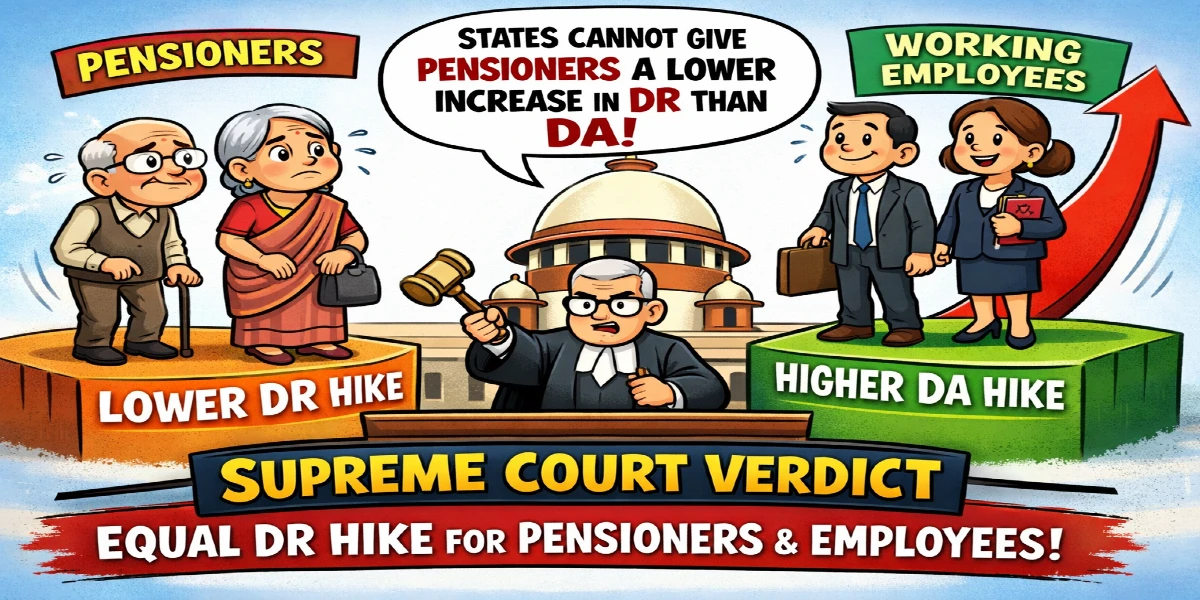
The Supreme Court has said that States cannot give pensioners a lower increase in Dearness Relief (DR) than the Dearness Allowance (DA given to working employees.
A Bench of Justice Manoj Misra and Justice Prasanna B Varale held that such a difference is unfair and violates Article 14 of the Constitution, which guarantees equality.
The Court explained that both DA and DR are meant to help people deal with rising prices and inflation. Since inflation affects both employees and pensioners in the same way, there is no valid reason to treat them differently.
Case Brief:
The case came from Kerala, where employees of the Kerala State Road Transport Corporation (KSRTC) were given a 14% increase in DA, while pensioners were given only an 11% increase in DR.
The State government challenged a High Court decision that had ruled in favour of pensioners. It argued that employees and pensioners are different groups, so giving them different benefits does not violate equality. KSRTC also said it was facing financial problems, which is why pensioners were given a lower increase.
However, the Supreme Court did not agree.
The judges said that while employees and pensioners are different groups, this difference has nothing to do with inflation. Since both DA and DR are meant to reduce the impact of rising costs, giving different rates is not justified.
The Court also made it clear that financial difficulties may be a reason to delay payments, but cannot be used to give pensioners less than employees.
In the end, the Supreme Court dismissed the appeals filed by the State and KSRTC, and upheld the High Court’s decision in favour of pensioners
Website designed, developed and maintained by webexy