
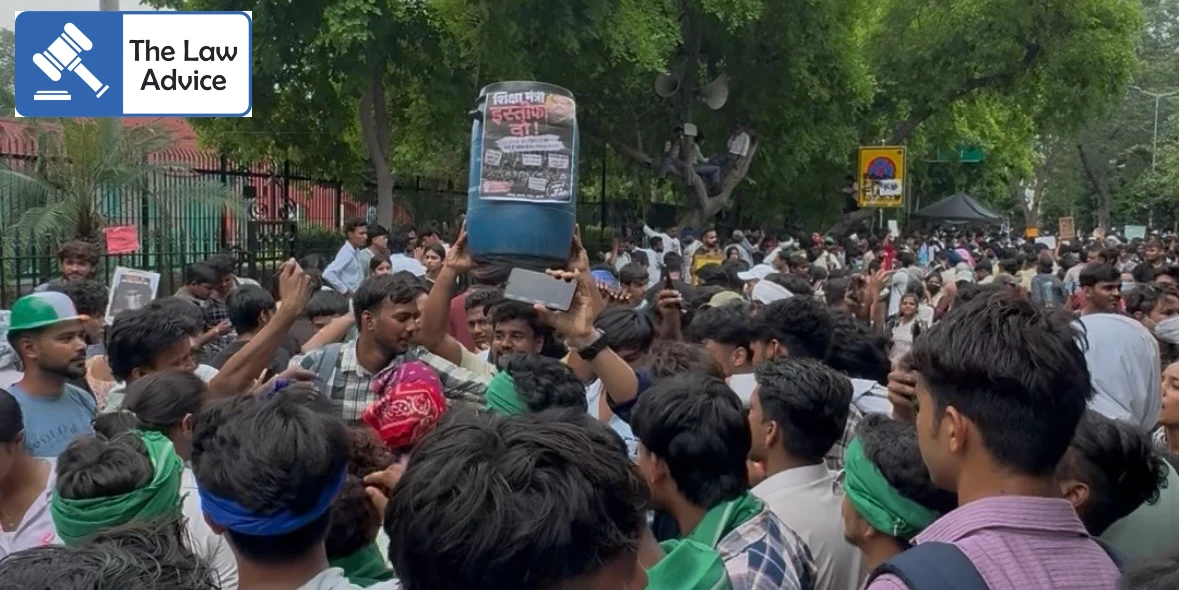
An IIT Patna student who claims she was injured during the police action at the July 20 'Sansad Chalo' protest in New Delhi has approached the Supreme Court, seeking a uniform protocol for crowd control and mandatory identification of police personnel deployed during protests.
The intervention application, filed through Advocate Neha Rathi, has been moved by Toshiwa Yadav in the pending case Himanshu v. Union of India & Ors. The plea seeks to assist the Court in deciding issues related to the alleged excessive use of force against students protesting over the NEET-UG 2026 controversy.
According to the application, Yadav participated in the July 20 protest at Jantar Mantar, where demonstrators were marching towards Parliament demanding the resignation of the Union Education Minister. She alleges that while returning from the protest, she was assaulted by police personnel who were in uniform but were not wearing name plates or identification badges. She claims she suffered a deep head injury that required immediate medical treatment and stitches.
The plea alleges that the police used arbitrary, excessive and disproportionate force against peaceful protesters, resulting in multiple injuries. It claims students were repeatedly lathi-charged, several sustained serious injuries, and some even lost consciousness.
It further raises concerns over the alleged participation of unidentified individuals and police personnel without visible identification in the use of force, arguing that such actions undermine transparency and accountability. The applicant has sought an independent inquiry to identify every person involved in the alleged assault and determine their authority and role.
The application also refers to allegations that police used lathis fitted with nails, electrified barricades, pellet guns and shock batons during the protest. It further cites reports claiming that women protesters were assaulted, including on private parts, and that an Additional Deputy Commissioner of Police slapped a woman bystander during the demonstration.
Arguing that the right to peaceful protest is protected under Articles 19(1)(a) and 19(1)(b) of the Constitution, the plea submits that police action must satisfy the constitutional tests of legality, necessity, reasonableness and proportionality. It also contends that powers under Sections 148 to 151 of the Bharatiya Nagarik Suraksha Sanhita (BNSS), 2023, relating to dispersal of assemblies, cannot be exercised arbitrarily or through excessive force.
To prevent similar incidents in the future, the applicant has proposed several safeguards, including:
The Supreme Court had last week sought responses from the Union Government, the Delhi Government and several State Governments on petitions challenging the police action against student protesters. It also directed that no coercive action be taken against the students and ordered the preservation of CCTV footage and official records. The matter is scheduled for hearing on August 3.
The Court is also hearing a separate petition filed by persons who allegedly suffered pellet gun injuries during the July 20 protest.
Case Title: IA in Himanshu v. Union of India & Ors., Writ Petition (Criminal) No. 279 of 2026
Website designed, developed and maintained by webexy