No Time for Videos’: Supreme Court Rejects Urgent NEET Reform Plea Amid Student Protest Claims
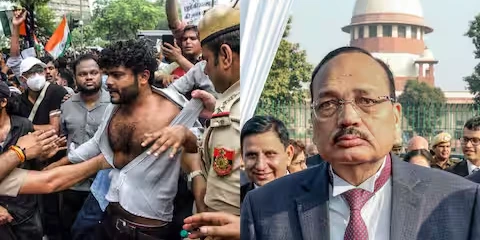
The Supreme Court on Wednesday refused to grant an urgent hearing to a petition seeking reforms in the National Eligibility cum Entrance Test (NEET) and alleging police excesses against students protesting in Delhi under the banner of the Cockroach Janta Party (CJP).
The matter was mentioned before a Bench comprising Chief Justice of India (CJI) Surya Kant, Justice Joymalya Bagchi and Justice V. Mohana.
The petitioner's counsel requested that the case be listed for hearing on Thursday, claiming there was video evidence of police brutality against protesting students.
"Student protest is going at Jantar Mantar. Police is taking brutal actions..." the lawyer submitted.
However, CJI Surya Kant declined the request, saying,
"Please don't waste our time and don't waste yours. Your time is more valuable than ours."
The lawyer further argued that the petition sought important directions, including ensuring a fair conduct of NEET examinations and dissolving the National Testing Agency (NTA), citing repeated examination paper leaks.
As the Bench moved on to the next case, the counsel again urged the Court to consider videos allegedly showing police action against the protesters. The Chief Justice, however, remarked,
"We are not interested in videos. We don't have time to watch."
Students from different parts of the country, along with members of the Cockroach Janta Party (CJP), an online satirical collective, have been protesting at Jantar Mantar and other locations in central Delhi. The demonstrators are demanding accountability for repeated examination paper leaks and seeking the resignation of Union Education Minister Dharmendra Pradhan.
Earlier this week, protesters attempted to march towards Parliament, but Delhi Police stopped the procession. Police used lathi charge and tear gas to disperse the crowd, and several protesters were reportedly injured.
The CJP movement traces its origins to proceedings before the Supreme Court on May 15, when CJI Surya Kant expressed concern over unemployed youth turning to social media and RTI activism. During the hearing, the Chief Justice made oral remarks comparing such individuals to "cockroaches," later clarifying that his comments were directed at people with fake degrees who engage in such activities, and not at unemployed youth in general.