
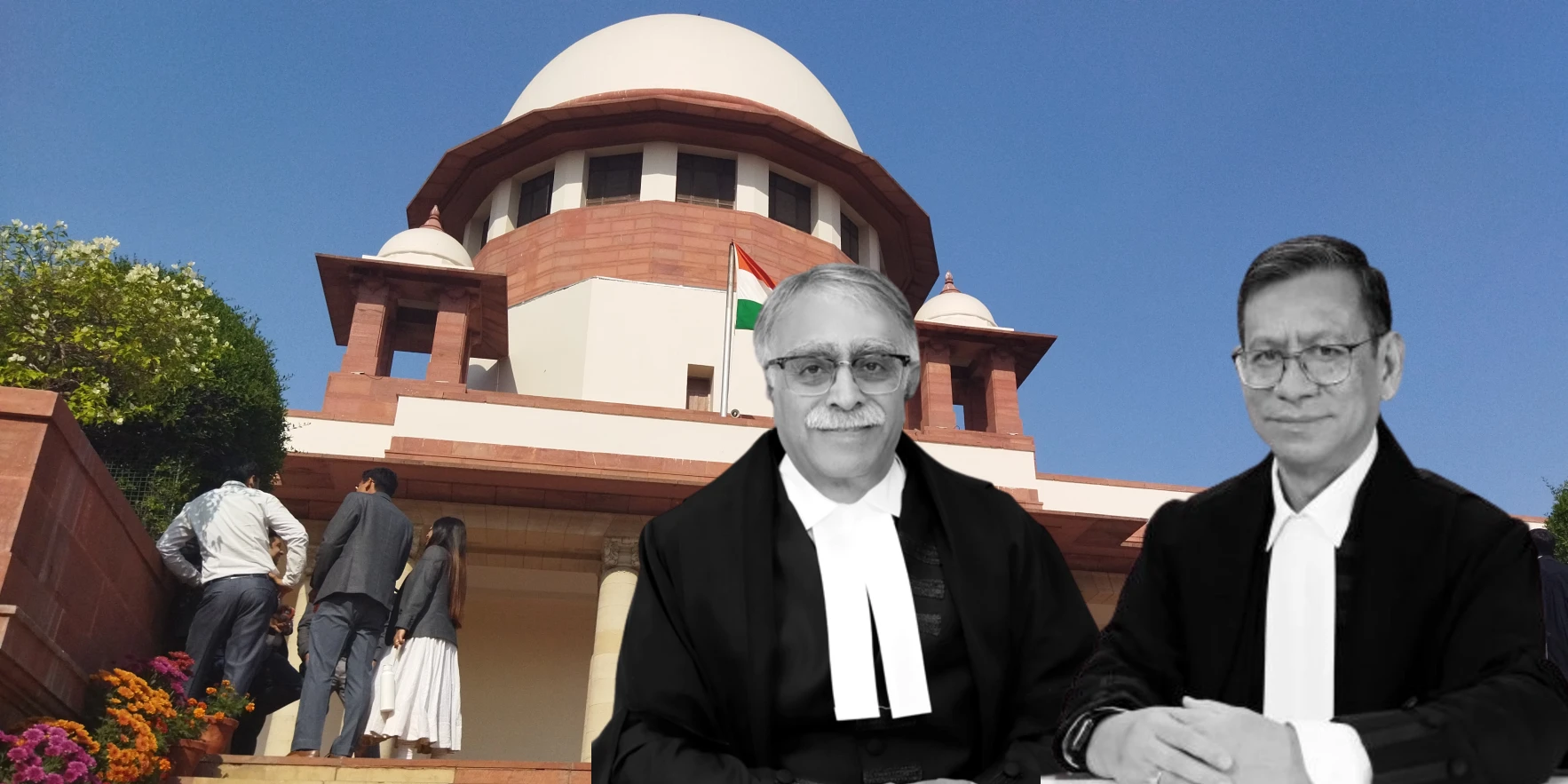
In a significant ruling, the Supreme Court has clarified the circumstances under which a judicial decision can be declared per incuriam—a legal doctrine that allows courts to disregard a precedent rendered in ignorance of binding law or an earlier authoritative judgment.
A Bench of Justices Sanjay Karol and Nongmeikapam Kotiswar Singh explained that the doctrine of per incuriam is a narrow exception to the principle of stare decisis and must be applied sparingly.
The Court held that a judgment may be treated as per incuriam when its ratio is irreconcilable with an earlier decision rendered by a Bench of equal or larger strength, or when a relevant statutory provision, rule, or regulation was not brought to the Court's attention. However, the doctrine applies only to the binding reasoning (ratio decidendi) of a judgment and not to its observations (obiter dicta).
The Bench further emphasized that judicial discipline requires a Bench of co-equal strength that disagrees with an earlier decision to refer the matter to a larger Bench rather than take a contrary view. It also reiterated that a decision of a larger Bench is binding on subsequent Benches of equal or lesser strength.
Importantly, the Court clarified that a judgment cannot be declared per incuriam merely because it reached an incorrect conclusion after considering an earlier precedent, or because an alternative interpretation may suggest a conflict with prior decisions.
Applying these principles, the Court held that its earlier decision in State of Haryana v. Raj Kumar (2021), which treated Haryana's 2002 remission policy as a statutory policy, was per incuriam as it conflicted with the binding three-judge Bench ruling in State of Haryana v. Jagdish that had recognized a similar remission policy as an exercise of constitutional powers under Article 161.
"14. We have to specifically deal with a submission on behalf of the appellant that the judgment in Rajkumar supra does not have value as precedent. When ‘does’ or ‘does not’ in a decision become per incuriam, is a question that has been discussed in various judgments. Certain facets emerge from these discussions as follows:
14.1 It is an exception to the rule of stare decisis and must be applied sparingly;
14.2 A judgment is per incuriam:
(a) when its ratio is not reconcilable with an earlier decision rendered by a Bench of equal or higher strength; or
(b) when a particular provision or a statute or a rule or a regulation has not been brought to the attention of the Court;
14.3 It applies only to the ratio decidendi of a judgment and not to obiter dicta;
14.4 Judicial discipline requires that if a bench disagrees with another bench of co-equal strength the matter should be referred to a bench of three judges to decide the issue;
14.5 The decision rendered by the Bench of largest strength binds any subsequent Bench of co-equal or lesser strength. A Bench of lesser strength cannot dissent from the view already taken by a Bench of larger strength;
14.6 A judgment cannot be said to be per incuriam:
(a) if it makes reference to an earlier decision and then concludes correctly or incorrectly; or
(b) if the ordinary reading of the judgment does not on the face of it show it to be in conflict with earlier decisions, the court should refrain adopting such an interpretation.
14.7 It is not the numerical strength of judges taking a particular view that is relevant but it is instead the strength of the Bench, which is the determinative factor of the binding nature of a particular view."
The ruling came while deciding the case of Parveen Kumar @ Parveen Chauhan v. State of Haryana, where the Court ultimately held that Haryana's 2002 remission policy was constitutional in nature and could not be overridden by the State's subsequent 2008 statutory remission policy.
Case: Parveen Kumar @ Parveen Chauhan v. State of Haryana & Ors. (2026 INSC 667)
Decision Date: July 1, 2026.

Representation:-
For Petitioner(s) :Mr. Sunil Kumar Verma, AOR, Ms. Kavita Vinayak, Adv., Ms. Bhavi Rathore, Adv., Mr. Desam Sudhakara Reddy, Adv., Mr. Himank Nargotra, Adv.
For Respondent(s) :Mr. Akshay Amritanshu, AOR, Ms. Aashna Gill, Adv., Ms. Harsh Rekha, Adv., Mr. Sarthak Srivastava, Adv.
Website designed, developed and maintained by webexy