
The Supreme Court has acquitted a man who was convicted of murdering two women in Haryana, holding that statements made by witnesses to the police during investigation cannot be treated as substantive evidence when those witnesses turn hostile during trial.
The Court set aside the conviction and life sentence imposed on the accused, observing that the prosecution had failed to establish his guilt beyond reasonable doubt. It emphasised that an FIR based on hearsay information cannot substitute for legally admissible evidence and that suspicion, however grave, cannot take the place of proof.
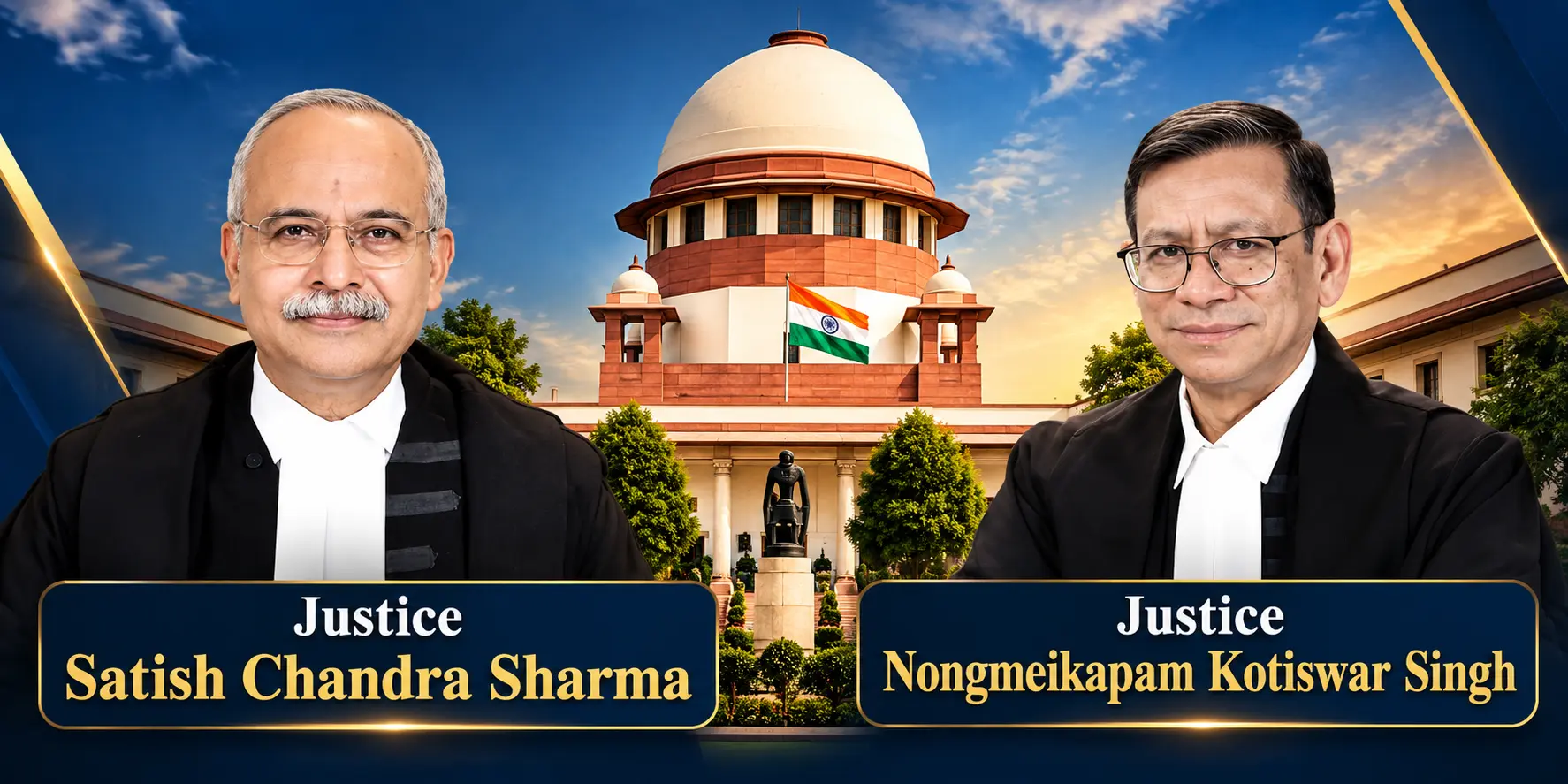
A Bench comprising Justice Satish Chandra Sharma and Justice Nongmeikapam Kotiswar Singh allowed the criminal appeals filed by Naresh against his conviction for the murders of Suman and Shakuntla.
Background of the Case
The case arose from the murder of two women, Suman, aged approximately 35 years, and Shakuntla, aged approximately 40 years, who were found dead at their respective houses in village Ranila, District Bhiwani, Haryana, on the night of April 17, 2011.
According to the prosecution, the two women were attacked near the village Post Office Chowk and their bodies were subsequently dragged into their respective houses.
The FIR was registered on April 18, 2011, at Police Station Baund Kalan under Section 302 IPC, naming Naresh as the accused. The prosecution alleged that he had murdered the women because he believed they were involved in prostitution.
The investigation subsequently implicated another accused, Subhash @ Tinku.
The Trial Court convicted both accused under Sections 302, 449, 297 and 201 read with Section 34 IPC and sentenced them to death.
However, the Punjab and Haryana High Court acquitted Subhash of all charges while upholding Naresh's conviction. Although the High Court declined to confirm the death sentence, it commuted the same to life imprisonment and imposed compensation under Section 357 CrPC.
Naresh thereafter approached the Supreme Court through the Supreme Court Legal Services Committee.
Supreme Court: Statements Under Section 161 CrPC Cannot Be Used as Substantive Evidence
One of the principal questions before the Supreme Court concerned the evidentiary value of statements recorded by police under Section 161 CrPC when the witnesses subsequently turned hostile during trial.
The Court noted that all the material private witnesses, including the informant, the alleged eyewitnesses and the son of one of the deceased women, had turned hostile and failed to support the prosecution's case before the Trial Court.
Despite this, the Trial Court and the High Court relied upon their earlier statements recorded by the police during investigation to establish the accused's involvement.
The Supreme Court held that this approach was legally impermissible.
Referring to Section 162 CrPC, the Bench explained that statements recorded by police during investigation are not substantive evidence. They can be used only for the limited purpose of contradicting a witness in accordance with the statutory procedure.
The Court relied upon the Constitution Bench judgment in Tahsildar Singh v. State of Uttar Pradesh and reiterated that a previous statement made to the police cannot be treated as evidence of the truth of its contents merely because the witness has turned hostile.
The Bench further clarified that decisions such as Ramesh Prasad Misra v. State of U.P. and Himanshu alias Chintu v. State (NCT of Delhi) do not permit courts to treat police statements of hostile witnesses as substantive evidence.
FIR Based on Hearsay Cannot Establish Guilt
The Supreme Court also found serious legal infirmities in the manner in which the FIR had been relied upon by the courts below.
The FIR was registered on the statement of Kailash Chander (PW-7), who had not witnessed the murders. His statement merely recorded that he had subsequently come to know that Naresh had murdered the two women.
However, the source of this information was never disclosed.
The Court reiterated that an FIR is not substantive evidence and can ordinarily be used only to corroborate or contradict its maker.
It observed that the mere admission of a signature on the FIR proves that the informant made the statement to the police, but does not establish the truth of information received from unidentified persons.
The Bench held that an FIR naming an accused on the basis of hearsay cannot supply the proof that the prosecution witnesses failed to provide during trial.
Recovery of Weapons Not Sufficient to Sustain Conviction
Another important aspect concerned the recovery of weapons allegedly used in the commission of the murders.
The prosecution initially claimed that the murders had been committed using a danda. However, the post-mortem examinations revealed multiple deep incised wounds on both deceased women.
The medical evidence established that the fatal injuries could not have been caused by a blunt weapon such as a danda.
Subsequently, after the post-mortem reports revealed incised wounds, a second disclosure statement was allegedly recorded in which Naresh purportedly disclosed the use of a gandasi.
The Supreme Court found this subsequent disclosure suspicious, particularly because it contradicted the earlier disclosure statement identifying the danda as the weapon of offence.
The Court also noted that the investigating officers had failed to depose to the exact words allegedly used by the accused in making the disclosure statements.
Referring to Ramanand alias Nandlal Bharti v. State of U.P., the Bench emphasised that the investigating officer must prove the contents of the discovery panchnama and narrate the exact information attributed to the accused.
The Court further observed that recovery of a weapon, even if stained with blood, cannot independently establish guilt unless the weapon is credibly connected with the crime.
It also found that the forensic evidence failed to establish a conclusive connection between the recovered weapons and the murders, as the blood group remained inconclusive.
Circumstantial Evidence Must Establish a Complete Chain
The Supreme Court examined the prosecution's case in light of the established principles governing circumstantial evidence.
Referring to the landmark judgment in Sharad Birdhichand Sarda v. State of Maharashtra, the Bench reiterated the five golden principles, commonly known as the panchsheel of proof, which must be satisfied before an accused can be convicted on the basis of circumstantial evidence.
The Court observed that the circumstances relied upon by the prosecution were not fully established and did not form a complete chain pointing exclusively towards the guilt of the accused.
It noted that:
The Court observed that the circumstances, even when considered together, could not exclude every reasonable hypothesis consistent with the innocence of the accused.
The Bench reiterated the settled principle that suspicion, however grave, cannot take the place of proof.
Supreme Court Sets Aside Conviction and Orders Release
Concluding that the prosecution had failed to establish the guilt of Naresh beyond reasonable doubt, the Supreme Court allowed the appeals.
The Court set aside the Punjab and Haryana High Court judgment dated October 8, 2013, insofar as it upheld his conviction and sentence, as well as the Trial Court's judgment of conviction and order on sentence.
Naresh was acquitted of all charges and directed to be released forthwith if in custody, unless required in connection with any other case.
The Court also set aside the compensation directed to be paid under Section 357 CrPC and ordered that the fine, if deposited, be refunded.
Importantly, while acquitting the accused, the Supreme Court observed that the acquittal should not diminish the loss suffered by the families of the deceased women.
It recommended that the District Legal Services Authority, Bhiwani, consider granting compensation to the legal representatives of Suman and Shakuntla under the applicable Victim Compensation Scheme, now governed by Section 396 of the Bharatiya Nagarik Suraksha Sanhita, 2023.
Case Details:-

Website designed, developed and maintained by webexy