
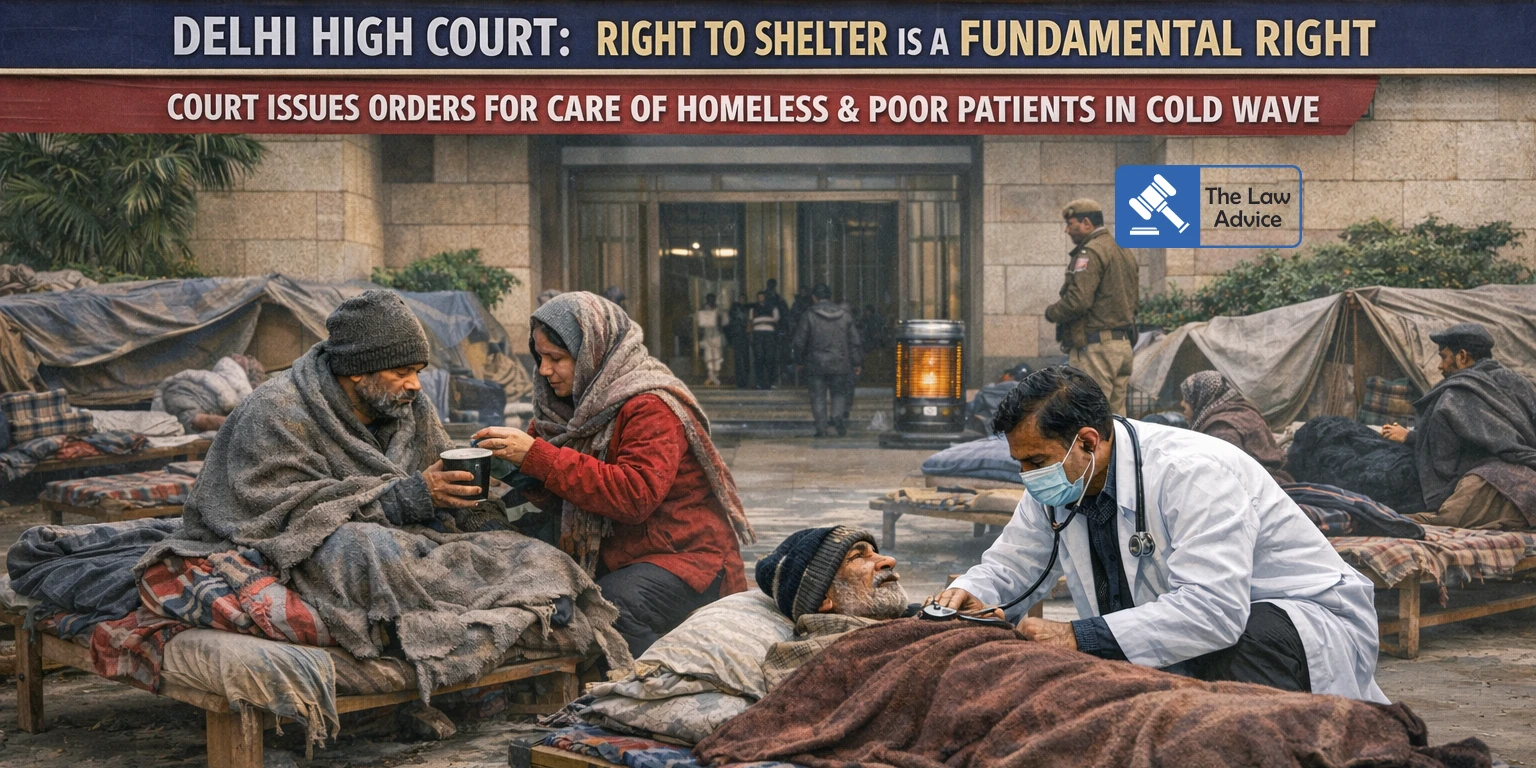
Today, Delhi High Court held that the right to shelter is a basic fundamental right and asked authorities in the national capital to take immediate steps to help homeless people and poor patients during the ongoing cold wave.
A Division Bench of Chief Justice Devendra Kumar Upadhyaya and Justice Tejas Karia directed the Delhi Urban Shelter Improvement Board (DUSIB) to take over subways near government hospitals by this evening and use them as night shelters.
“The authorities of DUSIB shall immediately proceed to spaces available near the hospitals and erect tents or pandals or take any other measures for the purpose of immediately providing shelter to as many patients and their kith and kin as possible. The land-owning agencies, MCD and DDA, will fully cooperate with the DUSIB officials, failing which the court may take a strong view of the matter and erring officials of these agencies may be held accountable. This direction shall apply with full force to the Delhi Police and Delhi Metro Rail Corporation as well,” the Court said.
Further, the Court mention that a meeting be held tomorrow under the chairmanship of the Principal District Judge (South District) to work out a short-term plan, which will be put into action from the same day to deal with the current situation.
It said the meeting will be attended by senior officials from AIIMS, Safdarjung Hospital, Ram Manohar Lohia Hospital, Lady Hardinge Medical College, the Delhi Police, DUSIB, the Delhi Development Authority, and other concerned stakeholders.
“The committee, while chalking out the short-term plan for meeting the current exigency, shall deliberate amongst its members and prepare a plan, and in case of any conflict between the views of the members, the final decision shall rest with the Principal District Judge. The Principal District Judge shall prepare a note and submit it to the court on the next date through the Registrar General of this Court,” the Court said.
The Bench issued these directions while hearing a suo motu public interest litigation (PIL) concerning the shortage of space and basic facilities in Delhi’s night shelters as the city faces a cold wave.
The Court took note of the issue after a newspaper report highlighted that several patients who had come to Delhi for treatment at AIIMS, along with their family members, were forced to sleep in the open.
During the hearing, the Court was informed that Central Government Standing Counsel Ashish Dixit had personally inspected night shelters in and around AIIMS the previous night and prepared a note with suggestions. He also submitted photographs showing people sleeping in subways and in open areas near the hospital.
Photographs submitted by a non-profit organisation, the Centre for Holistic Development, were also shown to the Court, stating that its members had visited several such locations.
After examining the images and hearing arguments from counsel representing various government authorities, the Bench noted that the situation on the ground was starkly different from what had been projected before the Court by the authorities.
The Court observed that denying citizens the right to shelter would amount to a violation of fundamental rights, and stressed that the government and its agencies are duty-bound to ensure that homeless persons and those who come to Delhi for medical treatment are provided adequate shelter.
“The State and its agencies like hospitals, development authorities or municipal corporations cannot shirk away from the responsibility and duty to provide adequate shelter at least to those who are visiting hospitals not willingly but under compelling circumstances in search of better medical care. No refuge can be permitted to be taken by the State and its agencies for denying such facilities due to paucity of funds or any other resources,” the Court observed.
The Court added that it will take up the matter again on Friday (January 16), and directed the authorities to file a status report detailing the steps taken to comply with its directions.
It also appreciated the efforts of Central Government Standing Counsel Ashish Dixit for personally visiting the sites.
Additional Solicitor General (ASG) Chetan Sharma represented the Union of India.
CGSC Satya Ranjan Swain appeared for AIIMS.
The Delhi government was represented through its Standing Counsel Sameer Vashisht.