
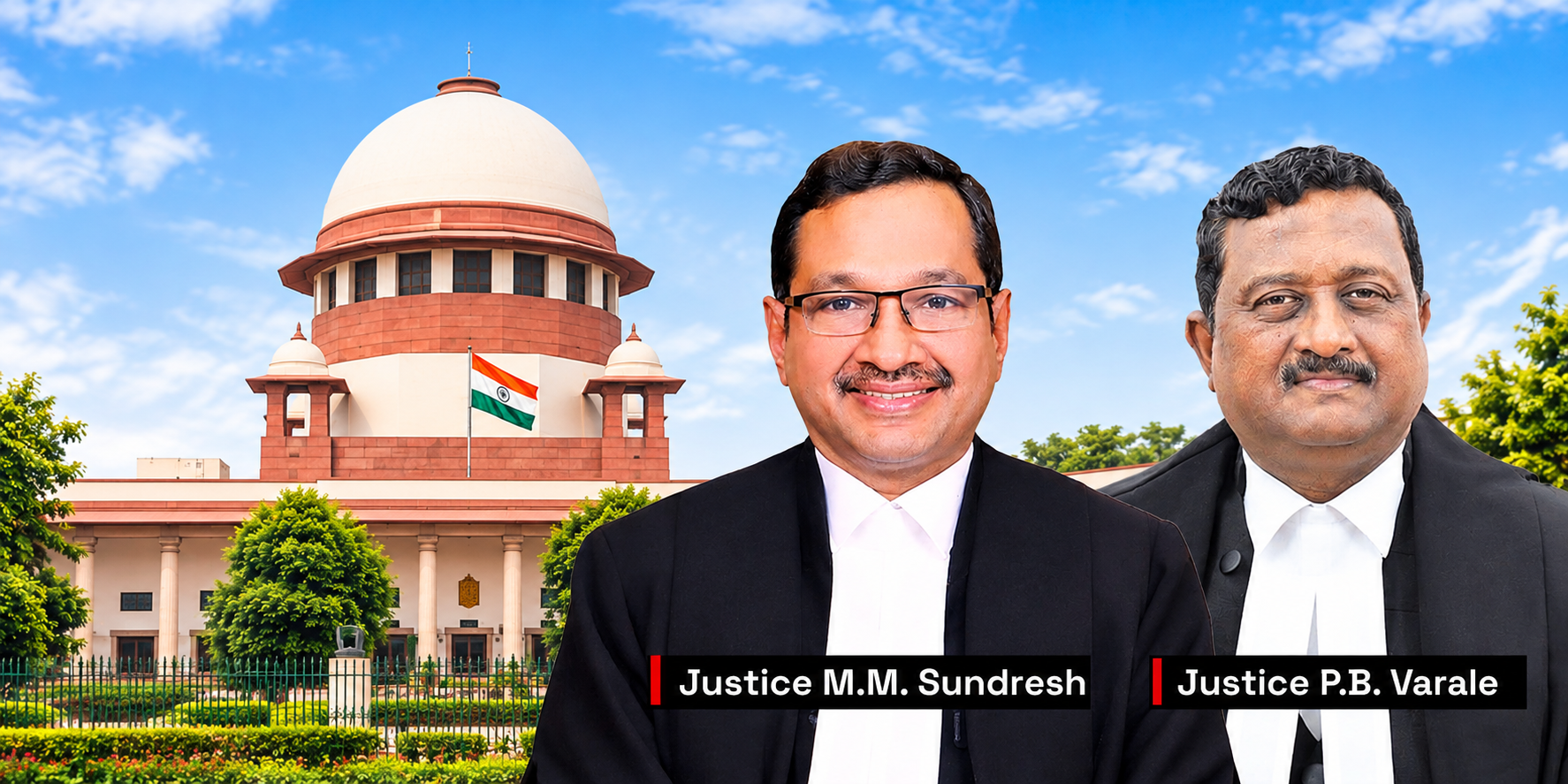
The Supreme Court has directed the Uttar Pradesh government to identify undertrial prisoners across 55 districts who have been granted bail but continue to remain in jail due to their inability to comply with bail conditions, including furnishing sureties.
A bench of Justice MM Sundresh and Justice PB Varale clarified that the exercise must cover all such prisoners, irrespective of whether they are represented by private lawyers or have received assistance from the District Legal Services Authority (DLSA). The exercise is to be conducted with the assistance of the respective DLSAs.
The directions were passed in a suo motu matter concerning undertrial prisoners who continue to remain in custody despite being granted bail, owing to their inability or unwillingness to fulfil the conditions imposed by the trial courts.
The bench emphasised that the exercise cannot be treated as adversarial litigation, with relief restricted only to prisoners receiving assistance from the National Legal Services Authority (NALSA).
"This direction shall be applicable even to those under-trial prisoners who could not comply with the bail conditions, despite the fact that they have engaged the private lawyers. There cannot be any differentiation between the under-trial prisoners, who have the assistance of District Legal Services Authority and those who have engaged private counsel," the Court observed.
During the hearing, Senior Advocate Pradeep Mishra, appearing for the Uttar Pradesh government, and counsel for NALSA informed the Court that 264 undertrial prisoners in 20 districts had been granted bail. However, only 158 of them had been released, while the remaining 106 continued to remain in custody due to their inability to furnish sureties or comply with other conditions imposed by the trial courts.
The Court was further informed that the figures related to only 20 districts and that NALSA was yet to undertake a similar identification exercise in 55 other districts.
Taking note of the submissions, the bench observed that prisoners represented by private counsel and those receiving assistance from the DLSA were similarly placed, as both categories faced difficulties in complying with bail conditions.
"The fact remains that both the categories are similar with respect to non-compliance of the bail conditions imposed. Merely because the private lawyers have been engaged, the assistance from the District Legal Services Authority counsel cannot be denied and also the benefit that has been extended to such of persons who have already been rendered assistance by the District Legal Services Authorities," the Court said.
It further observed that DLSAs could extend assistance to prisoners even when they were represented by private advocates, adding that the State must ensure that such prisoners are not unnecessarily kept in custody.
The bench also requested the concerned trial courts to take up cases identified by the respective DLSAs and suitably modify bail conditions wherever required to facilitate the release of the prisoners.
"In any case, the onus lies on the State to make sure that these persons are released from custody. We also request the concerned Courts to take up those cases which were brought into notice by the respective District Legal Services Authorities and modify the condition(s) suitably, so that the under-trial prisoners can be released accordingly," the Court stated.
The suo motu proceedings arise from a series of systemic issues concerning prison reforms, in which the Supreme Court had appointed Senior Advocate Gaurav Agarwal as amicus curiae.
One of the issues before the Court concerns undertrial prisoners who remain incarcerated despite being granted bail because they are unable to furnish bail bonds or fulfil other conditions.
In a report submitted in 2023, NALSA had informed the Court that around 5,000 undertrial prisoners continued to remain in jail despite being granted bail. Of these, 2,357 prisoners were provided legal assistance, following which 1,417 were released.
The report also highlighted that some prisoners remained incarcerated because multiple cases were pending against them, while others were unwilling to furnish bail bonds unless they were granted bail in all pending cases.
In this regard, the Supreme Court had earlier issued comprehensive directions to address the issue of prolonged detention despite the grant of bail. Among other directions, it had stated that where an accused failed to furnish bail bonds within one month of the grant of bail, the concerned court should take up the matter suo motu and consider relaxing the bail conditions.
Website designed, developed and maintained by webexy