
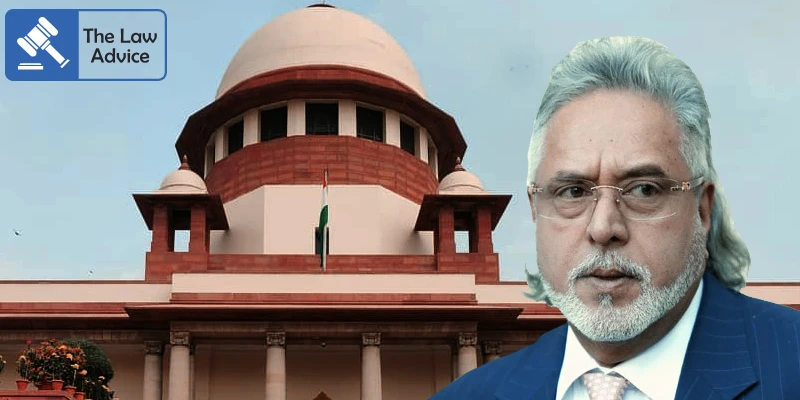
Recently, the Bombay High Court held that the nearly decade-long commercial dispute between fugitive businessman Vijay Mallya and the consortium of banks seeking recovery of their dues should now reach a logical conclusion.
The bench headed by Justice Milind Jadhav made the observation while hearing Mallya's petition challenging an order that allowed the State Bank of India (SBI)-led consortium of banks to use his assets attached by the Enforcement Directorate (ED) for recovery of their dues.
The dispute relates to around ₹9,000 crore in loans given to Mallya's now-defunct Kingfisher Airlines by a consortium of banks.
Mallya left India in March 2016 and was declared a "fugitive economic offender" in 2019. Since then, Indian authorities have been trying to recover the money by attaching his properties and other assets.
Mallya had approached the High Court in 2020 against an order passed by a special Prevention of Money Laundering Act (PMLA) court, which permitted the SBI-led consortium to utilise his attached assets.
During the latest hearing, Justice Jadhav said that the matter had been pending for almost ten years and should now be brought to an end.
The Court also sought details from the ED about the current status of its investigation and the assets attached in the case.
The judge observed that commercial disputes often contain the basis for their own resolution and said the parties should look for practical solutions instead of remaining stuck in prolonged litigation.
The Court further noted that keeping such a dispute unresolved could have a direct and negative impact on the country's economy.
The latest proceedings are separate from Mallya's challenge to his declaration as a "Fugitive Economic Offender."
Earlier this year, Mallya had challenged the order declaring him a fugitive economic offender under the Fugitive Economic Offenders Act.
During a hearing in February, the Bombay High Court indicated that it would not entertain his plea unless he returned to India and submitted to the jurisdiction of the Indian courts.
At the next hearing, Mallya said he was unable to specify when he would return to India, claiming that restrictions imposed by courts in England prevented him from leaving the UK.
Appearing for Mallya, Senior Advocate Amit Desai argued that the petitions could still be heard even if his client was not physically present in India. He relied on Supreme Court judgments where constitutional courts had proceeded with cases despite the absence of petitioners.
Mallya has been living in the UK since leaving India in 2016, while Indian authorities continue to seek his extradition.
The Bombay High Court's latest observations signal that the long-running dispute over Mallya's assets and the banks' recovery claims should now move towards a final resolution.
Website designed, developed and maintained by webexy