
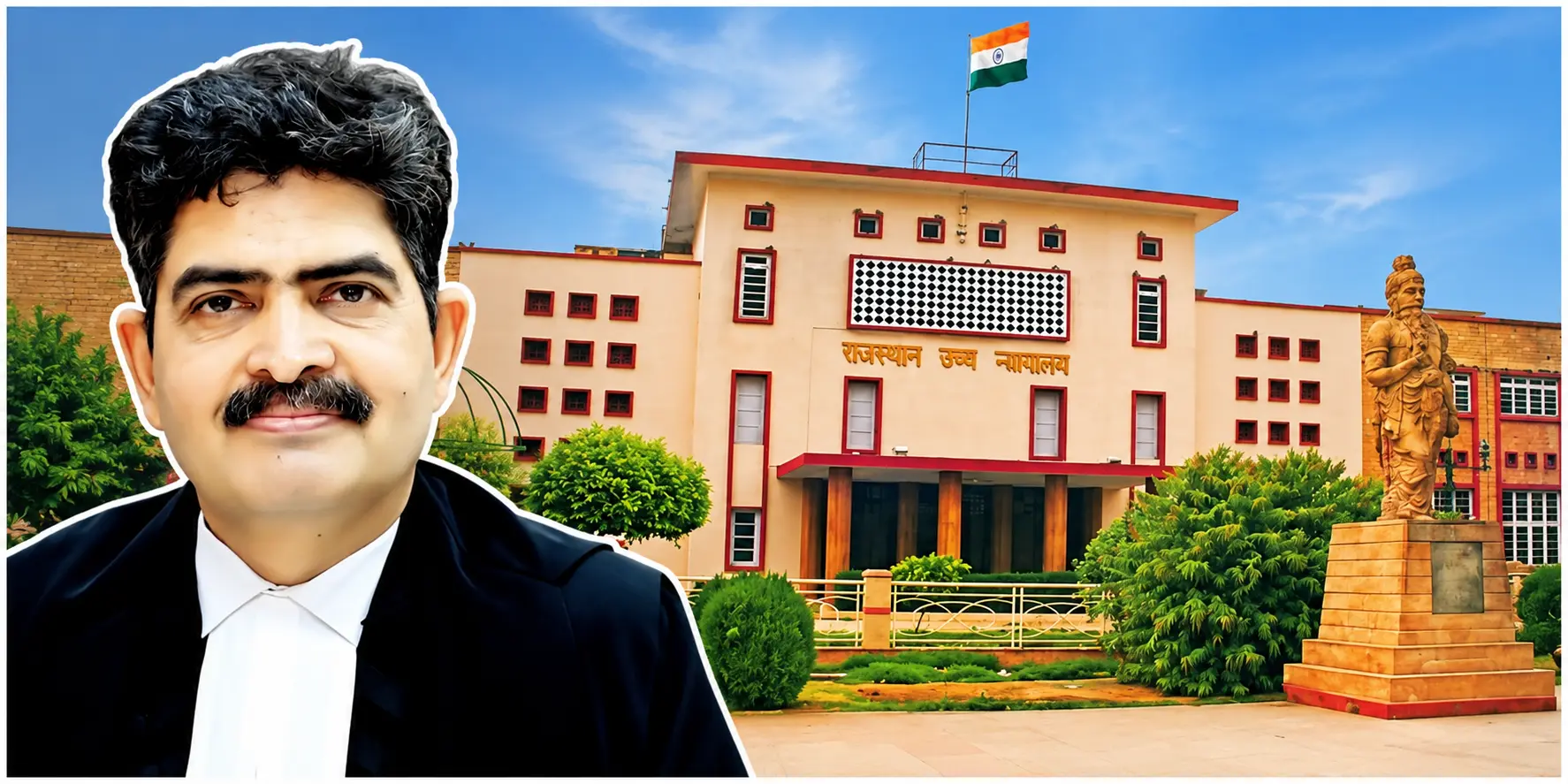
The Rajasthan High Court has held that a husband cannot be made liable for government dues arising from alleged irregularities committed by his wife during her tenure as a Sarpanch merely because of their marital relationship.
Justice Anoop Kumar Dhand directed the concerned authorities to immediately issue a No-Dues/No-Objection Certificate to the petitioner, enabling him to contest the upcoming Panchayati Raj elections.
The Court made it clear that the liabilities of a husband and wife are separate and that a person cannot be penalised for the alleged wrongdoing of their spouse solely on the basis of the marital relationship.
However, the Court observed that if an inquiry establishes that the husband himself was involved in or had assisted in the irregularity, appropriate action could be taken against him.
The case concerned Ram Lakshman Meena, whose wife Laxmi Bai served as Sarpanch of Gram Panchayat Falenda in Bundi district from 1995 to 2000.
Subsequently, an inquiry was conducted into certain work carried out during her tenure. Following the inquiry, an order was passed for recovery of a certain amount from Laxmi Bai.
When the amount was not deposited, the authorities initiated proceedings for attachment and auction of her property. Laxmi Bai challenged the action before the High Court in 2009.
On September 16, 2009, the High Court stayed the auction of her property, and the matter remains pending.
Ram Lakshman Meena wanted to contest the forthcoming Panchayati Raj elections from Gram Panchayat Falenda. For this purpose, he approached the authorities for a No-Dues Certificate.
The authorities, however, refused to issue the certificate on the ground that government dues were outstanding against his wife.
Meena argued that he had nothing to do with the alleged dues and was neither a surety nor a guarantor for the amount payable by his wife. Therefore, he could not be prevented from contesting an election because of the pending recovery proceedings against her.
The State opposed the plea, contending that as the husband of Laxmi Bai, he should be required to clear the outstanding amount before being issued a No-Dues Certificate.
Rejecting the State's stand, the High Court observed that where recovery of government money is to be made from a person, the recovery proceedings must ordinarily be directed against the person liable for the amount.
The Court noted that in appropriate circumstances, a surety or guarantor may also be held liable. However, in the present case, Ram Lakshman was neither a surety nor a guarantor for his wife's alleged dues.
Therefore, the authorities could not make him liable merely because he was her husband.
The Court further observed that neither the Panchayati Raj Act, 1994 nor the Panchayati Raj Rules, 1996 contains any provision permitting recovery of a Sarpanch's dues from another member of the family merely on account of the relationship.
The High Court emphasised that the responsibilities and liabilities of a husband and wife are distinct.
If a person holding a public office commits an irregularity, liability must be determined on the basis of that person's own role. The mere fact that the person is married to another individual does not make the spouse responsible for the alleged misconduct.
At the same time, the Court clarified that if an inquiry establishes the husband's own involvement in the Panchayat work or demonstrates that he acted jointly with his wife in the alleged irregularity, he could be proceeded against in accordance with law.
Thus, personal involvement, and not merely the marital relationship, is necessary to fasten liability.
The High Court found that the authorities had improperly withheld the petitioner's No-Dues/No-Objection Certificate by making its issuance conditional upon payment of his wife's outstanding dues.
Allowing the petition, the Court directed the concerned authorities to immediately issue the No-Dues/No-Objection Certificate to Ram Lakshman Meena, enabling him to contest the upcoming Panchayati Raj elections.
The Court also disposed of the petition along with the pending applications connected with the matter.
Website designed, developed and maintained by webexy