
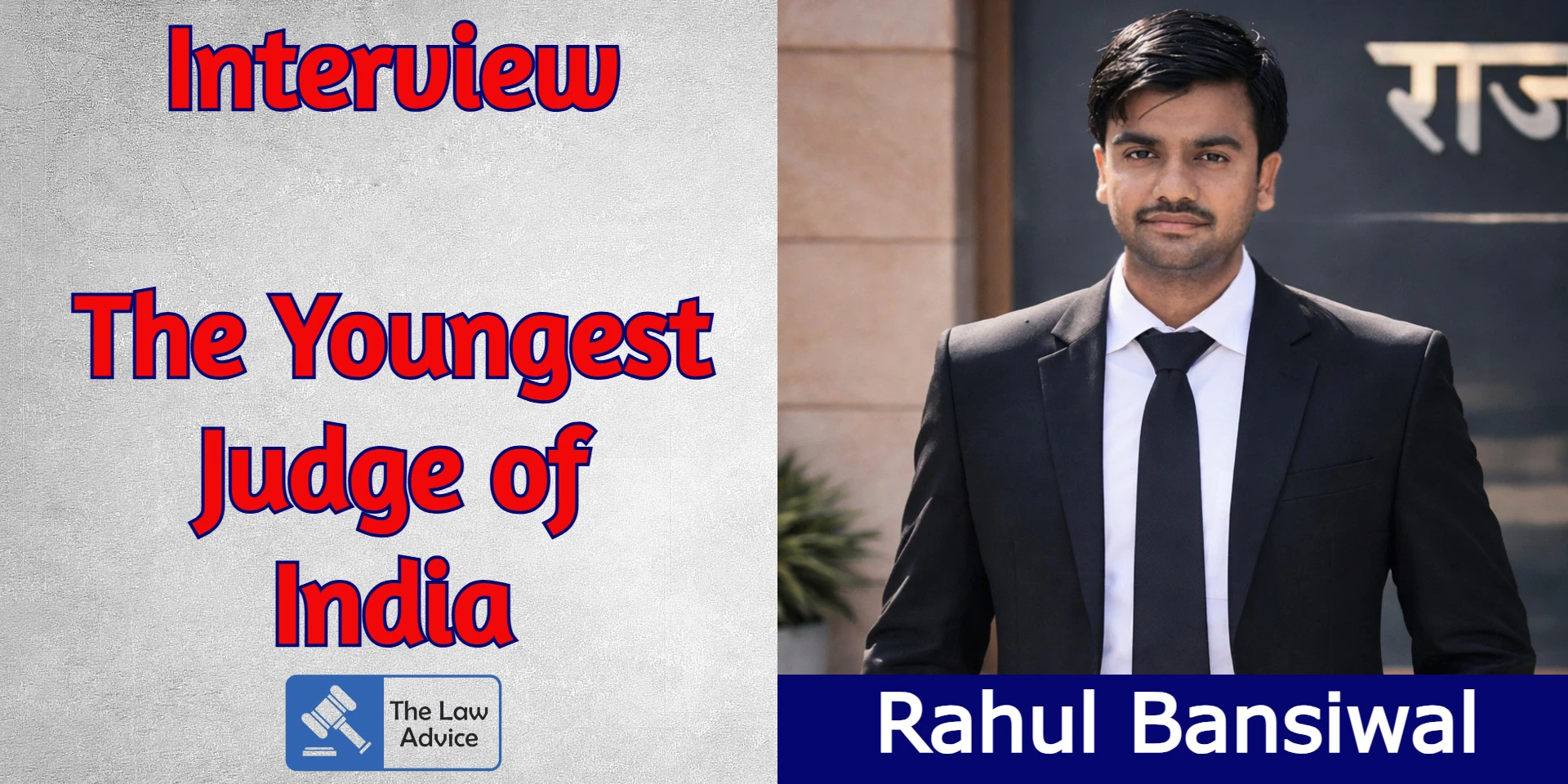
Rahul Bansiwal: The Youngest Judge of India on Discipline, Determination, and the Journey to the Bench
At an age when most law graduates are taking their first steps in the legal profession, Rahul Bansiwal has already etched his name into judicial history. Emerging as the youngest judicial officer in the country, his journey reflects an extraordinary blend of discipline, clarity of vision, and unwavering commitment to the rule of law.
In this exclusive interview with The Law Advice, Rahul Bansiwal speaks candidly about his early aspiration to join the judiciary, the rigour of judicial preparation, and the mindset required to shoulder judicial responsibility at a remarkably young age. He offers thoughtful insights into judicial independence, the evolving role of subordinate courts, and the balance between empathy and strict adherence to law.
More than a story of personal achievement, this conversation serves as a reflection on the values that sustain the justice delivery system and as a source of inspiration for countless judiciary aspirants across the country who dare to dream early—and work relentlessly to achieve it.
Q:- What was the defining moment when you decided to pursue the judicial services?
A:- From early childhood, I wanted to become a Judge. With the passage of time, when the time came, I chose Law as my career to move towards my ambition.
Q:- Coming from Rajasthan, what challenges did you face while preparing for the judiciary?
A:- For me, I don’t think I faced any such challenge being a judiciary aspirant from the State of Rajasthan.
Q:- How did your family react when you cleared the RJS examination at such a young age?
A:- Everyone was very happy and cheerful about my selection, and this happiness got doubled when I told them that I created a record by becoming the youngest Judge.
Q:- Did your educational background play a decisive role in shaping your judicial preparation?
A:- Definitely, my educational background played a crucial role in my preparation. I pursued a five-year law course, B.A. LL.B. (Hons.), and some Acts from my syllabus were similar to the curriculum, which got covered during my college.
Q:- How did you structure your daily study routine during preparation?
A:- I used to study in phases rather than studying continuously for hours. For example, first sitting in the morning from 10–12, then afternoon from 2–3, then evening from 6–8:30, and then at night from 10–12/1, depending. I always preferred quality over quantity.
Q:- What subjects did you find most challenging, and how did you overcome them?
A:- In law, every subject is interesting; however, certain Acts like Land Revenue, Excise, Court Fees, and Registration are more factual rather than conceptual. For these Acts, I read the Bare Act only, and that too with selective important portions.
Q:- How important was answer writing practice in your success?
A:- Answer writing practice is very important for judiciary exams. After prelims, I used to practise a lot of mains questions from PYQs and mocks. For mains, judgment writing, charge framing, and essay writing are scoring areas, and with a lot of answer writing, they can be mastered.
Q:- Did you rely more on coaching or self-study—and why?
A:- Personally, I think self-study is more important. Coaching can be helpful in saving time as they provide study material and practice papers. But ultimately, the aspirant has to study himself. Merely attending classes is not enough. It can be fruitful only if you properly utilise all those resources.
Q:- How did you manage pressure, self-doubt, and burnout during preparation?
A:- Personally, I never doubted myself, not for a second, that I could not clear RJS. Yes, for sure, some pressure was there as the time was limited and the syllabus was changed, and many more Acts were included. But I believe that a person gives better performance under pressure.
Q:- Being the youngest judicial officer, do you feel additional pressure to prove yourself?
A:- Not at all!
Q:- How do you plan to command authority and confidence in the courtroom despite your age?
A:- I think age is just a number. What actually matters is the position that a person is holding. The command will come from the person authorised to hold that position; age will not matter. Confidence comes with your ability of decision-making. I believe one should just have faith in oneself.
Q:- Do you think youth brings a different perspective to judging cases?
A:- Yes, I think young persons are more open to learning and exploring. Law is such a field in which you must always be enthusiastic to learn. In the legal field, you have to keep yourself updated with case laws, amendments, and new Acts.
Q:- How will you balance empathy with strict adherence to law as a judge?
A:- I believe that when the judiciary takes decisions without any pressure or without being affected by any such factors which can influence them, then that is judicial independence.
Q:- What does “judicial independence” mean to you personally?
(Answer already covered above.)
Q:- How do you view the role of a judge in a society increasingly influenced by social media?
A:- The biggest challenge faced by the judiciary is the huge pendency of cases.
Q:- In your opinion, should judges be strict interpreters of law or agents of social change?
A:- Subordinate courts can help in reducing pendency by disposing of cases at a fixed rate, by using arbitration and mediation to resolve disputes, and by using audio-video electronic means to reduce procedural time.
Q:- What qualities do you believe are essential for a good judge?
A:- I think that a judge should essentially have these qualities:
i. Disciplined
ii. Dedicated and hardworking
iii. Impartial
iv. Punctual
v. Confident and firm in decisions
Q:- What according to you is the biggest challenge facing the Indian judiciary today?
A:- The biggest challenge faced by the judiciary is the huge pendency of cases.
Q:- How can subordinate courts help reduce pendency of cases?
A:- Subordinate courts can help in reducing pendency by disposing of cases at a fixed rate, by using arbitration and mediation to resolve disputes, and by using audio-video electronic means to reduce the time of procedure.
Q:- Are there any judges or legal personalities who inspire you?
A:- There are many great judges and lawyers in our country. Personally, I draw inspiration from the life of my father. At present, he is working as a District Judge. His journey and life struggles motivate me a lot. Also, many more great legal personalities inspire law aspirants.
Q:- What advice would you give to young aspirants preparing for judicial services?
A:-
i. Command over the Bare Acts, especially core subjects like CPC, CrPC, IPC, and Evidence.
ii. Be regularly updated with current and legal affairs. I used LiveLaw.
iii. Read newspapers daily, especially legal articles and editorials, like the Indian Express – Law Explained column.
iv. Practise MCQs as much as possible for prelims and practise a lot of answer writing, especially PYQs.
v. Focus on the language portion; it can be a game-changer. Practise essay writing and grammar in both languages. I used to read diglot Bare Acts, which helped me learn new vocabulary.
vi. Don’t completely stop using social media. Stay updated. Watch movies and web series in your free time to stay refreshed.
vii. Don’t take stress at all. Properly manage your routine. Always prioritise quality productive study over quantity.
viii. Have faith in yourself, trust the process, and remain positive throughout the journey.
Q:- What common mistakes should judiciary aspirants avoid?
A:-
i. Don’t read everything. Be selective. Analyse what needs to be studied and what can be skipped.
ii. Don’t skip revision; it helps a lot.
iii. Don’t leave PYQs; they are crucial, and sometimes questions get repeated.
iv. Don’t indulge only in note-making. Keep reading and revising.
Q:- How do you unwind or relax outside law books?
A:- I used to watch movies and web series a lot. I also played chess and Candy Crush. I used to read novels and poems, and sometimes even wrote poems.
Q:- If not a judge, what profession would you have chosen?
A:- I would be a writer.
Q:- What does success mean to you today?
A:- Success is different for each person. I think achieving what you have desired or dreamt of is success. So, for me, selection in the judiciary can be said to be success.