
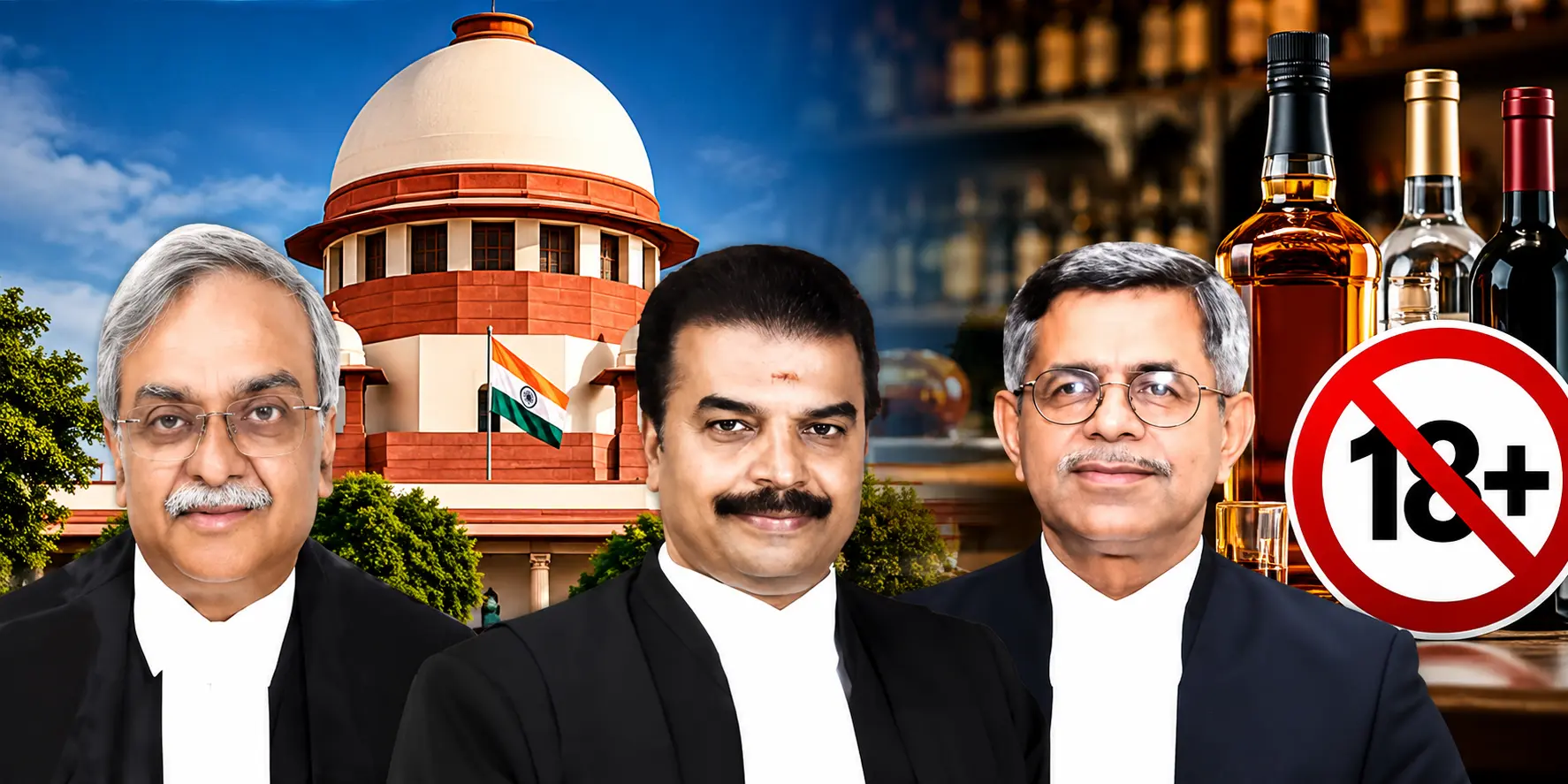
The Supreme Court on Wednesday expressed concern over the Union Government’s failure to appear in proceedings concerning a plea seeking mandatory age verification at liquor outlets across India, despite notice having been served.
A Bench of Justice Vikram Nath, Justice R. Mahadevan and Justice Aparesh Kumar Singh questioned the Centre’s absence, observing that the matter raised an important issue concerning the prevention of underage drinking and drunk driving.
“Respondent No. 1 (the Union Government) notice is served. No one is appearing for the Union. It is an important issue. They don’t take you seriously?” Justice Nath remarked during the hearing.
When the petitioner’s counsel responded that the government was not taking the matter seriously, the Court granted the Union Government four weeks to file its response. The Bench also stated that it would request Solicitor General of India Tushar Mehta to appear in the matter.
The Court directed the petitioner to serve a copy of the order on the Solicitor General’s office and listed the matter after six weeks.
Plea Seeks Uniform Age-Verification Mechanism Across India
The petition has been filed by the non-profit organisation Community Against Drunken Driving (CADD), seeking directions for a mandatory age-verification mechanism at liquor shops, bars, pubs and restaurants across the country.
The organisation has highlighted the absence of a uniform system for checking the age of people purchasing alcohol. According to the plea, inadequate age verification allows minors to access liquor and increases the risk of accidents involving underage drivers allegedly driving under the influence.
During Wednesday’s hearing, counsel for CADD submitted that the legal drinking age differs across States, making a uniform verification protocol necessary.
“There should be a protocol mandate for age verification at the first point of sale all over India,” counsel submitted, referring to the differing minimum age requirements across States.
The plea seeks to establish a consistent process for verifying purchasers’ ages at the point of sale, irrespective of variations in State excise laws.
Supreme Court Also Hears Plea Against Alcohol in Tetra Packs
The Bench also considered a connected plea filed by CADD seeking restrictions on the sale of alcoholic beverages in packaging that resembles ordinary non-alcoholic drinks, including fruit juices.
Senior Advocate Arvind Datar, appearing for the Tetra Pack Manufacturers Association, sought impleadment in the proceedings. The Court allowed the application.
Datar informed the Court that alcoholic beverages were being sold in tetra packs across 10 States and Union Territories.
CADD’s counsel raised concerns over the packaging and marketing of alcoholic cocktails in containers resembling fruit-juice packs. Counsel referred to products marketed under names such as “chilli mango vodka”, arguing that the presentation could make the alcoholic nature of the products less apparent to consumers.
The counsel questioned the absence of adequate warnings and submitted that such packaging could mislead consumers.
Earlier Supreme Court Proceedings on Alcohol Packaging
In May 2026, a Bench comprising then Chief Justice of India Surya Kant and Justice Joymalya Bagchi had sought responses from the Union Government and State excise departments on CADD’s plea seeking a ban on alcohol sold in inconspicuous packaging, including tetra packs and sachets.
The Bench had described such packaging as “very deceptive”.
The latest proceedings bring two related public-interest concerns before the Supreme Court: establishing a uniform age-verification mechanism at alcohol-sale points and examining the sale of alcoholic beverages in packaging that may resemble non-alcoholic products.
The Union Government has been granted four weeks to respond to the age-verification plea. The matter is expected to be taken up again after six weeks.
Case Title: Community Against Drunken Driving v. Union of India & Ors.
Website designed, developed and maintained by webexy