
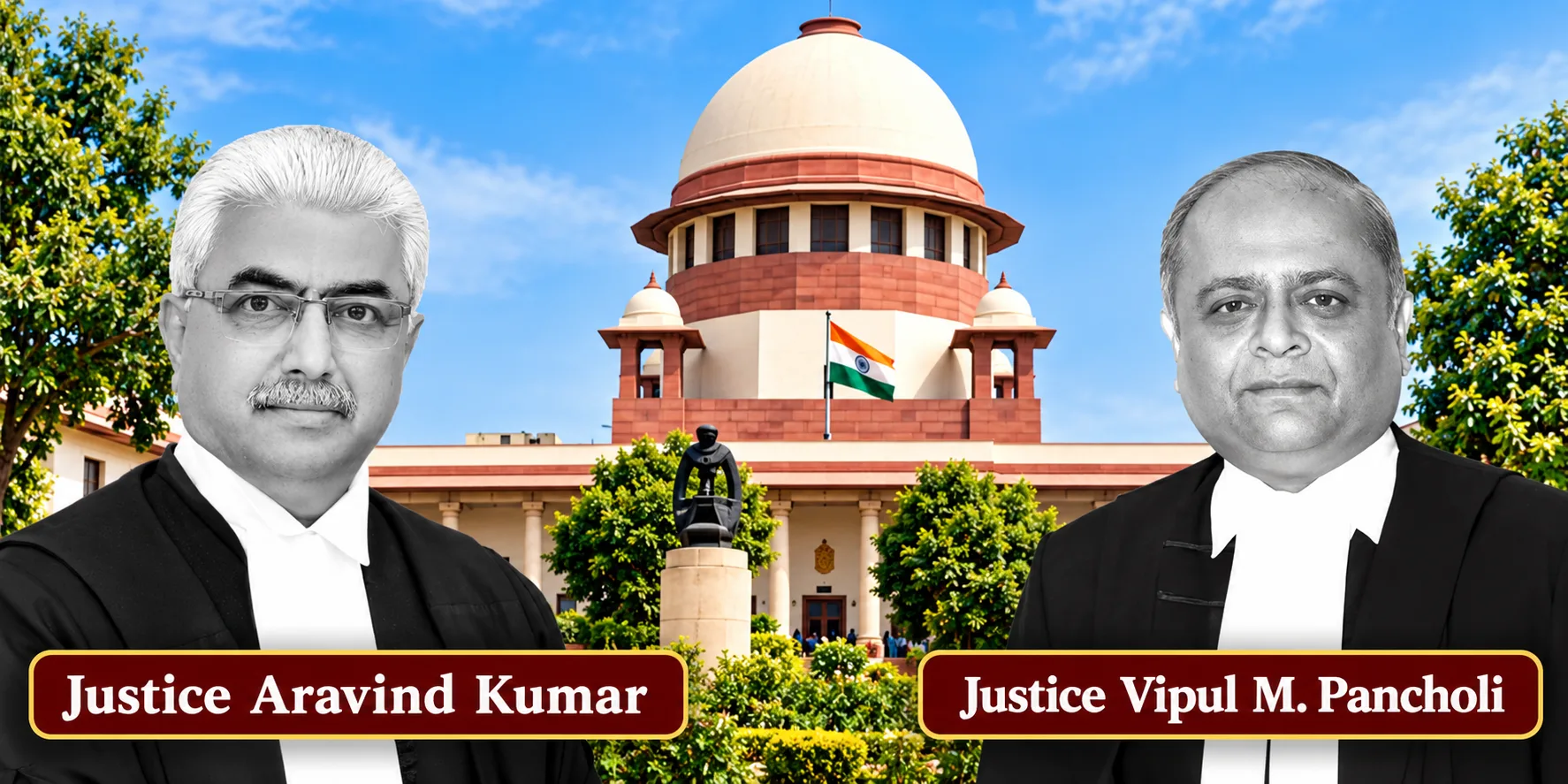
The Supreme Court has set aside the cancellation of two sand-mining auctions in Madhya Pradesh, holding that the government cannot reject the highest bids merely because they are lower than the amounts offered in an earlier auction. The Court emphasised that an auction conducted in accordance with law carries legal sanctity and cannot be cancelled without valid and objective reasons.
A Bench comprising Justice Aravind Kumar and Justice Vipul M. Pancholi ruled that although the government has the authority to reject bids, such power must be exercised fairly and on rational grounds.
Background of the Case
The dispute concerned auctions for sand-mining areas in Shahdol and Katni districts of Madhya Pradesh. In an auction conducted in October 2025, Sahakar Global Limited and Dhanlaxmi Merchandise Private Limited emerged as the highest bidders for the respective mining areas. Both companies submitted bids exceeding the reserve prices fixed by the government.
However, the Madhya Pradesh State Mining Corporation cancelled the auctions because the fresh bids were lower than the amounts offered by the companies in an earlier auction. The Corporation maintained that accepting the lower bids would result in a loss of government revenue.
The Madhya Pradesh High Court upheld the cancellation, prompting the companies to approach the Supreme Court.
Earlier Higher Bids Cannot Automatically Determine the Value
Setting aside the cancellation, the Supreme Court observed that a higher bid received in an earlier auction cannot automatically be treated as the correct measure of the value of property in a subsequent auction.
The judgment, authored by Justice Aravind Kumar, emphasised that an authority must establish a reasonable basis for concluding that bids received in a fresh auction are inadequate. The mere fact that the earlier offers were higher does not, by itself, justify cancelling a subsequent auction conducted in accordance with law.
The Court observed:
“An auction conducted in accordance with law carries a sanctity which cannot be disregarded merely because the authority thereafter considers that a higher figure might have been desirable.”
Comparison Must Have a Rational Basis
The Supreme Court also criticised the approach of the High Court and the Mining Corporation in treating the difference between the earlier and subsequent bids as a corresponding loss to the public exchequer.
The Bench explained that the earlier bids could be relevant to the decision-making process, but they could not automatically be treated as the appropriate benchmark for determining the value of the mining areas in the fresh auction.
The Court observed:
“A numerical comparator does not become sufficient merely because it exists; the comparison must bear a rational nexus with the subject and circumstances of the auction whose result is sought to be discarded.”
The Court found that the authorities had treated the difference between the earlier and later bids as decisive without adequately establishing why the results of the fresh competitive auction were unacceptable.
Supreme Court Restores the Auction Process
Allowing the appeals, the Supreme Court set aside the Madhya Pradesh High Court's judgment and quashed the Corporation's decision cancelling the Shahdol and Katni auctions.
The Court restored the tender process dated September 18, 2025, for both mining areas. It directed Sahakar Global Limited and Dhanlaxmi Merchandise Private Limited to communicate their unconditional willingness to stand by their respective final bids dated October 10, 2025, within two weeks.
The bids were ₹48,20,40,000 for Shahdol and ₹54,07,41,111 for Katni. The companies were also required to comply with the remaining tender conditions.
Key Legal Principle
The judgment reiterates that public authorities cannot cancel a lawfully conducted auction merely because they believe a higher price could have been obtained. Any decision to reject bids must rest on relevant, objective and rational considerations rather than a mechanical comparison with earlier offers.
The ruling reinforces the requirement of fairness and non-arbitrariness in government tender and auction processes, particularly where bids exceed the prescribed reserve price.
Case Title: M/s Dhanlaxmi Merchandise Pvt. Ltd. v. State of Madhya Pradesh & Ors. (with connected case)
Citation: 2026 INSC 1125
Bench: Justice Aravind Kumar and Justice Vipul M. Pancholi

Representation:-
For Petitioner(s) : Mr. Balbir Singh, Sr. Adv. Ms. Megha Karnwal, AOR Mr. Aaditya Thorat, Adv. Ms. Shreya Mishra, Adv. Mr. Christy J. Philip Vettickattu, Adv. Mr. Vedant Kohli, Adv. Ms. Shivali Shah, Adv. Mr. K. Parameshwar, Sr. Adv. Mr. Mukesh Butani, Adv. Mr. Shoeb H. Khan, Adv. Mr. Shankey Agrawal, AOR Mr. Harsh Shukla, Adv. Mr. N. Sai Kaushal, Adv. Mr. Siddharth Agrawal, Adv. Mr. Nitin Dhatarwal, Adv. Mr. Anas Hasan Khan, Adv.
For Respondent(s) : Mr. Tushar Mehta, Solicitor General Mr. Maninder Singh, Sr. Adv. Mr. Prashant Singh, Advocate General Mr. D. S. Parmar, A.A.G. Ms. Mrinal Gopal Elker, AOR Ms. Manisha T. Karia, A.A.G. Mr. Harmeet Singh Ruprah, AOR Mr. Arkaj Kumar Ga, Adv. Ms. Niharika Singh, Adv. Mr. Ruchil Jain, Adv. Mr. Mohammad Shadab Naqvi, AOR Mr. Anirudh Sharma, AOR Mr. Atreyi Chatterjee, Adv. Mr. Varun Kesharwani, Adv. Mr. Arayan Khare, Adv.
Website designed, developed and maintained by webexy