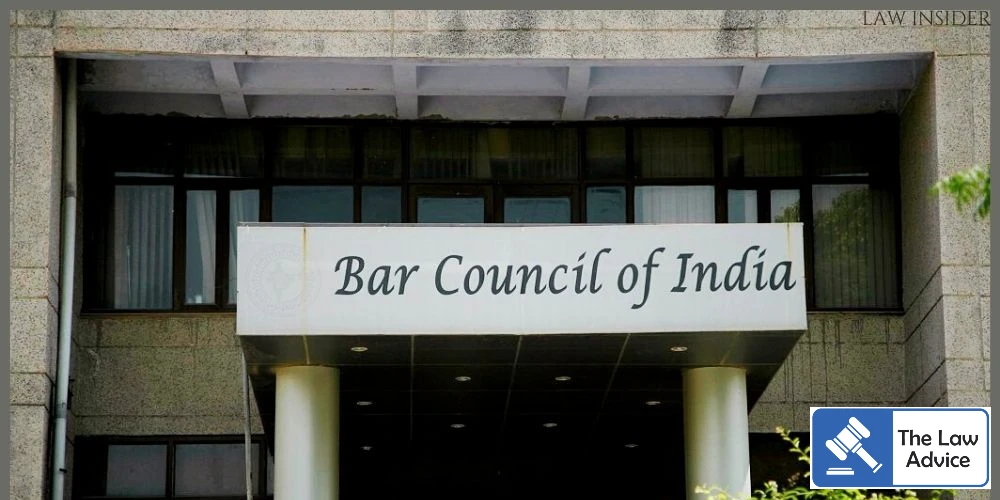
The Bar Council of India (BCI) has approved a one-time arrangement permitting certain law graduates with attendance shortages to apply for enrolment as advocates, provided they fall within the category protected by the Supreme Court and satisfy all other statutory requirements.
The arrangement applies specifically to students whose academic session was ongoing when the Delhi High Court delivered its judgment on November 3, 2025, and who were subsequently granted protection by the Supreme Court through its order dated July 21, 2026.
The BCI issued the order on August 12, 2026, following representations from students of the Faculty of Law, University of Delhi. The students had raised difficulties at the enrolment stage as their universities were unable to issue the usual Attendance or Attendance-cum-Character Certificate because of their attendance shortage.
The BCI noted that the issue was not confined to individual students or institutions. It involved candidates who had been permitted to appear in their final or supplementary examinations despite having attendance deficiencies.
Under the one-time arrangement, an eligible candidate covered by the Supreme Court's protection cannot have their enrolment application rejected, withheld or kept pending solely on the ground of attendance shortage pertaining to the protected academic session.
The BCI reasoned that if the attendance deficiency could not prevent a student from completing their LLB degree because of the judicial protection, the same deficiency should not subsequently be used on its own to deny consideration of their enrolment as an advocate.
The BCI emphasised that the arrangement is intended to give meaningful effect to the Supreme Court's protection without creating any blanket exemption from the Rules of Legal Education.
No General Relaxation of Attendance Rules
The BCI has made it clear that the relief is strictly limited to the academic session covered by the Supreme Court's July 21 order.
The arrangement will not amount to a relaxation of Rule 12 of the Rules of Legal Education, 2008, for any other batch, semester or academic session.
Describing the measure as "one-time, exceptional and transitional", the BCI clarified that it will not create a precedent for students outside the protected category.
Who Is Eligible?
The arrangement will benefit candidates who satisfy the following conditions:
- They were admitted to and pursued a recognised LLB programme at a BCI-recognised university and approved Centre of Legal Education.
- They were permitted to appear in the final or supplementary examination in accordance with the legal position applicable to the protected academic session.
- They successfully passed the prescribed examinations and obtained an LLB degree.
- They satisfy the requirements under Sections 24 and 24A of the Advocates Act, 1961, along with other applicable enrolment requirements.
The BCI has also clarified that the arrangement will have nationwide application and will not be restricted to students of Delhi University or its law centres.
The decisive factor, according to the BCI, will be whether the candidate falls within the category and academic session protected by the Supreme Court's July 21, 2026 order and otherwise fulfils the statutory requirements for enrolment.
Universities Not Required to Falsely Certify Attendance
The BCI has separately addressed the issue of attendance certificates.
Universities and Centres of Legal Education will not be required to certify that a candidate had the prescribed attendance when their contemporaneous records show otherwise. Institutions have also been directed not to alter historical attendance records or treat deficient attendance as regular.
Instead, institutions may issue an alternative certificate confirming that the candidate:
- was duly admitted to the LLB programme;
- belonged to the academic session covered by the Supreme Court's order;
- was permitted to appear in the relevant examination;
- successfully completed the LLB programme; and
- holds a genuine LLB degree.
Such certification may also mention that the attendance deficiency relates to the academic session protected by the Supreme Court, without falsely certifying that the candidate satisfied the ordinary attendance requirement.
The BCI's decision therefore provides a limited enrolment pathway for the affected graduates while preserving the general attendance requirements applicable to other law students.