
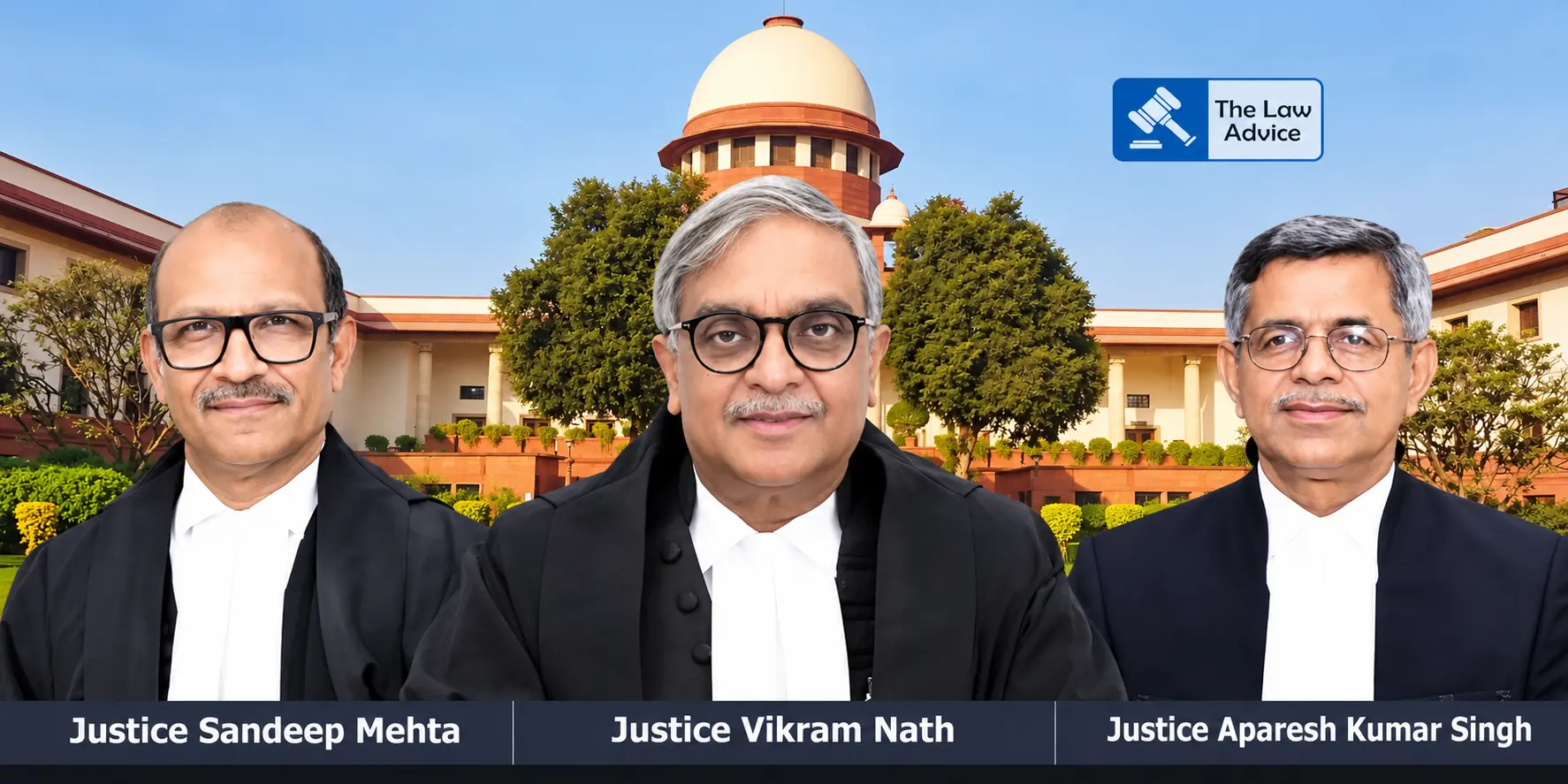
A three-judge Bench comprising Justice Vikram Nath, Justice Sandeep Mehta and Justice Aparesh Kumar Singh reserved its judgment in Mohammed Rasal C. & Anr. v. State of Kerala & Anr., SLP (Crl.) No. 6588/2025.
The proceedings arise from a challenge concerning an order of the Kerala High Court granting pre-arrest bail to the petitioners, who had approached the High Court without first seeking relief before the Sessions Court. Although the Supreme Court made the interim protection granted to the petitioners absolute, it examined the broader legal question concerning the practice of directly approaching High Courts for anticipatory bail.
The issue was referred to a three-judge Bench after a two-judge Bench comprising Justice Vikram Nath and Justice Sandeep Mehta expressed concern about the practice and noted conflicting judicial views on the issue.
The Court had observed that although the Sessions Courts and High Courts exercise concurrent jurisdiction under Section 482 of the BNSS, the hierarchy of courts ordinarily requires an applicant to approach the Sessions Court first.
According to the Court's earlier observations, permitting applicants routinely to bypass Sessions Courts could lead to a substantial increase in anticipatory bail applications before High Courts. The Sessions Courts, it reasoned, could act as a first level of consideration, potentially resolving many applications before they reach the High Courts.
Senior Advocate Siddharth Luthra was appointed amicus curiae, assisted by Advocate Arudhra Rao, to assist the Court in examining the issue.
The amicus suggested that applicants should ordinarily approach the Sessions Court first, while recognising that exceptional circumstances may justify a direct approach to the High Court.
The circumstances identified in the submissions included:
Where the accused does not reside within the territorial jurisdiction of the Sessions Court concerned and apprehends arrest.
Where local law-and-order disturbances, hostility or a reasonable apprehension of serious bodily harm to the accused or family members makes it difficult to seek effective relief before the Sessions Court.
Where a medical emergency or a similar exceptional situation prevents the accused from approaching the Sessions Court.
Where the court of first instance exercising jurisdiction under the anticipatory bail provision is a Special or designated Court of the rank of an Additional Sessions Judge or Sessions Judge dealing with a special or local law.
These were suggestions placed before the Court by the amicus and do not, by themselves, constitute a final ruling on the circumstances in which a direct application may be entertained.
The question has generated differing judicial approaches. While some courts have ordinarily required applicants to approach the Sessions Court first, others have held that the concurrent jurisdiction conferred upon the Sessions Court and the High Court does not create an absolute bar against directly approaching the High Court.
In Manjeet Singh v. State of Uttar Pradesh (2025), the Supreme Court set aside an Allahabad High Court order that had refused to entertain an anticipatory bail application because the applicant had not first approached the Sessions Court.
Similarly, in Kanumuri Raghuarama Krishnam Raju v. State of Andhra Pradesh (2021), the Supreme Court held that an anticipatory bail application could not be rejected merely because the applicant had approached the High Court first, noting that both courts exercised concurrent jurisdiction.
On the other hand, in Jagdeo Prasad v. State of Bihar (2025), the Supreme Court cautioned High Courts against directly entertaining anticipatory bail applications in the ordinary course and emphasised that applicants should ordinarily approach the Sessions Court first.
The Kerala High Court has also witnessed differing judicial views on the issue.
In Usman v. S.I. of Police (2003), a single judge took the view that the High Court should not ordinarily exercise anticipatory bail jurisdiction when the Sessions Court had not first been approached. Directions were also issued concerning the numbering of such applications.
Subsequently, in Balan v. State of Kerala (2003), a Division Bench overruled those directions and held that Section 438 CrPC did not restrict the applicant's choice between the two courts. Despite this, differing approaches continued within the High Court.
The Supreme Court's decision is expected to clarify the legal position concerning the exercise of concurrent anticipatory bail jurisdiction and the circumstances, if any, in which a High Court may be approached directly without first seeking relief from the Sessions Court.
Case: Mohammed Rasal C. & Anr. v. State of Kerala & Anr.
Case Number: SLP (Crl.) No. 6588/2025
Bench: Justice Vikram Nath, Justice Sandeep Mehta and Justice Aparesh Kumar Singh
Website designed, developed and maintained by webexy