
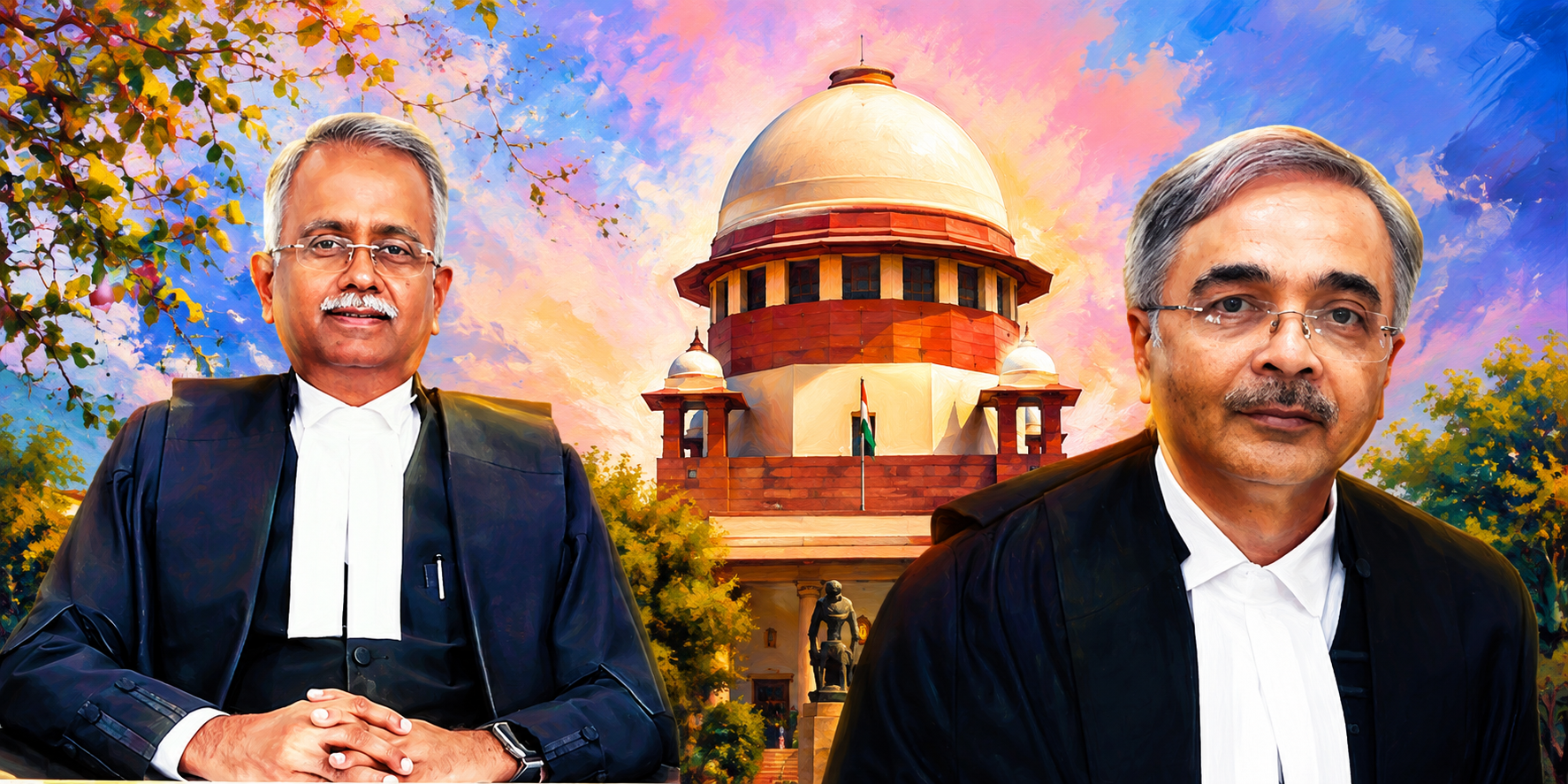
The Supreme Court has enhanced compensation payable to a motor accident victim to ₹50,81,876, holding that an acquittal in a criminal case does not by itself displace civil liability for negligence in proceedings before the Motor Accident Claims Tribunal (MACT).
A Bench comprising Justice S.V.N. Bhatti and Justice N.V. Anjaria held that FIRs and charge sheets have prima facie evidentiary value in motor accident claims and that criminal proceedings and MACT proceedings operate on different standards of proof.
The case arose from a road accident that occurred at about 1:20 AM on October 14, 2005, on NH-48 near Siddeshwara Petrol Bunk, opposite Sapthagiri Hospital, Kunigal, Karnataka.
A Hyundai Santro carrying the appellant Reena, her husband Nandan Shet, her mother-in-law Geetha Shet and family friend Mahesh collided with a KSRTC heavy passenger vehicle.
Nandan Shet, Geetha Shet and Mahesh died in the accident, while Reena survived after suffering injuries and hospitalization.
The accident resulted in FIR No. 275 of 2005 at Kunigal Police Station and a charge sheet was filed against the KSRTC bus driver. However, the criminal court subsequently acquitted the bus driver by giving him the benefit of doubt.
Reena filed separate compensation claims for the death of her husband, the death of her mother-in-law and the injuries suffered by her.
The Motor Accident Claims Tribunal, after considering her evidence, the FIR, charge sheet and the statement of the bus conductor, found that the accident had occurred because of the rash and negligent driving of the KSRTC bus driver.
The High Court of Karnataka, however, partly altered the findings and held that there was 50% contributory negligence on the part of the Santro driver. It enhanced the compensation relating to the husband's death to ₹14,35,267 but reduced the payable amount to ₹7,17,634 after applying 50% contributory negligence.
The Supreme Court closely examined the evidence regarding the accident.
The Court noted that the bus conductor had given a statement to the police stating that the KSRTC bus was being driven rashly and negligently and had hit the car coming from the opposite direction. The impact dragged the car for around 50 to 60 feet, after which it hit a PWD compound wall.
The Bench also noted that the defence had not put to the claimant that the accident was caused by negligent driving of the Santro driver.
The Court found that the High Court had relied substantially on the position of the Santro shown in the site sketch to attribute 50% negligence to the deceased driver.
The Supreme Court held that this approach was erroneous and restored the Tribunal's finding that the accident occurred due to the rash and negligent driving of the KSRTC bus driver.
One of the important aspects of the judgment concerns the effect of a criminal court's acquittal in motor accident compensation proceedings.
The Supreme Court reiterated that criminal proceedings and MACT claims operate in different legal realms.
The standard required for establishing criminal liability is substantially higher than the civil standard applicable in motor accident claims. Consequently, findings or acquittals in criminal proceedings cannot control the outcome of MACT proceedings, which are decided on the basis of the preponderance of probabilities.
The Court specifically observed that the bus driver had not been “honourably acquitted”; rather, he had received the benefit of doubt.
Therefore, the High Court should have independently assessed the oral and documentary evidence available in the MACT proceedings.
The Court laid down the relevant principles emerging from its earlier decisions.
It held that:
The Bench also observed that the location where a lighter vehicle comes to rest after an accident cannot automatically be treated as the location or position from which the vehicle was being driven before the collision. A heavy vehicle can drag or push a smaller vehicle after impact.
The Supreme Court also reconsidered the income of the deceased husband, Nandan Shet.
The High Court had taken his notional income at ₹20,000 per month. The Supreme Court found this assessment to be on the lower side considering his qualifications and professional background.
The deceased held a Bachelor of Engineering degree in Mechanical Engineering and had acquired specialised software certifications in Oracle and Visual Basic. The record also contained invoices, quotations and banking material showing that he had transitioned from salaried employment to independent IT business activities.
Considering the overall evidence, the Court assessed his realistic income at ₹70,000 per month at the time of his death in October 2005.
Supreme Court Allows Additional Evidence
The Court also permitted the claimant to place additional documents on record despite the delay.
The Bench noted that the accident had left the claimant in severe physical and mental shock and that the litigation had continued for 21 years. It held that the additional documents were relevant for determining just compensation.
The Court relied upon Order XLI Rule 27(1)(b) CPC and the beneficial nature of the Motor Vehicles Act to permit the additional evidence.
Compensation Enhanced to ₹50.81 Lakh
After reassessing the deceased's income, future prospects and the applicable multiplier, the Supreme Court calculated the compensation for the death of Nandan Shet as follows:
The amount will carry 6% annual interest from the date of filing of the claim petition until realization.
The compensation awarded in the other connected appeals concerning the death of the mother-in-law and the claimant's injuries was confirmed, but the liability was modified to be exclusively payable by KSRTC in light of the finding that there was no contributory negligence on the part of the Santro driver.
Key Legal Principle
An acquittal in a criminal case does not determine or extinguish civil liability in a motor accident claim. MACT proceedings are governed by the standard of preponderance of probabilities, and FIRs and charge sheets can constitute prima facie evidence of negligence. A post-accident vehicle position shown in a site sketch cannot, without corroborating evidence, be used alone to establish contributory negligence.
Case Details

Representation:-
Amicus Curiae:- Ms. Awantika Manohar AOR
For Petitioner(s):- Petitioner-in-person
For Respondent(s):- Ms. Kiran Suri Sr. Adv., Mrs. T S Shanthi Adv., Ms. Sneha Irine Kachhap Adv., Mr. Amith J Adv., Mr. P. Srinivasan AOR, Mr Aditya Kumar Adv., Mr. Yash Kotak Adv
Website designed, developed and maintained by webexy