
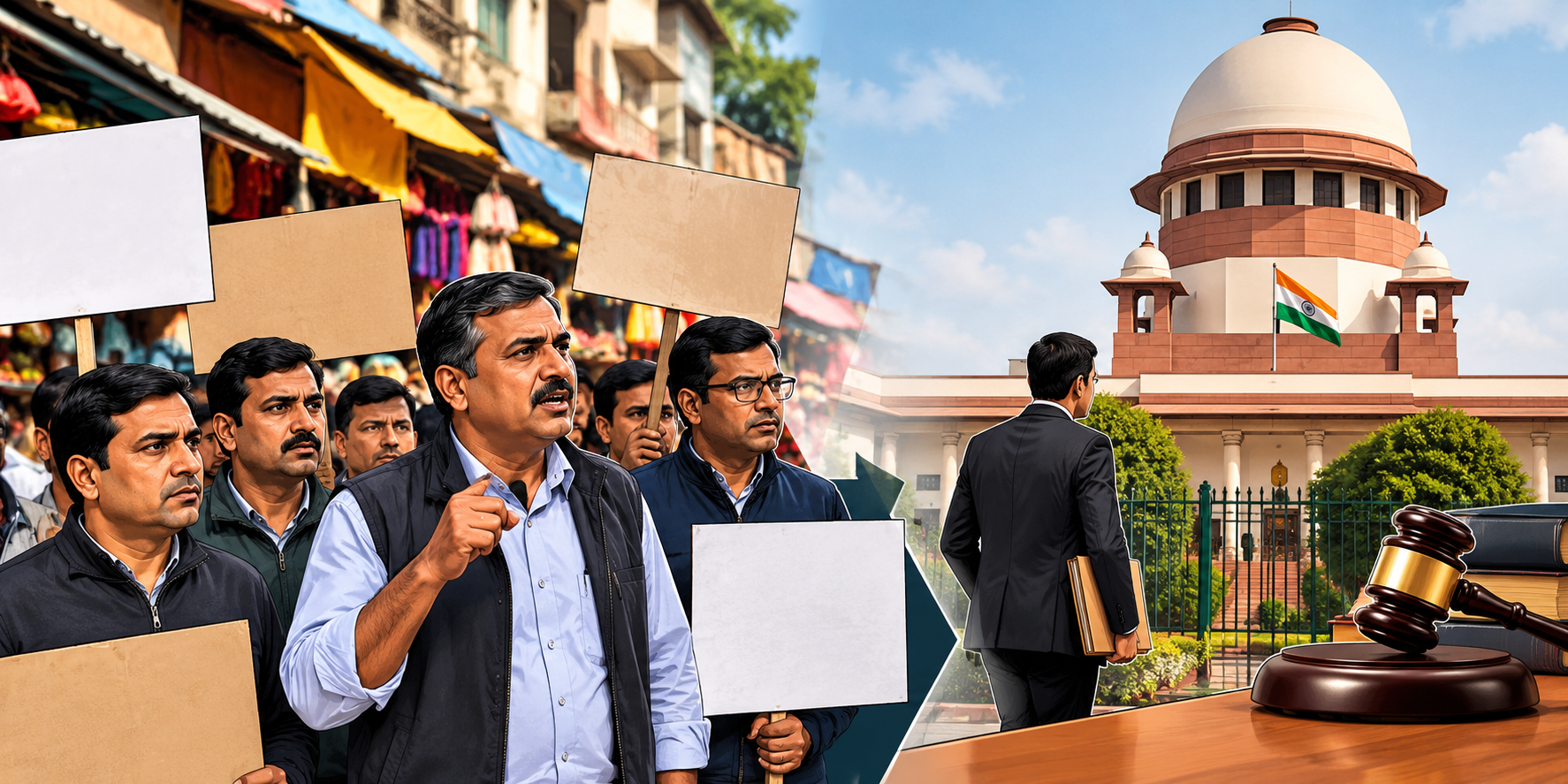
The Supreme Court on Friday declined to pass an immediate order on a plea filed by Delhi traders' associations seeking protection against business losses allegedly caused by the proposed Cockroach Janta Party (CJP) protest at Central Park in Connaught Place and the consequent decision to shut the park.
Tghe bench of Chief Justice of India Surya Kant said the Court would exercise its powers if the protest resulted in any unlawful disruption of business. The CJI-led Bench indicated that it would hear the plea in the last week of October.
The petition was filed by the Delhi Kirana Committee and the Delhi Iron and Hardware Merchant Association, which expressed apprehension that the proposed protest could disrupt commercial activities in Connaught Place. The traders claimed that the market handles business worth around Rs 200 crore a day.
Emphasising the impact of disruptions on small traders and their families, CJI Surya Kant said, “We hope better sense will prevail on everyone... We know that all small shopkeepers, they earn their livelihood during these days. We know the hardship and difficulty entire families will face.”
The petitioners also highlighted the potential impact of the closure of Central Park on hawkers and small traders, who could lose business during the festive and wedding season.
“Someone wants to protest, someone wants to sell moongfali (peanuts), someone wants law and order, all are related,” Justice Joymalya Bagchi observed while referring to other petitions before the Court concerning the protests.
The traders' associations have sought directions to ensure that protests, sit-ins, processions and road blockades do not disrupt commercial activities or access to major markets in Delhi. The plea estimates that traders have suffered losses of around Rs 2,000 crore due to protests since October 10.
The New Delhi Traders Association has separately claimed that traders in Connaught Place alone incurred losses of Rs 150 crore to Rs 200 crore due to the protest held on October 10.
The petitioners have sought three principal directions from the Court. First, they have sought uninterrupted access to major markets and roads leading to them between October 2026 and January 2027. Second, they have called for suitable protest sites to be identified and officially notified away from commercial areas and the city centre. Third, they have sought the formulation of a standard operating procedure (SOP) to regulate protests while balancing the right to protest with the interests of businesses, livelihoods and public transport.
Responding to the traders' concerns, CJP founder Abhijeet Dipke blamed the government's actions for the alleged business losses. In a post on X, he said, “Businesses do not suffer because of peaceful protests. They suffer when the govt decides to shut down an entire city, suspend internet services and restrict the movement of its own citizens and turn the city into a war-zone.”
Website designed, developed and maintained by webexy