
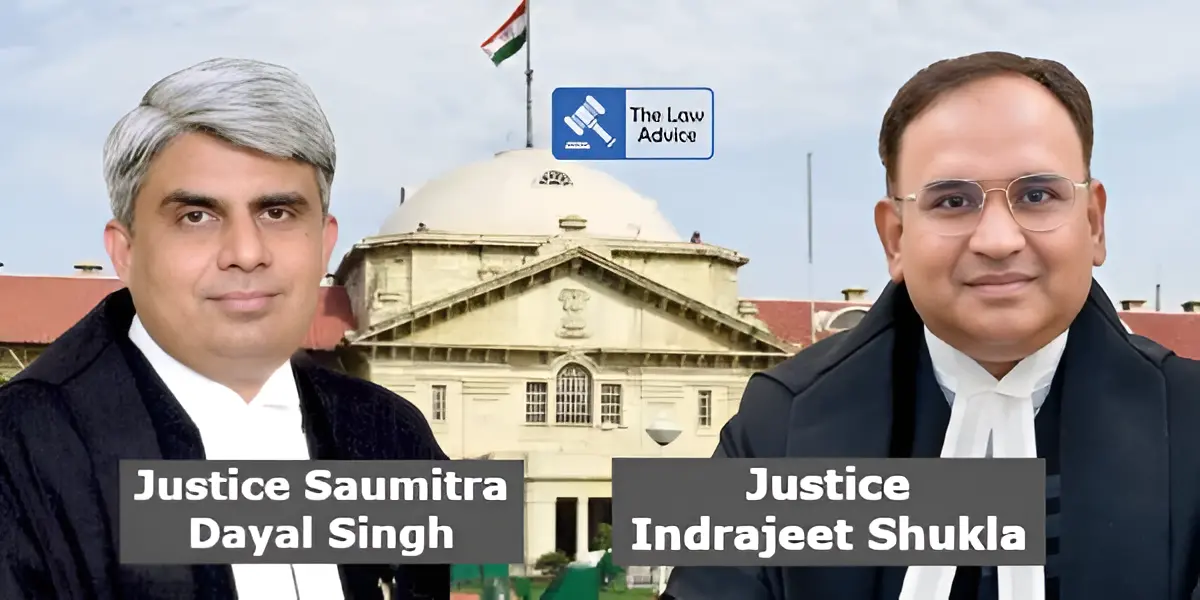
The Allahabad High Court has held that the Directorate of Revenue Intelligence (DRI) cannot retain seized cash beyond the statutory period of six months unless a valid extension order is passed by the competent authority after recording reasons in writing and communicating the same to the affected person within the prescribed period.
A Division Bench comprising Justice Saumitra Dayal Singh and Justice Indrajeet Shukla ruled that retention of seized cash beyond six months without compliance with Section 110(2) of the Customs Act, 1962, is illegal, without jurisdiction, and contrary to the procedure established by law.
The Court made the observations while allowing a writ petition filed by Shalabh Agarwal and another petitioner seeking release of ₹25.20 lakh seized by DRI officials during search proceedings conducted in August 2025.
During the proceedings, the DRI relied on a note-sheet dated February 18, 2026, claiming that it constituted a valid order extending the period for investigation and issuance of a show cause notice.
However, the High Court found that the document merely contained signatures of the concerned authority and failed to disclose any independent application of mind or recorded reasons justifying the extension.
The Bench observed:
"The existence of the signature on the order sheet is nothing more than a rubber stamp, affixed without application of mind."
The Court emphasized that Section 110(2) of the Customs Act specifically requires the competent authority to record reasons in writing before extending the period for retention of seized goods or cash.
According to the Bench, a mere signature without any reasoning cannot amount to a valid exercise of statutory power.
The Court further noted that Section 110(2) requires not only the passing of a valid extension order but also its communication to the affected person before expiry of the original six-month period.
The DRI admitted before the Court that the alleged extension note-sheet had never been communicated to the petitioners before the expiry of the statutory period.
Recording this admission, the Bench held:
"Thus, neither of the conditions prescribed under Section 110 of the Act was fulfilled."
As a result, the petitioners acquired a statutory right to return of the seized cash immediately after the expiry of six months from the date of seizure.
The High Court categorically held that retention of the cash after February 20, 2026 was wholly illegal.
The Court observed:
"The retention of the money from 20.02.2026 to 20.05.2026 is wholly illegal and outside the procedure prescribed by the law."
It further stated that the seized cash ought to have been returned automatically once the mandatory statutory requirements were not fulfilled, even without any application from the petitioners.
The Court also expressed serious concern over the conduct of DRI officials in transferring the seized cash to the Income Tax Department during the pendency of the writ petition.
The Bench observed that the legality of the retention of the cash was already under judicial scrutiny and that the DRI authorities were fully aware of the ongoing proceedings.
Making strong remarks against the department, the Court observed:
"We are forced to reach a conclusion that DRI authorities have deliberately attempted to defeat the ends of justice and specifically the present petition."
The Court further noted that the conduct of the authorities appeared aimed at overreaching the judicial process rather than participating in it in accordance with law.
Initially, the Court proposed imposing costs of ₹10 lakh on the DRI for its actions.
However, during the hearing, the DRI filed an affidavit through a senior officer tendering an unconditional apology and assuring the Court that similar lapses would not occur in the future. The department also produced an office order directing officers not to take action in matters pending before courts without verifying the status of judicial proceedings.
Taking note of these assurances, the Court reduced the costs but still held that the petitioners had suffered due to the illegal retention of their money for nearly three months beyond the statutory period.
Accordingly, the Court directed the DRI to pay ₹1 lakh as costs to the petitioners.
The judgment reinforces that authorities exercising powers under the Customs Act must strictly comply with the safeguards contained in Section 110(2). Any extension of the period for retaining seized cash or goods must be supported by recorded reasons, approved by the competent authority after due application of mind, and communicated to the affected person within the prescribed period. Failure to satisfy these requirements renders continued retention unlawful.
Case: Shalabh Agarwal and Another v. Additional Director General and Another
Neutral Citation: 2026:AHC:124246-DB
Website designed, developed and maintained by webexy