
The Supreme Court has quashed the land acquisition proceedings initiated by the Odisha Government for a mining project of Dalmia Cement, holding that the acquisition violated the mandatory requirements of the Right to Fair Compensation and Transparency in Land Acquisition, Rehabilitation and Resettlement Act, 2013. The Court ruled that prior consent of the Gram Sabha under Section 41(3) is mandatory for acquisition in Scheduled Areas and cannot be treated as a mere procedural formality.
The Supreme Court has set aside the land acquisition proceedings initiated by the State of Odisha for acquiring approximately 273.57 acres of agricultural land in three villages of Sundergarh district for mining operations by M/s Dalmia Cements Bharat Limited.
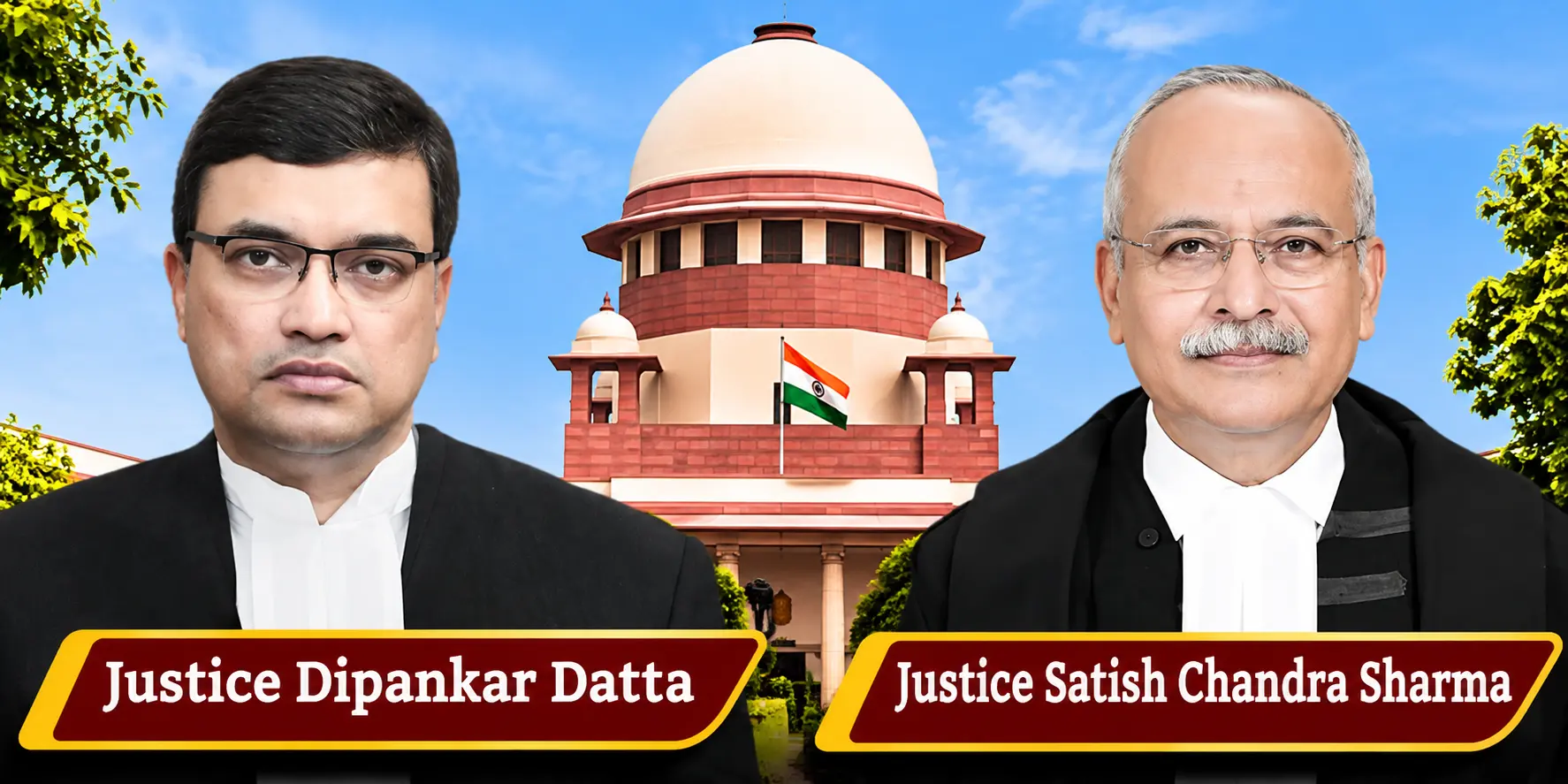
A Bench of Justice Dipankar Datta and Justice Satish Chandra Sharma, in its judgment dated November 18, 2026, allowed the appeal filed by residents of Kukuda, Bihabandha and Lanjiberna villages and held that the acquisition proceedings were legally unsustainable.
The Court quashed the acquisition along with the relevant notifications and orders, while clarifying that the State would remain at liberty to initiate fresh land acquisition proceedings in accordance with law and the findings recorded in the judgment.
Background of the Case
The State Government had granted a mining lease to Dalmia Cements Bharat Limited over an area of approximately 893.55 hectares. The lease was extended from time to time, with the latest extension continuing until February 29, 2040.
In 2015, the company sought acquisition of surface rights over approximately 273.57 acres of agricultural land situated in Kukuda, Bihabandha and Lanjiberna villages to undertake mining activities.
The State initiated acquisition proceedings under the Right to Fair Compensation and Transparency in Land Acquisition, Rehabilitation and Resettlement Act, 2013.
On January 26, 2020, the concerned Gram Panchayats passed resolutions rejecting the proposed acquisition. However, the State proceeded with the acquisition process and issued notifications under the 2013 Act.
The affected villagers challenged the acquisition before the Orissa High Court. The High Court dismissed their petition, holding, among other things, that the requirement of prior consent did not apply in the manner contended by the villagers and that consent could be obtained at different stages of the acquisition process.
Aggrieved by the decision, the villagers approached the Supreme Court.
Acquisition for a Private Company Requires 80% Prior Consent
The Supreme Court examined Section 2(1) and Section 2(2) of the 2013 Act and observed that Section 2(1) applies where the Government acquires land for its own use, hold and control, whereas Section 2(2) applies when the Government acquires land for private companies for a public purpose.
The Bench found that the acquisition in the present case was undertaken exclusively for the mining activities of Dalmia Cement, a private company. The State had no intention of using, holding or controlling the acquired land for its own purposes.
Consequently, the acquisition was governed by Section 2(2)(b) of the 2013 Act, which requires the prior consent of at least 80% of the affected families in cases involving acquisition for private companies.
The Court further held that such consent must be obtained along with the Social Impact Assessment (SIA) study and before the Government examines the acquisition proposal under Section 8 of the Act.
Rejecting the argument that consent could be obtained at any stage of the acquisition proceedings, the Court observed that such an interpretation would defeat the very purpose of the statutory requirement of prior consent.
The State had claimed that consent from 482 affected families had been obtained. However, the Court noted that no material had been placed on record to establish that consent was obtained in the prescribed Form J under Rule 21 of the Odisha Rules.
The Bench held that even assuming such consent had subsequently been obtained, it could not cure the failure to obtain prior consent at the legally prescribed stage.
Section 41(3): Prior Consent of Gram Sabha Is Mandatory in Scheduled Areas
One of the significant findings in the judgment concerns the interpretation of Section 41(3) of the 2013 Act.
The provision requires prior consent of the concerned Gram Sabha, Panchayat or Autonomous District Council, as applicable, before issuing a land acquisition notification in Scheduled Areas falling under the Fifth Schedule of the Constitution.
The respondents argued that the requirement under Section 41(3) was directory rather than mandatory, relying upon the expressions “as far as possible” and “demonstrable last resort” appearing in Sections 41(1) and 41(2).
Rejecting this interpretation, the Supreme Court held that the three sub-sections operate in distinct spheres.
The Court explained that Section 41(1) requires the Government to avoid acquisition in Scheduled Areas as far as possible, while Section 41(2) requires that any such acquisition be undertaken only as a demonstrable last resort. However, once the Government decides to proceed with acquisition, Section 41(3) makes prior consent of the Gram Sabha mandatory.
The Bench held that the mandatory requirement under Section 41(3) cannot be diluted by referring to the language used in the preceding sub-sections.
Importantly, the Court noted that the Gram Sabhas concerned had expressly rejected the acquisition proposal through resolutions dated January 26, 2020. Despite this rejection, the State proceeded with the acquisition without obtaining the required consent.
The Court observed that the statutory requirement had not merely been reduced to a paper formality; in the present case, there was not even paper consent of the Gram Sabha in the prescribed Form M under Rule 41 of the Odisha Rules.
No Public Hearing Conducted on Social Impact Assessment
The Supreme Court also found serious procedural deficiencies in the Social Impact Assessment process.
Although a public hearing had been scheduled for April 16, 2021, there was no material to establish that the hearing had actually taken place.
The Court referred to RTI responses received from the concerned Gram Panchayats, which indicated that no public hearing could be conducted on the scheduled date due to COVID-19 restrictions.
The respondents had argued that villagers attended the hearing but that videography could not be completed due to non-cooperation and disturbances. However, the Court found no supporting material for this explanation.
It further noted that the views and concerns of affected persons were required to be recorded in the final SIA report, but no such views formed part of the report.
Inclusion of Company-Connected Person in Expert Group Violated Section 7
Another important issue concerned the composition of the Expert Group constituted under Section 7 of the 2013 Act to evaluate the Social Impact Assessment report.
The appellants contended that the independence of the Expert Group was compromised because one of its members, Mr. Ashok Kumar Sahoo, was associated with the company as its Advisor for Land Acquisition.
The Supreme Court agreed with this contention.
The Court observed that Section 7(1) expressly requires the SIA report to be evaluated by an independent multidisciplinary Expert Group. Although Section 7(2) provides for the inclusion of a technical expert, such inclusion cannot compromise the statutory requirement of independence.
The Bench observed that a person having a direct financial and professional connection with the project proponent could not be expected to independently assess whether the project serves public interest or whether its social costs outweigh its benefits.
Holding that the inclusion of Mr. Sahoo compromised the independence of the Expert Group, the Court observed that it had the effect of rendering the Group's deliberations a “fixed match”.
The respondents were therefore found to have violated Section 7 of the 2013 Act.
Mining Lease Cannot Override Land Acquisition Law
The Supreme Court also rejected the argument that the Mines and Minerals (Development and Regulation) Act, 1957 (MMDR Act) operated as a complete code and permitted the mining company to undertake mining activities without complying with the land acquisition requirements under the 2013 Act.
The Court held that the MMDR Act and the 2013 Act operate in distinct spheres.
While the MMDR Act regulates mining concessions and the relationship between the State and the mining lessee, the 2013 Act governs the acquisition of land, including consent, compensation, rehabilitation and resettlement.
The Bench clarified that a mining lease granted by the State cannot override the proprietary rights of third-party landowners or dispense with statutory requirements for acquiring their land.
It observed that a contractual arrangement between the State and a mining lessee cannot adversely affect the independent proprietary rights of landowners who are not parties to that arrangement.
Supreme Court Sets Aside Entire Acquisition Proceedings
On the issue of locus standi, the Supreme Court also observed that the State could not question the appellants' connection with the acquired land after failing to discharge its statutory obligation to update the land records during the acquisition process.
The Court held that when the State itself had committed statutory violations, a constitutional court should not reject a challenge merely on technical grounds, particularly where the defect was curable and could have resulted from the State's own inaction.
Concluding that the acquisition proceedings suffered from multiple statutory violations, the Supreme Court allowed the appeal and held that the land acquisition was unsustainable.
The Court accordingly:
Case Details

Representation:-
For the Appellants: Mr. Sanjay Parikh, Senior Advocate, Mr. Abhimanue Shrestha, Advocate-on-Record, Ms. Sridevi Panikkar, Advocate, Mr. Ashok Kumar Minj, Advocate, Ms. Kritika, Advocate, Mr. Satwik Parikh, Advocate.
For the Respondents: Mr. K. M. Nataraj, Additional Solicitor General, Mr. Pitambar Acharya, Advocate General, Ms. Divya Roy, Advocate-on-Record, Ms. Deveshi Mishra, Advocate, Mr. Vinayak Sharma, Advocate, Mr. Ruturaj Satpathy, Advocate, Mr. Yogya Rajpurohit, Advocate, Mr. Rakesh Dwivedi, Senior Advocate, Mr. Mahesh Agarwal, Advocate, Mr. M.S. Ananth, Advocate, Ms. Kamakshi Sehgal, Advocate, Mr. Paranjai Singh, Advocate, Mr. Eklavya Dwivedi, Advocate, Mr. Mohd. Yasir, Advocate, Mr. E.C. Agrawala, Advocate-on-Record.
Website designed, developed and maintained by webexy