
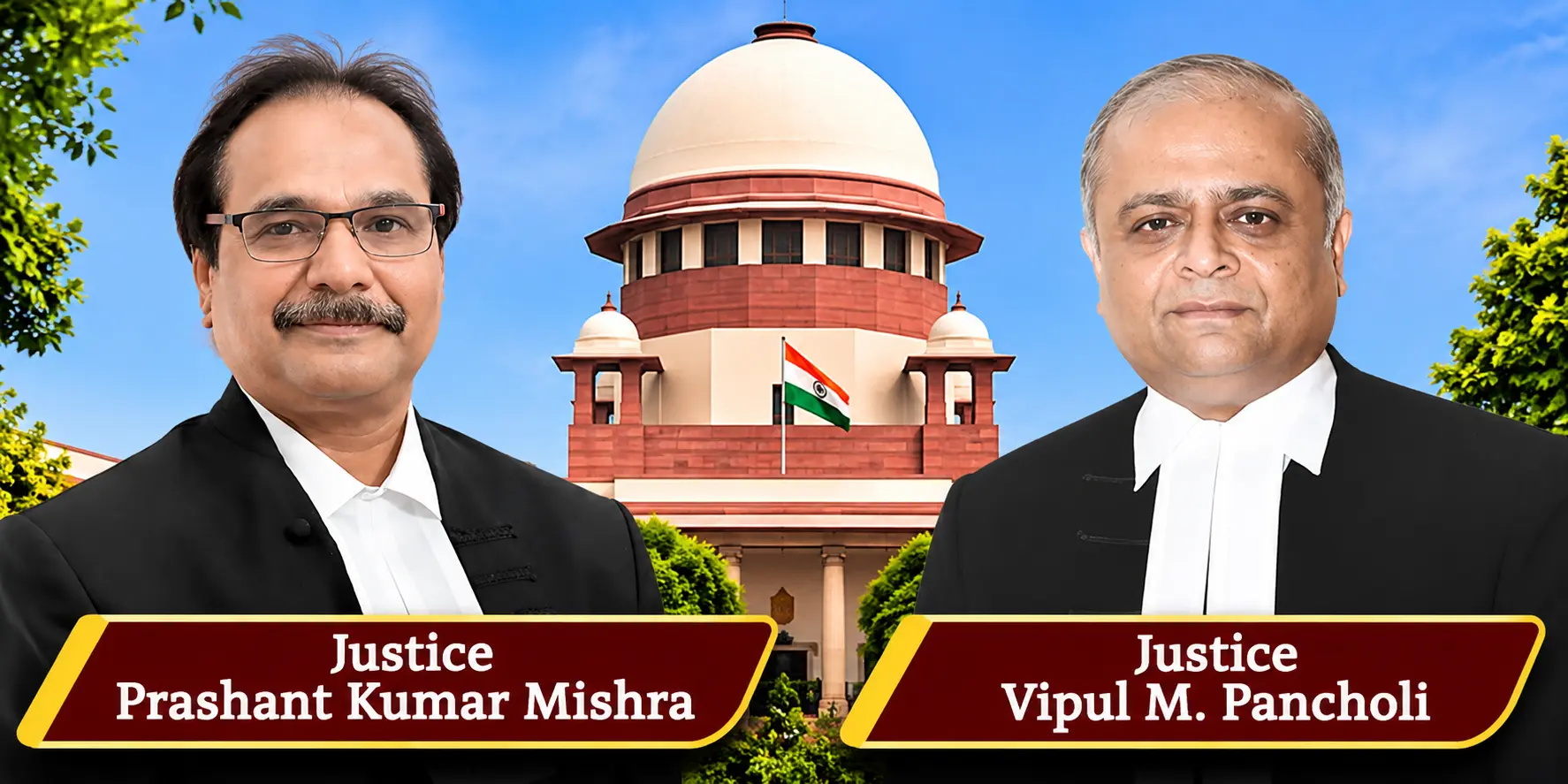
The Supreme Court has set aside the life sentence of a man convicted of murdering a woman, holding that the prosecution failed to establish an unbroken chain of circumstantial evidence. The Court observed that the recovery of jewellery allegedly belonging to the deceased, by itself, cannot establish guilt for murder unless the prosecution proves that the theft and murder formed part of the same transaction.
The Supreme Court has acquitted Bheemanagouda alias Bheemajja, who had been convicted under Section 302 of the Indian Penal Code (IPC) for the murder of Sharadamma, observing that the prosecution had failed to prove his guilt beyond reasonable doubt.
A Bench of Justice Prashant Kumar Mishra and Justice Vipul M. Pancholi, in its judgment dated November 18, 2026, allowed the appeal and set aside the conviction and life imprisonment awarded to the appellant by the Trial Court and affirmed by the Karnataka High Court.
The case arose from the discovery of the dead body of a woman inside an iron drum near a limestone kiln at Harapanahalli, Karnataka, on September 5, 2013. The deceased was subsequently identified as Sharadamma. The prosecution alleged that the appellant, who was stated to be in a relationship with her, had strangled her and taken away her gold and silver ornaments.
The Trial Court convicted the appellant under Section 302 IPC and sentenced him to life imprisonment, relying principally upon the recovery of the deceased's ornaments from his house. It had, however, rejected the prosecution's last-seen-together theory and acquitted him under Section 201 IPC. The Karnataka High Court subsequently upheld the murder conviction.
Before the Supreme Court, the appellant argued that the case rested entirely on circumstantial evidence and that the prosecution had failed to establish a complete chain connecting him with the crime.
Supreme Court's Observations
The Supreme Court reiterated that in cases based entirely on circumstantial evidence, the prosecution must satisfy the five golden principles laid down in Sharad Birdhichand Sarda v. State of Maharashtra.
On the alleged motive, the Court found that the prosecution had failed to establish that the appellant suspected the deceased of having a relationship with another person. Although witnesses spoke about an alleged relationship between the appellant and the deceased, none testified that the appellant had such suspicion or that any quarrel had taken place on that account. The Court held that the alleged motive was based on conjecture and surmise.
On the last-seen-together theory, the Court noted that the statements of the two witnesses, Nagappa (PW-13) and Palakshappa (PW-14), were recorded by the investigating officer nearly two months after the incident. The Trial Court had rejected their testimonies due to the unexplained delay of 58 days. The Supreme Court held that the High Court had erred in relying upon these testimonies without addressing the delay or giving reasons for reversing the Trial Court's finding.
The Court also found inconsistencies in the prosecution's account concerning the discovery of the dead body inside the iron drum. The informant who allegedly alerted the complainant about the body was neither traced nor examined by the investigating agency. Further, the inquest and post-mortem reports did not reveal any trace or stain of limestone on the deceased's body or clothing.
Recovery of Jewellery Not Sufficient to Prove Murder
A significant part of the judgment dealt with the recovery of gold and silver ornaments allegedly belonging to the deceased from the appellant's house.
The Supreme Court found several deficiencies in the recovery proceedings. The independent witnesses did not provide cogent evidence supporting the alleged disclosure statement made by the appellant. The Court also noted inconsistencies in the seizure mahazar and the testimony of the goldsmith/appraiser, who admitted that he was a regular police witness.
Further, the prosecution failed to establish that the deceased was actually wearing the recovered ornaments when she was last seen alive. The Court also noted that one of the witnesses had stated that the police had informed him about the recovery of the ornaments from the appellant's house on the day following the incident, contradicting the prosecution's claim that the recovery took place eight days later.
Relying upon the decisions in Sanwat Khan v. State of Rajasthan and Raj Kumar @ Raju v. State (NCT of Delhi), the Court observed that unexplained possession of stolen articles may give rise to a presumption concerning theft or receipt of stolen property under Illustration (a) to Section 114 of the Evidence Act. However, such possession cannot, by itself, be stretched to infer guilt for murder unless there is cogent evidence establishing that the theft and murder formed part of the same transaction.
The Court further observed that the prosecution had not framed any charge against the appellant under Sections 379, 392 or 404 IPC for theft or robbery.
Conviction Set Aside; Appellant Ordered to Be Released
Concluding that the chain of circumstantial evidence was incomplete and unbroken, the Supreme Court held that the findings of guilt recorded by the Trial Court and affirmed by the High Court were based on conjectures and surmises.
The Bench allowed the appeal, quashed the appellant's conviction under Section 302 IPC and set aside the sentence of life imprisonment and fine. The acquittal under Section 201 IPC was maintained.
The Court directed that the appellant, who was in custody undergoing the life sentence, be released forthwith unless his presence was required in any other case.

Representation:-
For the Petitioner(s): Mr. A. Sirajudeen, Senior Advocate, Ms. Jyotika Kalra, Advocate-on-Record, Mr. Arun Bir Singh Yadav, Advocate, Mr. Inderdeep Singh, Advocate, Mr. Aditya Jha, Advocate, Ms. Sonakshi Shankar Dikshit, Advocate, Ms. Shrika Gautam, Advocate.
For the Respondent(s): Mr. Avishkar Singhvi, Additional Advocate General, Mr. Rajesh Gulab Inamdar, Advocate-on-Record, Mr. Shashwat Anand, Advocate, Ms. Rakshita Singh, Advocate, Mr. Himanshu Mishra, Advocate, Mr. Vivek Kr. Singh, Advocate.
Website designed, developed and maintained by webexy