
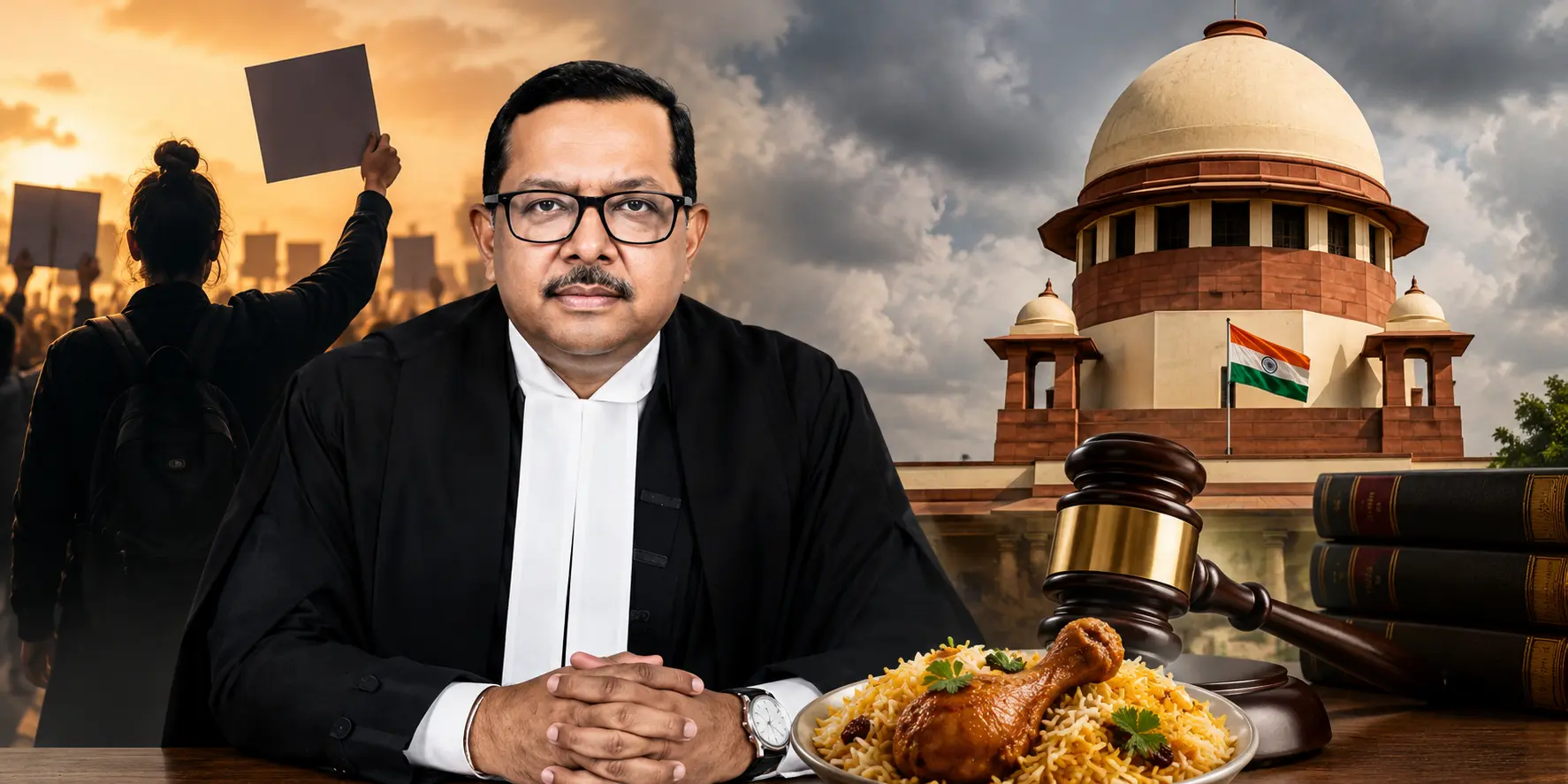
Supreme Court Judge Justice Ujjal Bhuyan has expressed serious concern over what he described as the shrinking democratic space for expressing dissent in India, warning that peaceful protests and divergent opinions are increasingly being criminalised. Addressing law students at the Justice G.P. Singh 4th Memorial Lecture held at the National Law Institute University (NLIU), Bhopal, Justice Bhuyan underscored the judiciary's constitutional responsibility to safeguard fundamental freedoms, judicial independence, and democratic values.
Speaking on the importance of constitutional liberties, Justice Bhuyan observed that the right to express opinions and participate in peaceful demonstrations forms the very foundation of a democratic society. However, he noted with concern that these freedoms are increasingly coming under pressure.
"It will not be an exaggeration to say that public space for expressing divergent opinion is shrinking in India. Debate and dissent are the essence of democracy. Unfortunately, even normal activities are being criminalised," Justice Bhuyan remarked.
According to him, individuals protesting against environmental degradation, students demonstrating on university campuses, and ordinary citizens exercising their constitutional rights are increasingly facing criminal proceedings.
Justice Bhuyan specifically highlighted the plight of students participating in campus protests. He observed that many students are arrested merely for expressing dissent and are often denied timely bail.
He pointed out that in several cases, students remain behind bars for 30 to 40 days before obtaining bail and are simultaneously subjected to disciplinary action such as suspension from educational institutions, forcing them to seek judicial intervention.
According to Justice Bhuyan, although courts eventually grant relief in many such matters, justice often comes after considerable delay, diminishing the practical value of constitutional protections.
Justice Bhuyan further questioned the growing practice of imposing stringent conditions while granting bail.
He observed that courts frequently direct accused persons not to participate in public meetings, refrain from posting on social media, or avoid travelling abroad. Such conditions, he suggested, raise important constitutional questions regarding freedom of speech and peaceful dissent.
He questioned whether such restrictive conditions indirectly discourage citizens from exercising their democratic rights.
"By such restrictive orders, are the courts indirectly telling the citizens or discouraging the citizens not to express their dissent?" he asked.
Illustrating his concerns, Justice Bhuyan referred to the widely discussed case involving a group of youngsters who were arrested after consuming chicken biryani while breaking their fast on a boat in the River Ganga.
Calling the arrests unjustified, he observed that consuming chicken biryani is not an offence under any law.
"There is no law prohibiting consumption of chicken over the Ganga river," he remarked, noting that despite the absence of any legal prohibition, the individuals remained in jail for nearly three months before obtaining relief.
Justice Bhuyan also recalled proceedings before the Bombay High Court relating to a proposed demonstration expressing solidarity with Gaza.
He observed that it was surprising that a judicial query was raised questioning why citizens wished to protest over events occurring outside India, suggesting that democratic societies must respect peaceful expressions of solidarity irrespective of geographical boundaries.
Addressing law students directly, Justice Bhuyan emphasized that universities must become centres of free inquiry rather than institutions that suppress uncomfortable questions.
He urged universities to encourage students to think independently, question prevailing views, and critically analyse legal developments.
According to him, legal education should produce inquisitive minds rather than graduates who merely reproduce textbook knowledge.
"Students should be encouraged to question. Unless students question, they will only be parroting the texts," he observed.
Justice Bhuyan also stressed that judicial decisions should remain open to academic scrutiny.
"Criticism of a judgment does not amount to criticism of a judge," he said, encouraging students to critically examine landmark Supreme Court judgments, including the judgment upholding reservation for the Economically Weaker Sections (EWS).
Justice Bhuyan expressed concern over reports that a National Law University had initiated disciplinary proceedings against a student merely for asking questions.
He stated that universities should foster debate and encourage students to engage with difficult and uncomfortable issues instead of suppressing such discussions.
According to him, institutions of higher education must protect intellectual freedom and promote constitutional discourse.
Justice Bhuyan devoted a significant portion of his address to the constitutional doctrine of separation of powers.
Using the analogy of a three-legged stool representing the Legislature, Executive, and Judiciary, he explained that democratic governance remains stable only when all three institutions function independently while maintaining constitutional balance.
He warned that any imbalance between the three organs could weaken democratic governance and constitutional accountability.
Without naming the individual, Justice Bhuyan also criticised the statement made by a former Chief Justice of India that he joined the Rajya Sabha to bridge the gap between the judiciary and the executive.
Justice Bhuyan stated that such reasoning was fundamentally inconsistent with the constitutional principle of separation of powers.
According to him, the Constitution deliberately separates the powers of the Legislature, Executive, and Judiciary to prevent concentration of authority and to preserve institutional independence.
He reiterated that the judiciary carries the ultimate responsibility of protecting the Constitution's basic features, including judicial independence, federalism, the rule of law, and separation of powers.
Justice Bhuyan concluded his lecture by calling for greater judicial introspection.
He observed that unlike the executive or legislature, the judiciary derives neither authority from the "purse" nor the "sword," but from the confidence reposed in it by the people.
He cautioned against judges praising the institution themselves, stating that the true measure of the judiciary's strength lies in public confidence rather than self-congratulation.
"It is for the citizens to assess where the judiciary stands today," he remarked.
Justice Bhuyan emphasized that constructive criticism, institutional self-reflection, and a vibrant media are essential for strengthening democratic institutions.
Ending his address on an optimistic note, Justice Bhuyan expressed confidence in India's younger generation of lawyers and law students.
He stated that the present generation appears more committed to constitutional values, the rule of law, and democratic principles than previous generations.
"I see great hope in them," he concluded.
Website designed, developed and maintained by webexy