
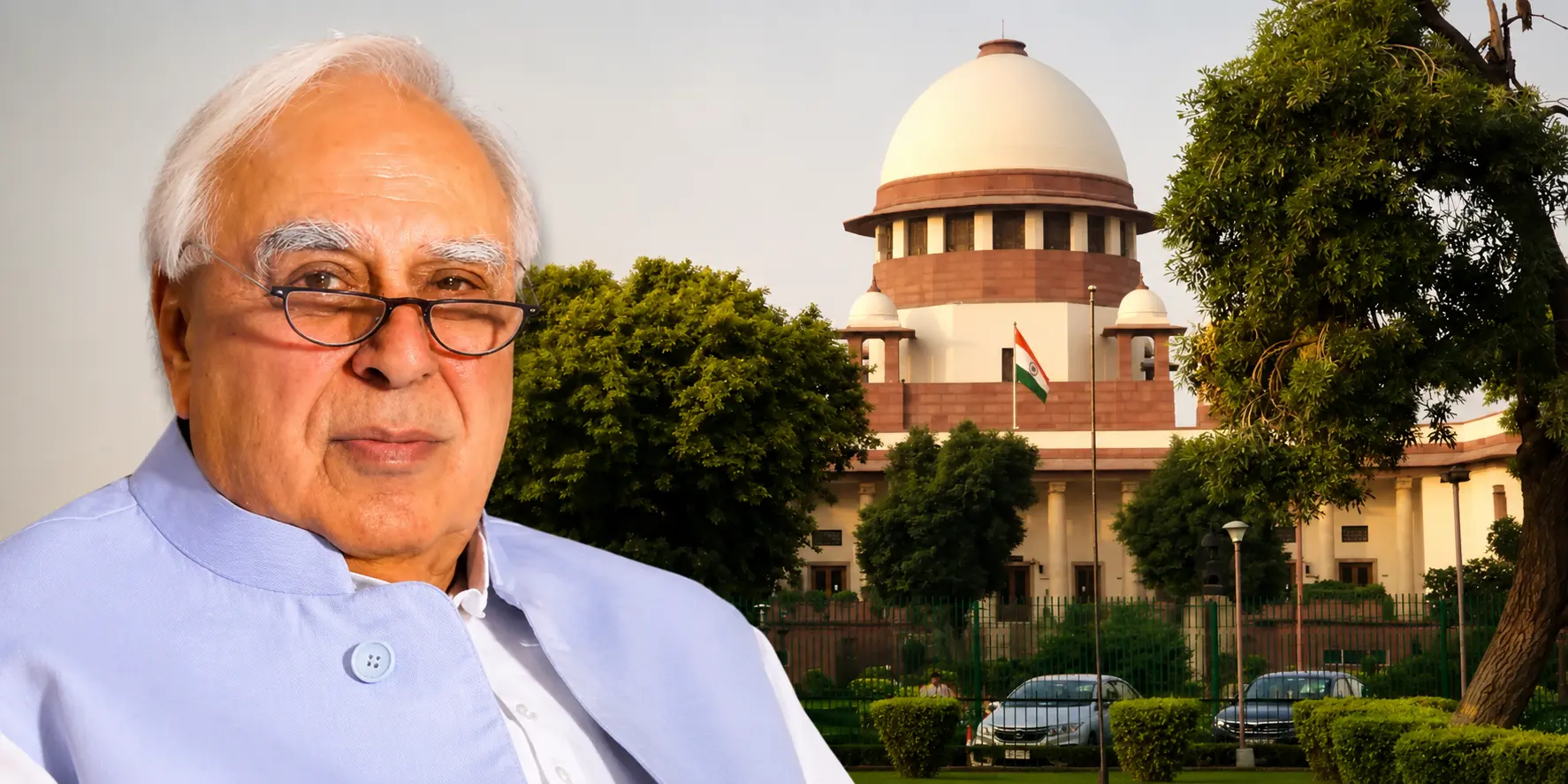
Senior Advocate and Rajya Sabha MP Kapil Sibal has questioned the delay in the Supreme Court’s decision on the interpretation of the “merger” provision under the Tenth Schedule of the Constitution, popularly known as the anti-defection law.
Sibal has raised concerns over the prolonged uncertainty surrounding the issue, pointing out that the question is not merely confined to individual political disputes but has wider implications for the functioning of parliamentary democracy in the country.
The issue concerns Paragraph 4 of the Tenth Schedule, which provides an exception from disqualification where a member’s original political party merges with another political party and the member and the requisite number of legislators agree to the merger. The provision has become particularly significant in cases involving political defections, rival factions within political parties and claims of mergers following a split in a political party.
The anti-defection law was introduced through the 52nd Constitutional Amendment in 1985 with the principal objective of preventing elected representatives from changing political parties for political or other considerations.
Under the Tenth Schedule, a Member of Parliament or a Member of a State Legislative Assembly can face disqualification if the member voluntarily gives up the membership of the political party on whose ticket the member was elected or votes or abstains from voting contrary to the directions of the political party, subject to the exceptions provided under the law.
One such exception is contained in Paragraph 4, relating to merger.
The provision contemplates a situation where the original political party merges with another political party and not less than two-thirds of the members of the legislature party have agreed to such merger. Members satisfying the constitutional requirements can then claim protection from disqualification.
The interpretation of this provision has generated important constitutional questions, particularly in situations where there is a dispute over whether an actual merger of the political party has taken place or whether legislators have merely joined another political group.
The question assumes significance because the anti-defection law seeks to strike a balance between two competing constitutional considerations.
On one hand, the law seeks to maintain political stability and party discipline by preventing elected representatives from switching sides after being elected on a particular party's ticket.
On the other hand, legislators are elected representatives who may have legitimate political differences, and the Constitution also recognises circumstances in which political parties may merge.
The interpretation of Paragraph 4 therefore determines the circumstances in which legislators can legitimately change political allegiance without attracting disqualification.
Sibal's criticism focuses on the consequences of leaving such an important constitutional question unresolved for a prolonged period.
According to the concern raised by him, the issue is not simply about determining the fate of particular legislators or political parties. The interpretation ultimately adopted by the Supreme Court could establish the legal framework that governs future political defections, mergers and realignments across the country.
The anti-defection framework also places considerable responsibility on the Speaker or Chairman of the concerned House, who ordinarily decides questions of disqualification under the Tenth Schedule.
The Supreme Court has, however, repeatedly examined the scope of the Speaker's powers and the extent to which judicial review can be exercised over such decisions.
The question becomes particularly complicated when political disputes involve rival factions, claims of control over the original political party and competing claims that legislators have either defected or legitimately participated in a merger.
The constitutional courts have therefore been called upon to examine not only the conduct of individual legislators but also the broader relationship between political parties, legislative parties and constitutional authorities.
The concern expressed by Sibal is particularly significant because decisions under the anti-defection law can have a direct impact on the composition of legislative bodies and, in certain circumstances, on the survival of governments.
If a constitutional issue remains pending while political developments continue, the eventual judicial interpretation may come after the political circumstances that gave rise to the dispute have substantially changed.
This raises a larger question about the ability of constitutional adjudication to provide timely clarity in matters affecting elected governments and legislative institutions.
The interpretation of the merger provision could potentially determine whether a particular political realignment amounts to a constitutionally protected merger or constitutes defection attracting disqualification.
The Supreme Court's eventual ruling on the issue could therefore have significance beyond the immediate parties before it.
A clear interpretation could provide guidance to Speakers, legislators, political parties and constitutional courts when dealing with future cases involving mergers and defections.
It could also clarify the circumstances in which the two-thirds requirement under Paragraph 4 can be invoked and the relationship between the legislature party and the original political party in determining whether a valid merger has occurred.
Sibal's remarks consequently bring the focus back to the larger constitutional purpose of the anti-defection law and the need for timely judicial determination of questions that have a direct bearing on representative government.
The central issue is not merely who is entitled to claim the benefit of the merger exception, but how the constitutional scheme governing political defections should operate in a parliamentary democracy.
With political realignments and disputes over party control continuing to generate litigation, the Supreme Court's eventual decision on the interpretation of the Tenth Schedule's merger provision could become an important constitutional precedent for the future.
Sibal's observation that the issue has implications for the “future of democracy” thus underscores the larger significance of the pending constitutional question: ensuring that the anti-defection law prevents opportunistic defections while simultaneously preserving the constitutional space for genuine political mergers.
Website designed, developed and maintained by webexy