
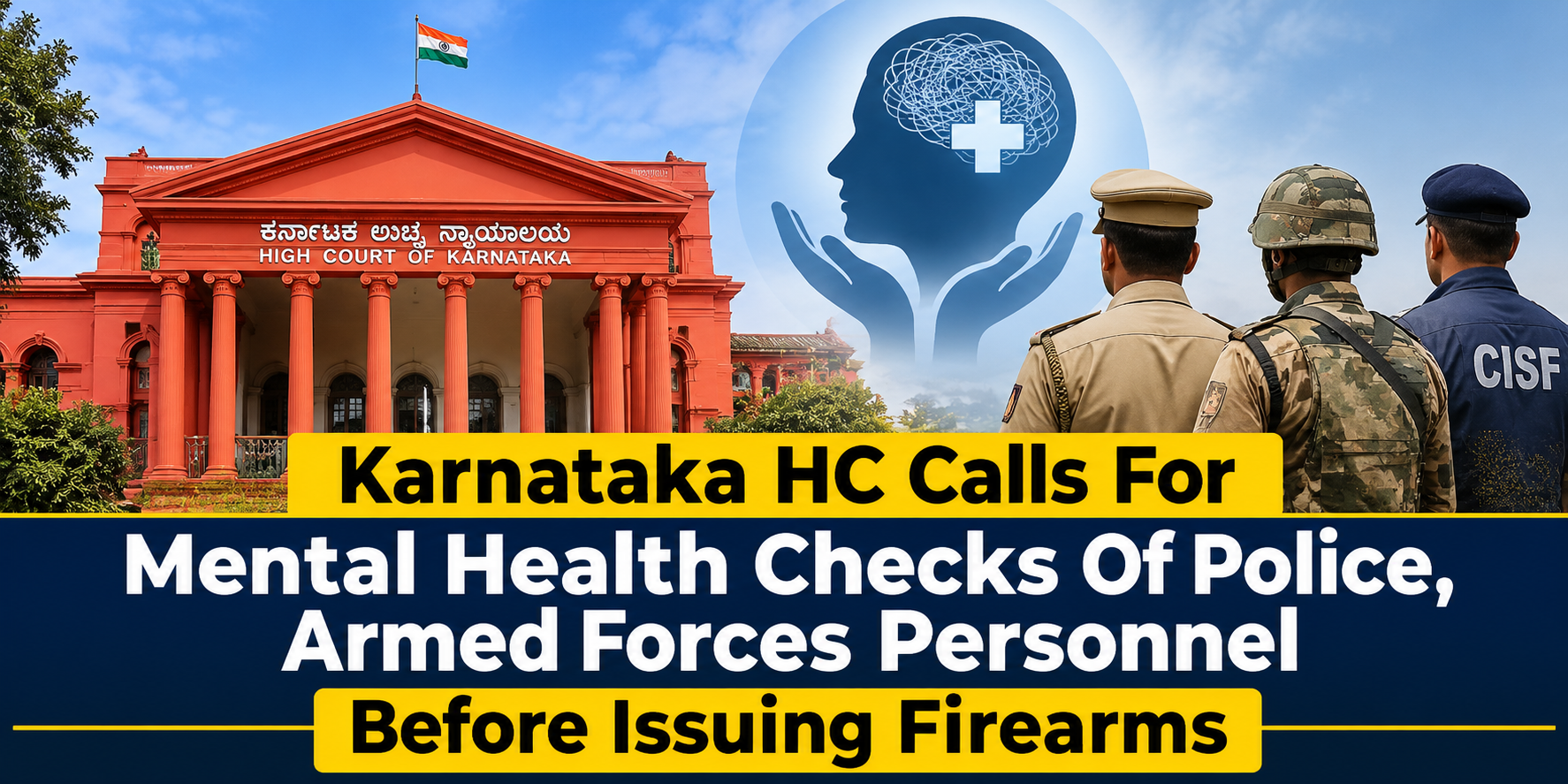
The bench headed by Justice Suraj Govindaraj, in a November 12 order, observed that security organisations have a responsibility to safeguard the physical and mental health of their personnel and cannot limit their role to merely assigning duties.
The Court emphasised that personnel must have access to mental health assistance without stigma or fear of adverse consequences. It said their need for counselling, medical treatment, family support, rest or temporary relief from certain duties must be recognised and addressed.
Highlighting the link between mental health and operational readiness, the Court said that the issue assumes particular significance for personnel entrusted with firearms.
It, therefore, called upon authorities to establish appropriate mechanisms for assessing the mental health and fitness of personnel before issuing firearms and conducting periodic assessments thereafter. Reassessments should also be undertaken whenever circumstances warrant.
The Court further stressed that access to firearms should be regulated where genuine safety concerns arise, including concerns relating to a personnel's mental well-being. However, such measures should not become punitive or result in automatic exclusion from service.
The Court made these observations while allowing a plea filed by a woman Sub-Inspector of the Central Industrial Security Force (CISF), seeking discharge from a criminal case registered against her in 2022 under Section 309 of the Indian Penal Code (IPC), which dealt with attempts to die by suicide.
According to her counsel, the Sub-Inspector was under severe mental stress due to her inability to conceive. Following the incident, she was also subjected to disciplinary proceedings and imposed a major penalty of reduction by one stage in her pay for the remainder of her service, besides being denied promotions for five years.
The case prompted the Court to observe that personnel serving in security forces are human beings who experience grief, anxiety, financial difficulties and other personal challenges.
It said that the expectation that security personnel must remain available for duty at all times, irrespective of their mental state or personal circumstances, requires reconsideration.
"Discipline and dedication are essential, but they cannot be demanded at the cost of ignoring the basic human needs of personnel," the Court observed.
On the criminal proceedings against the Sub-Inspector, the High Court set aside the trial court's order refusing to discharge her. It held that the trial court had failed to consider the statutory presumption under Section 115 of the Mental Healthcare Act, 2017.
The provision presumes that a person attempting suicide is under severe stress and should not be tried or punished under Section 309 IPC, unless the prosecution establishes that the person was not experiencing such stress.
The Court observed that the legislative approach is to treat a person who attempts suicide as someone requiring care, treatment and rehabilitation rather than penal action.
It further directed the authorities to establish professional, accessible and confidential mental healthcare facilities for personnel serving in the police, armed forces and other security organisations.
The Court said that the welfare of personnel and the security of the forces must go hand in hand, adding that a force which looks after the mental and physical well-being of its personnel is better equipped to maintain discipline, operational readiness and public safety.
The Registry was directed to forward a copy of the order to the Director General of CISF, the Director General of Police, Karnataka, and heads of other organisations in the State having personnel entrusted with firearms.
Advocate Tarunn Surana appeared for the CISF Sub-Inspector, while High Court Government Pleader Ranjith Kumar represented the State.
Case: Jyoti Bai v. State of Karnataka
Website designed, developed and maintained by webexy