
The Supreme Court has enhanced compensation from ₹2 lakh to ₹30 lakh for a man who remained in jail for more than seven years despite being acquitted by the High Court in a murder case, holding that the prolonged incarceration amounted to a gross violation of his fundamental right to personal liberty under Article 21 of the Constitution.
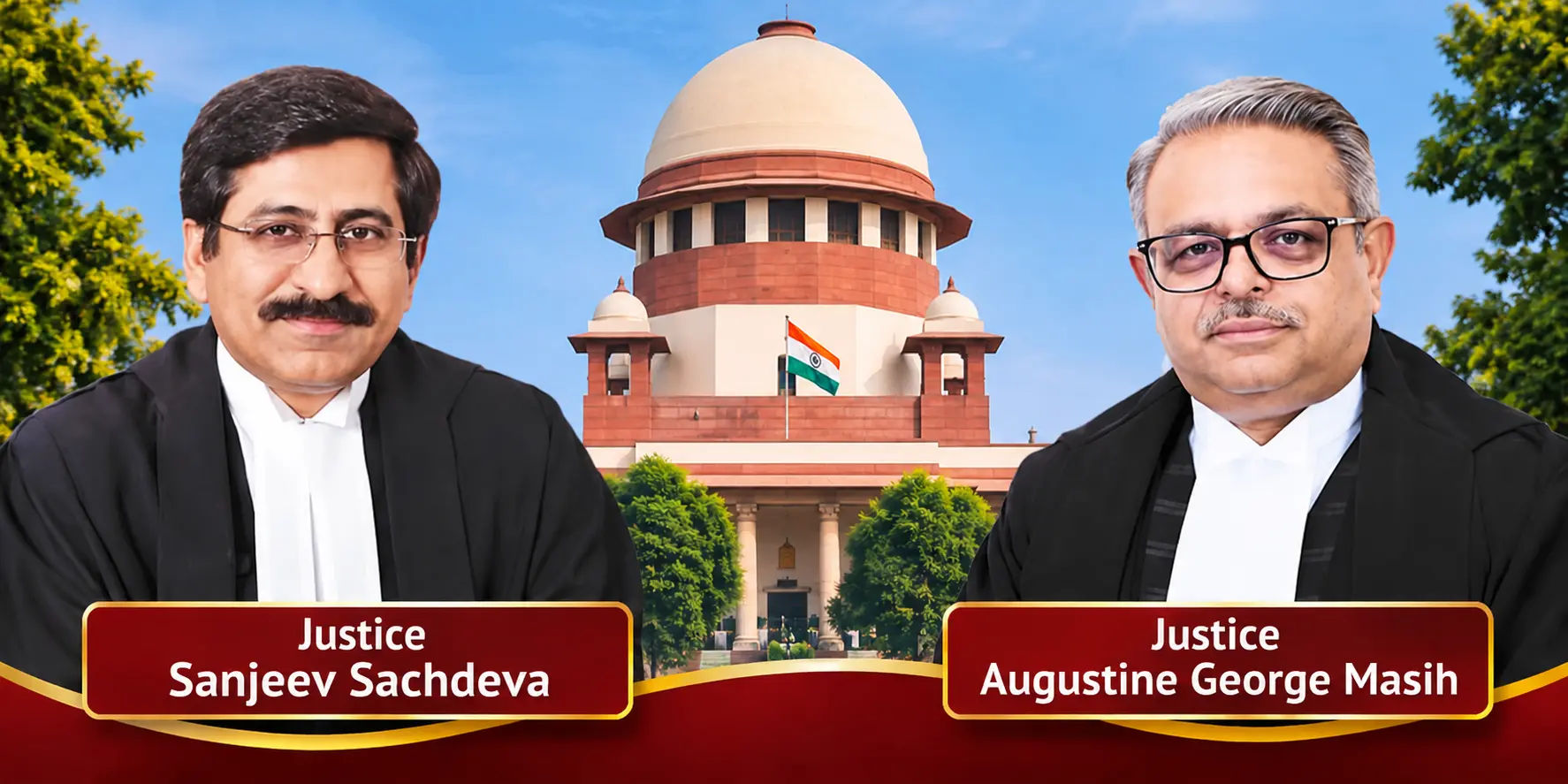
A Bench comprising Justice Augustine George Masih and Justice Sanjeev Sachdeva passed the judgment in Devilal Gond v. State of Chhattisgarh & Ors., allowing the appeal against the Chhattisgarh High Court's order awarding only ₹2 lakh as compensation for the illegal detention.
Acquitted in 2018 But Remained in Jail Until 2025
The appellant was arrested on December 7, 2012, in connection with a murder case registered under Section 302 of the Indian Penal Code. He was subsequently convicted by the Sessions Court on August 14, 2013, and sentenced to life imprisonment.
However, the Chhattisgarh High Court, by its judgment dated January 20, 2018, allowed his criminal appeal, set aside the conviction and sentence, and acquitted him of the charges.
Despite the acquittal, the appellant continued to remain in prison because the order of acquittal was not communicated to the jail authorities.
He was finally released on May 19, 2025, after the discrepancy was discovered during a records-verification exercise undertaken in respect of appeals filed by convicted prisoners lodged in Central Jail.
The appellant thereafter approached the High Court seeking ₹50 lakh as compensation for his prolonged illegal detention.
The High Court acknowledged that his continued detention was illegal and violative of Article 21 but awarded only ₹2 lakh.
Aggrieved by the quantum of compensation, he approached the Supreme Court.
Supreme Court: Institutional Apathy Cannot Be Excused
The Supreme Court observed that the explanation furnished by the State revealed complete remissness on the part of the authorities, along with a lack of coordination and institutional dysfunction.
The State had submitted that the jail authorities had written to the concerned legal aid panel lawyer in April and June 2018 seeking information about the status of the appellant's criminal appeal. However, due to communication and coordination failures, the outcome of the appeal never reached the prison authorities.
Rejecting the explanation as insufficient to justify the prolonged incarceration, the Court observed that the appellant had lost the prime years of his life because of the apathy and lack of promptitude on the part of the authorities.
The Bench emphasised that Article 21 guarantees the right to life and personal liberty and that no person can be deprived of liberty except according to the procedure established by law.
The Court further observed that monetary compensation must not merely provide relief to the victim but should also act as a deterrent against the recurrence of such grave violations by State authorities.
Compensation Enhanced From ₹2 Lakh To ₹30 Lakh
Considering the prolonged illegal detention and the grave infringement of the appellant's fundamental rights, the Supreme Court enhanced the compensation to ₹30 lakh under both pecuniary and non-pecuniary heads.
The Court directed the State of Chhattisgarh to pay the amount within four weeks, subject to adjustment of any amount already paid pursuant to the High Court's order.
The Bench also issued specific directions to ensure that the compensation is protected and utilised for the appellant's benefit:
1. Out of the total compensation, ₹5 lakh shall be transferred directly to the appellant's savings bank account.
2. The remaining ₹25 lakh shall be deposited in an interest-bearing Fixed Deposit Receipt (FDR) with an auto-renewal facility.
3. The monthly interest accrued on the FDR shall be credited to the appellant's savings bank account.
4. No loan, advance, withdrawal or premature discharge of the FDR shall be permitted without prior permission of the Secretary, District Legal Services Authority.
5. The District Legal Services Authority may permit withdrawal in cases of medical emergencies or for the creation of a long-term revenue-generating asset.
Supreme Court Asks High Courts To Strengthen Criminal Justice Ecosystem
In an important direction, the Supreme Court asked all High Courts to consider issuing directions similar to those issued by the Madhya Pradesh High Court pursuant to the Supreme Court's earlier order in Sohan Singh @ Bablu.
The Court also asked High Courts to consider establishing an Online Criminal Justice Ecosystem similar to the platform developed by the Madhya Pradesh High Court.
Such an integrated system facilitates the sharing of information among the police, courts, prisons, prosecution, forensic departments and hospitals, helping ensure timely communication of judicial orders and other important information.
The judgment also highlighted the absence of a dedicated legislative mechanism in India for compensating persons who have suffered wrongful incarceration.
The Supreme Court directed that a copy of the judgment be forwarded to the Registrar Generals of all High Courts for placing it before their respective Chief Justices for consideration.

Representation:-
For the Petitioner(s): Mr. Abhinav Shrivastava AOR, Ms. Sunita Jain Adv., Ms. Unnati Vaibhav Adv., Ms. Barkha Agrawal Adv., Ms. Dibya Rai Adv.
For the Respondent(s): Mr. Atul Jha A.A.G., Mr. Abhishek Pandey Adv., Mr. Siddhartha Sinha AOR.
Website designed, developed and maintained by webexy