
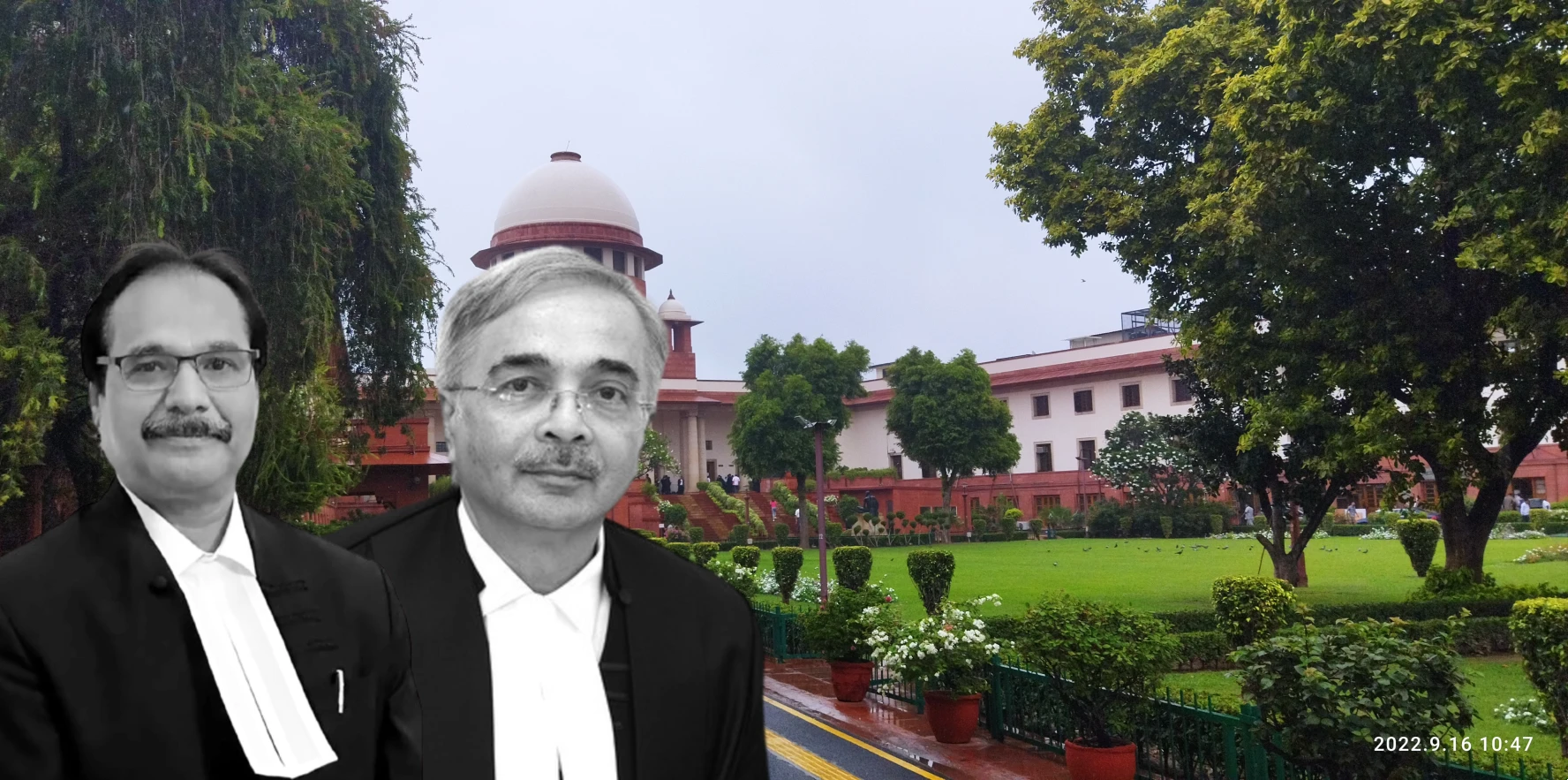
The Supreme Court has held that the mere execution of an agreement to sell between a landlord and an existing tenant does not, by itself, terminate the landlord-tenant relationship.
A Bench of Justice Prashant Kumar Mishra and Justice N.V. Anjaria dismissed a Special Leave Petition filed by Nazim Shaikh Hasan, upholding the concurrent findings directing him to vacate the shop premises.
The dispute concerned a 200 sq. ft. shop in Kondhwa Khurd, Pune, which had been let to the petitioner at a monthly rent of ₹1,500. During the subsistence of the tenancy, the landlord entered into an agreement to sell the premises to the tenant for ₹1.90 lakh. The tenant paid ₹40,000, while the balance ₹1.50 lakh was to be paid within three months.
Subsequently, the landlord sought possession on grounds including rent default, change in use and bona fide requirement. The tenant argued that the landlord-tenant relationship had ended with the execution of the agreement to sell and claimed that he had paid ₹90,000 towards the sale consideration.
The Small Causes Court rejected the tenant's contention and held that the landlord-tenant relationship continued even after the agreement to sell. The First Appellate Court and the Bombay High Court subsequently affirmed the decision.
The Supreme Court considered whether execution of an agreement to sell by a landlord in favour of a tenant, coupled with receipt of part consideration, automatically brings the tenancy to an end.
The Court examined its earlier judgment in R. Kanthimathi v. Beatrice Xavier, where the relationship between landlord and tenant had changed because the agreement itself contained language indicating that possession was being held pursuant to the sale agreement and a substantial portion of the consideration had been paid.
However, the Bench found the agreement in the present case materially different. It contained no clause indicating that possession would thereafter be referable to the agreement to sell, nor did it provide for cessation of rent or otherwise indicate an intention to alter the existing landlord-tenant relationship.
Referring to Section 111(e) and (f) of the Transfer of Property Act, 1882, the Court explained that a tenancy can be determined through express or implied surrender.
The Court held that the mere execution of an agreement to sell does not automatically amount to surrender of tenancy. There must be terms of the agreement or unequivocal conduct of the parties demonstrating that the existing tenancy has been expressly or impliedly surrendered.
The Court distilled the legal position into four propositions:
Mere execution of an agreement to sell between a landlord and tenant does not, by itself, determine the subsisting tenancy.
The tenancy ends only where the agreement or unequivocal conduct of the parties establishes express or implied surrender under Section 111(e) or (f) of the Transfer of Property Act.
Continued possession after an agreement to sell does not amount to part performance under Section 53A unless the possession is directly relatable to and flows from the agreement.
An unregistered agreement to sell does not by itself confer title or interest in the property.
Applying these principles, the Court held that payment of ₹40,000 out of the total consideration of ₹1.90 lakh, along with execution of the agreement to sell, could not be treated as determining the tenancy.
The agreement itself provided that if the purchaser's loan was not sanctioned, the agreement would stand cancelled and possession would have to be handed back in the previous condition. According to the Court, this clause was consistent with the continuation of the existing tenancy rather than its replacement by a vendor-vendee relationship.
The Court also rejected the petitioner's claim of protection under Section 53A of the Transfer of Property Act. Since the agreement to sell was executed in 2004 and was admittedly unregistered, Section 17(1A) of the Registration Act, 1908 barred the petitioner from claiming protection under Section 53A.
The Supreme Court further noted that the petitioner had not instituted a suit for specific performance, which also weakened his claim that the parties' relationship had transformed from landlord-tenant to vendor-vendee.
Finding no infirmity in the judgments of the courts below, the Supreme Court dismissed the SLP as meritless.

Representation:-
For Petitioner(s):- Mr. Abhay Anil Anturkar Adv., Mr. Dhruv Tank Adv., Mr. Sarthak Mehrotra Adv., Ms. Surbhi Kapoor AOR, Mr. Uday Gautam Adv., Ms. Aradhya Srivastava Adv., Mr. Nakul Patwardhan Adv.
Website designed, developed and maintained by webexy