
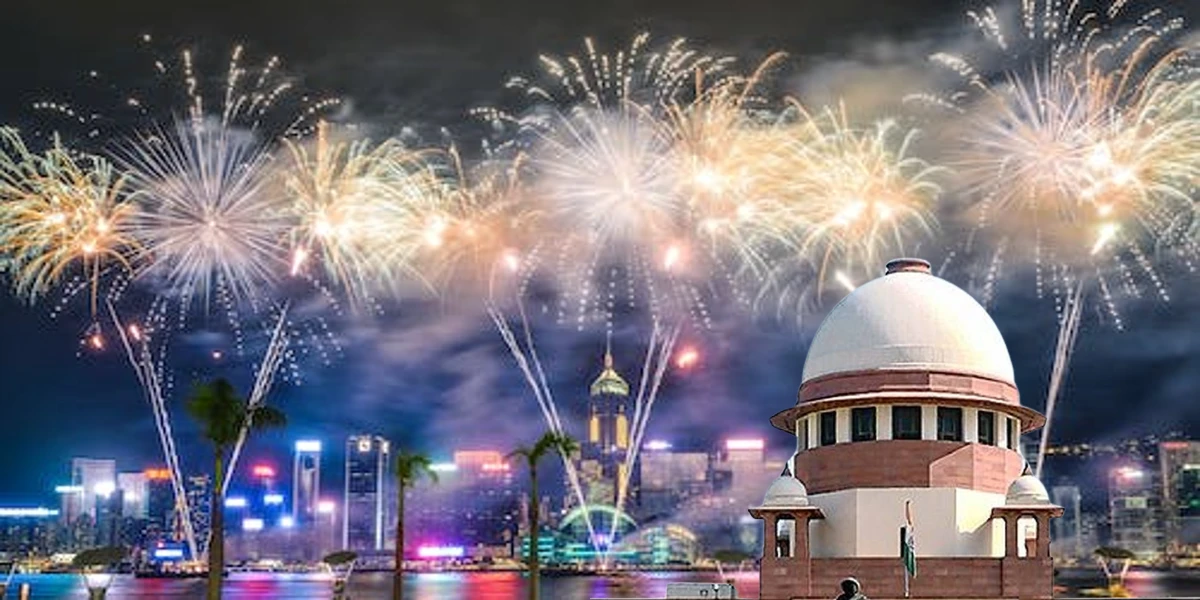
The Supreme Court on Friday said that efforts to curb air pollution during Diwali and other festivals must evolve into a "people's movement", observing that pollution control cannot be achieved solely through judicial orders and police enforcement.
A Bench headed by Chief Justice of India (CJI) Surya Kant, along with Justices Joymalya Bagchi and V Mohana, urged the Delhi government and other authorities to involve local municipal councillors in spreading awareness and encouraging people to avoid bursting polluting firecrackers during Diwali.
The Bench observed that excessive judicial intervention could sometimes lead to greater non-compliance.
"The more orders the Court passes, the more violations there may be. That is the tendency. Involve local councillors. Ask them to appeal to people to ensure that their Diwali celebrations do not contribute to pollution. It should become a people's movement," the CJI remarked.
The observations were made during the hearing of the case titled In Re: Curbing Air Pollution in the National Capital Region - Regulatory and Policy Framework, Air Quality Governance and Other Ancillary Issues, concerning deteriorating air quality in Delhi-NCR ahead of the winter season.
During the hearing, the Amicus Curiae highlighted the practical limitations of physical policing, observing that the State "cannot have one police officer in every house."
Senior Advocate Aparajita Singh, also assisting the Court as Amicus Curiae, raised concerns over the enforcement of restrictions on firecrackers. She pointed out that vendors were misusing permissions granted for green crackers by displaying green boxes at their shops while secretly selling banned conventional firecrackers.
Highlighting the health impact of air pollution on children, Singh referred to a 2012 Central Pollution Control Board (CPCB) study titled Study on Ambient Air Quality, Respiratory Symptoms and Lung Function of Children in Delhi. The study found that 43.5% of schoolchildren in Delhi had reduced lung function compared to children living outside the national capital.
Another lawyer appearing in the matter urged the Bench to reconsider the Graded Response Action Plan (GRAP), particularly the provisions concerning school restrictions, and introduce protective measures at earlier stages of pollution.
Additional Solicitor General Aishwarya Bhati, appearing for the government, agreed on the need for intensified public awareness campaigns. She also submitted a sector-wise compliance chart prepared using inputs from NCR States, covering construction dust, municipal waste burning, vehicular emissions and industrial activities.
The Amicus further pointed out that States often act swiftly only when the Supreme Court seeks direct compliance reports or summons senior bureaucrats. She informed the Bench that comprehensive notes on airshed management, vehicular pollution and industrial emissions had been prepared for detailed consideration.
After taking the status reports and compliance charts on record, the Bench indicated that it would issue formal directions seeking updated compliance reports from the concerned authorities.
The matter will be taken up for detailed consideration immediately after the upcoming Diwali break.
Website designed, developed and maintained by webexy