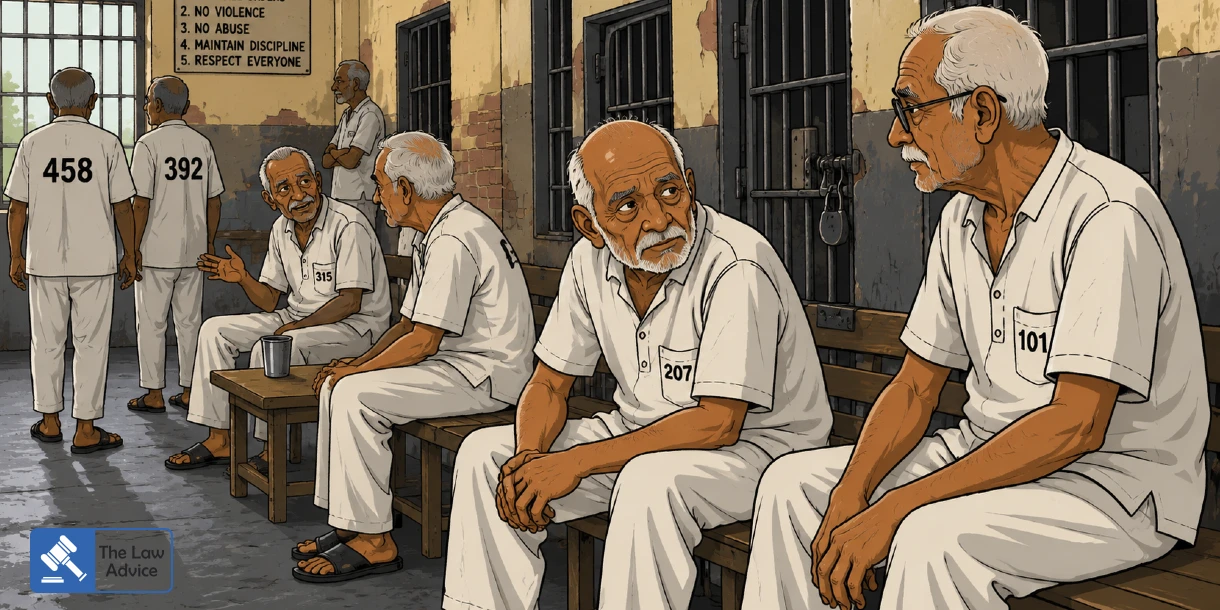
No Prisoner Should Spend Final Days Behind Bars Due to Delays: Supreme Court
The Supreme Court on Thursday directed all States and Union Territories to formulate and notify a comprehensive policy within three months for the early or premature release of prisoners who are of old age or terminally ill.
A Bench of Justice Vikram Nath and Justice Sandeep Mehta said the policy must be prepared in consultation with the respective State Legal Services Authorities to ensure effective coordination and proper identification of eligible prisoners.
The directions came while hearing a petition seeking nationwide guidelines for the compassionate release of terminally ill, seriously ill, infirm and elderly prisoners, particularly those aged above 70 years.
The Court directed that every policy must clearly lay down the eligibility criteria and procedural framework for considering applications for compassionate or premature release.
It further ordered that the policy should adopt a clear and uniform definition of "terminal illness". For this purpose, States may refer to the definition provided in the Handbook on Prisoners with Special Needs published by the United Nations Office on Drugs and Crime (UNODC).
The Bench also instructed States and UTs to establish independent medical boards at the divisional and State levels to objectively assess and certify cases involving terminal illness or severe medical vulnerability.
The Court said the policy must provide a transparent, accessible and time-bound mechanism for filing, examining and deciding applications for compassionate release. It stressed that unnecessary procedural delays should be avoided so that prisoners are not forced to spend their final months or years behind bars. Every decision, it added, must be supported by reasons and remain open to judicial review.
The Supreme Court further directed that the policy be integrated with the functioning of Undertrial Review Committees (UTRCs). These committees must periodically review the cases of prisoners who are terminally ill, elderly or physically incapacitated and recommend appropriate legal remedies, including bail, parole or remission.
The Bench observed that States and UTs may adopt the framework proposed by the National Legal Services Authority (NALSA) or suitably modify it in accordance with local legal and administrative requirements.
Additionally, the policy should ensure coordination with community healthcare providers, social welfare departments and legal aid institutions to facilitate continued medical treatment and social support for prisoners released on compassionate grounds.
In a significant move towards digitisation, the Court directed that the entire process of considering applications for early or premature release be integrated with the e-Prisons portal.
The portal will digitally record every stage of the process, including submission of applications, medical assessments, reports of prison authorities, recommendations of medical boards and UTRCs, final decisions and the reasons for those decisions.
According to the Court, the e-Prisons system should also generate automated alerts to ensure timely processing, enhance transparency and accountability, produce periodic compliance reports and enable effective oversight by State governments, State Legal Services Authorities and other competent authorities, while safeguarding the confidentiality of prisoners' medical and personal information.
To facilitate implementation, the Court directed the Ministry of Law and Justice, the Ministry of Home Affairs and the National Informatics Centre (NIC) under the Ministry of Electronics and Information Technology to provide the necessary technical assistance and digital infrastructure to all States and Union Territories.
The matter has been listed for further hearing on January 19, 2027, when the Supreme Court will review compliance with its directions.