
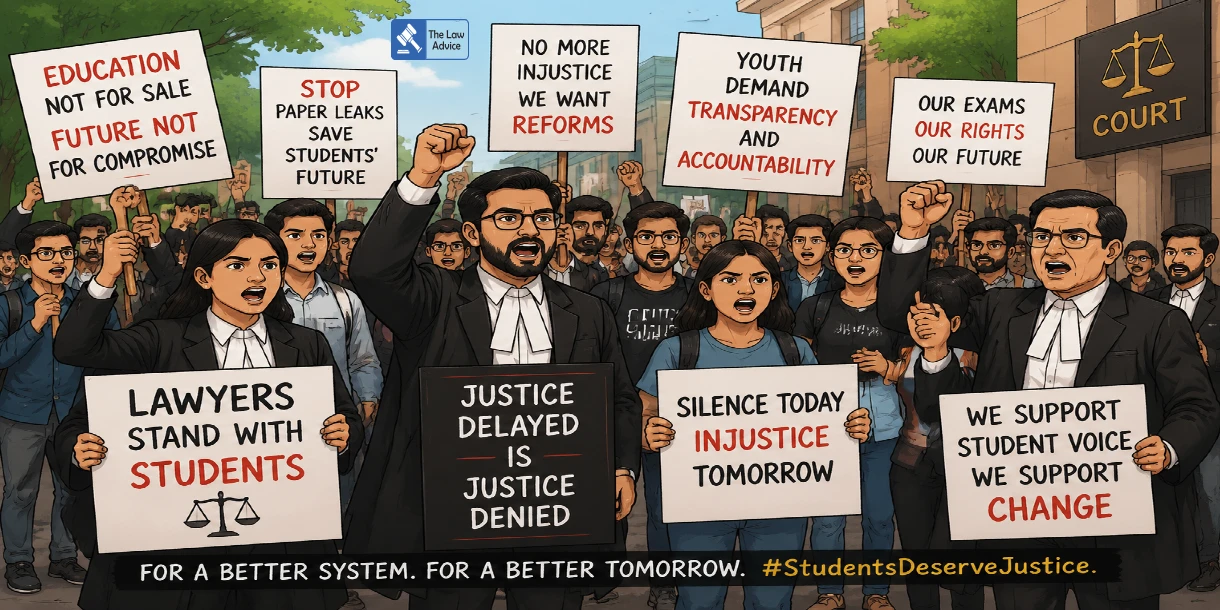
Lawyers' organisations in Delhi and Mumbai have strongly criticised the police action against students protesting over alleged exam paper leaks and demanding reforms, calling it an attack on constitutional rights and democratic dissent.
The legal bodies questioned the use of force against peaceful demonstrators and the broad restrictions imposed on public gatherings, urging authorities to uphold the right to protest.
In Delhi, over 650 lawyers, including senior advocates Indira Jaising, Raju Ramachandran, Chander Uday Singh, Sanjay Hegde, Vrinda Grover, Prashant Bhushan and Shahrukh Alam, issued a joint statement condemning the alleged use of force by the Delhi Police during the July 20 student protest at Jantar Mantar.
The protest turned tense after demonstrators attempted to march towards Parliament.
Calling the police response unacceptable, the lawyers said that violence against peaceful protesters undermines the constitutional values of free expression, dignity and the right to dissent.
"The sight of students being met with violence instead of dialogue is unacceptable. Police brutality against protesting students is an attack on the principles of free expression, human dignity, and the right to dissent."
The statement further asserted that Parliament should remain accessible to citizens and demanded accountability for those responsible for the alleged excessive use of force. The signatories also urged the government and constitutional institutions to ensure the safety of peaceful protesters.
The Supreme Court Bar Association (SCBA) also passed a resolution condemning the alleged lathi charge on students and members of the legal fraternity, describing the use of excessive force as unacceptable in a democratic society. It called for an impartial and time-bound inquiry into the incident.
Separately, the Supreme Court Advocates-on-Record Association (SCAORA) expressed concern over reports and visuals showing police action against students protesting for fairness in public examinations.
The association emphasised that peaceful protest is protected under Articles 19(1)(a) and 19(1)(b) of the Constitution and said the strength of a constitutional democracy lies in protecting, not suppressing, peaceful dissent.
The Bombay Bar Association also criticised the reported use of lathi charges and tear gas against student protesters, stating that peaceful protest is an essential part of democratic governance.
The association said that if the reported incidents were accurate, the use of force against students exercising their constitutional rights was deeply troubling. It also objected to what it described as intimidation through the registration of FIRs.
Meanwhile, on July 21, more than 120 lawyers, including several senior advocates practising before the Bombay High Court, criticised consecutive prohibitory orders issued by the Mumbai Police Commissioner under Section 37(3) of the Maharashtra Police Act.
The first order remained in force from July 7 to July 21, while the second covers July 23 to August 6. The orders prohibit assemblies of five or more persons and public processions across Mumbai.
The lawyers alleged that the orders had been used to detain over 300 people, including minors, near Shivaji Park and argued that issuing back-to-back prohibitory orders with only a one-day gap appeared to bypass the legal requirement of obtaining State government approval for restrictions extending beyond 15 days.
They urged the Mumbai Police Commissioner to withdraw the orders, contending that they did not comply with statutory requirements and unnecessarily forced citizens to approach already overburdened courts.
Website designed, developed and maintained by webexy